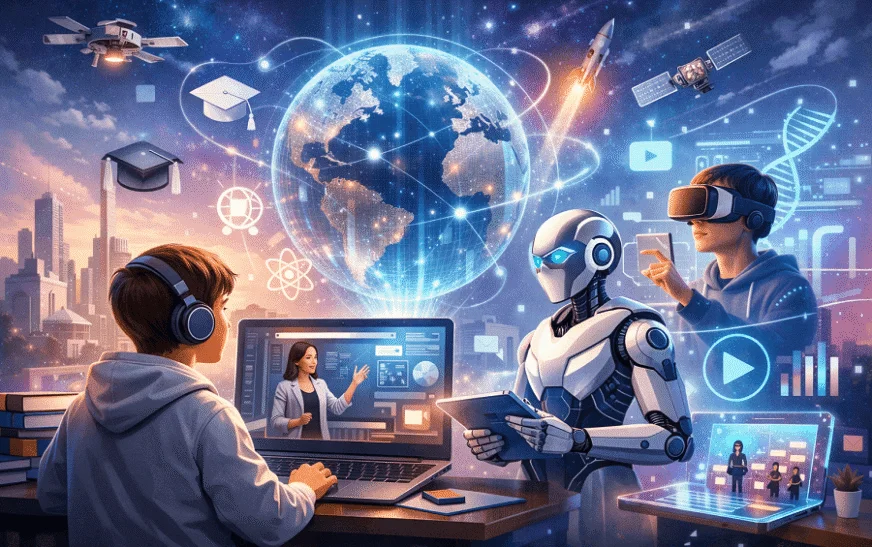
Online education has transformed from a convenient alternative into a core part of modern learning. What was once limited to recorded lectures and downloadable PDFs has evolved into interactive learning experiences powered by artificial intelligence, cloud technology, virtual collaboration, and personalized learning platforms.
Students today have access to thousands of online courses, digital certifications, university programs, coding bootcamps, professional workshops, and self-paced learning platforms. This accessibility has changed how people acquire knowledge, develop professional skills, and prepare for future careers.
The next phase of online education is expected to go even further. Artificial intelligence is making learning more personalized, immersive technologies are creating virtual classrooms, employers are increasingly recognizing skills-based credentials, and lifelong learning is becoming essential as industries continue to evolve.
Rather than replacing traditional education, online learning is expanding educational opportunities by making high-quality resources available to more people regardless of location or background.
This guide explores the major trends expected to shape the future of online education in 2026 and beyond, explaining how students, professionals, educators, and lifelong learners can prepare for an increasingly digital learning environment.
How Online Education Has Evolved
Online education has changed dramatically over the past two decades.
Early online learning platforms primarily offered static content, including video lectures, downloadable reading materials, and discussion forums.
Today’s digital learning environments are far more interactive.
Students can now:
- Participate in live virtual classrooms
- Collaborate on group projects
- Complete interactive simulations
- Receive instant AI-powered feedback
- Access personalized study recommendations
- Earn industry-recognized certifications
- Learn through gamified experiences
Technology has shifted online education from passive content consumption to active engagement.
As internet access, cloud computing, and AI continue advancing, learning experiences are becoming increasingly flexible and responsive to individual needs.
Why Online Learning Continues to Grow
Several factors are driving continued growth in online education.
Greater Accessibility
Students no longer need to relocate or attend physical campuses to access quality education.
Online platforms enable learners from different countries and backgrounds to study with universities, industry experts, and training organizations worldwide.
This flexibility has significantly expanded educational opportunities.
Flexible Learning Schedules
Unlike traditional classroom environments, many online courses allow students to learn at their own pace.
This flexibility benefits:
- Working professionals
- Parents
- Career changers
- University students
- Entrepreneurs
- Lifelong learners
Learning can fit around existing personal and professional commitments.
Rapid Technological Innovation
Cloud computing, artificial intelligence, faster internet connections, and mobile devices have made digital learning more engaging and accessible than ever before.
These technologies continue improving both the quality and availability of online education.
Demand for Continuous Learning
Industries evolve rapidly.
Professionals increasingly need to update their knowledge throughout their careers rather than relying solely on qualifications earned earlier in life.
Continuous education has become essential for adapting to changing technologies and workplace requirements.
Major Trends Shaping the Future of Online Education
The following trends are expected to define the next generation of digital learning.
Artificial Intelligence Is Personalizing Learning
Artificial intelligence is becoming one of the most influential technologies in education.
Rather than providing identical learning experiences for every student, AI can adapt educational content based on individual progress, strengths, weaknesses, and learning preferences.
AI-powered learning systems may recommend additional practice materials, identify knowledge gaps, generate quizzes, explain difficult concepts, and provide personalized feedback.
This allows students to receive more targeted support throughout their educational journey.
How AI Supports Students
Artificial intelligence is increasingly used for:
- Personalized tutoring
- Instant feedback
- Homework assistance
- Language translation
- Study planning
- Writing support
- Coding assistance
- Research summaries
- Exam preparation
Instead of replacing teachers, AI serves as an educational assistant that complements classroom instruction and independent study, and for a curated selection of the most effective AI tools for students, explore our comprehensive guide to the best AI tools for students in 2026.
Personalized Learning Experiences
Traditional classrooms often follow standardized lesson plans designed for large groups.
Online education allows learning experiences to become more individualized.
Future learning platforms may automatically adjust:
- Lesson difficulty
- Learning pace
- Assessment methods
- Practice exercises
- Course recommendations
- Revision schedules
This personalization helps students spend more time strengthening weaker areas while progressing more quickly through concepts they already understand.
Micro-Credentials and Digital Certifications
Employers are increasingly recognizing specialized certifications that demonstrate practical skills.
Instead of completing only long academic programs, many learners now earn smaller credentials focused on specific competencies.
Examples include certifications in:
- Artificial intelligence
- Cloud computing
- Cybersecurity
- Digital marketing
- Data analytics
- UX design
- Programming
- Project management
Micro-credentials support continuous learning by allowing professionals to update their expertise throughout their careers.
Why They Matter
Micro-credentials offer several advantages:
- Shorter learning periods
- Lower educational costs
- Practical skill development
- Industry relevance
- Career flexibility
- Continuous professional growth
Many employers now value demonstrated skills alongside traditional educational qualifications.
Skills-Based Education
The future job market increasingly emphasizes what people can do rather than simply what degrees they hold.
Educational institutions are responding by incorporating more project-based learning, practical assessments, collaborative assignments, and real-world problem solving into their programs.
Students are expected to graduate with portfolios demonstrating applied skills rather than relying solely on examination results.
Examples of In-Demand Skills
Future-focused education increasingly emphasizes:
- Critical thinking
- Problem solving
- Communication
- Collaboration
- AI literacy
- Digital literacy
- Leadership
- Creativity
- Data analysis
- Adaptability
These transferable skills remain valuable across multiple industries and career paths.
Virtual and Immersive Learning
Virtual Reality (VR), Augmented Reality (AR), and Mixed Reality (MR) are beginning to create more immersive educational experiences.
Students may increasingly participate in:
- Virtual science laboratories
- Medical simulations
- Engineering practice environments
- Historical recreations
- Interactive language learning
- Architecture visualization
Immersive technologies can make abstract concepts easier to understand by allowing learners to experience them in realistic digital environments.
Educational Benefits
Immersive learning can improve:
- Student engagement
- Practical understanding
- Knowledge retention
- Collaboration
- Experiential learning
Although adoption varies across institutions, these technologies continue to advance and become more accessible.
Collaborative Digital Classrooms
Learning is becoming increasingly collaborative, even in online environments.
Modern education platforms allow students to interact with classmates, instructors, mentors, and industry professionals from different parts of the world. Rather than studying alone, learners can participate in discussions, complete group projects, share ideas, and receive feedback in real time.
Digital collaboration also helps students develop communication and teamwork skills that are valuable in today’s workplace.
How Collaboration Is Evolving
Online classrooms increasingly include:
- Live virtual lectures
- Interactive discussion forums
- Group assignments
- Shared digital whiteboards
- Cloud-based document collaboration
- Peer review activities
- Virtual breakout rooms
These features create more engaging learning experiences while encouraging students to actively participate rather than passively consume information.
Benefits for Students
Collaborative learning helps students:
- Improve communication skills
- Learn from different perspectives
- Develop teamwork abilities
- Build professional networks
- Strengthen problem-solving skills
- Increase engagement
As remote work becomes more common, learning how to collaborate digitally is becoming an important professional skill.
Lifelong Learning Is Becoming the New Standard
Graduating from school or university no longer marks the end of education.
Technology evolves rapidly, industries change, and new careers continue to emerge. As a result, professionals are expected to update their knowledge throughout their working lives.
This shift has made lifelong learning one of the defining characteristics of modern education.
Why Lifelong Learning Matters
Continuous learning helps individuals:
- Adapt to changing industries
- Learn emerging technologies
- Improve career opportunities
- Stay competitive in the job market
- Explore new professional interests
- Build long-term career resilience
Rather than earning a single qualification, many professionals now complete multiple certifications and specialized training programs throughout their careers.
Who Benefits?
Lifelong learning is valuable for:
- Students
- Working professionals
- Entrepreneurs
- Career changers
- Freelancers
- Business leaders
- Retirees pursuing new interests
Learning has become an ongoing process rather than a one-time achievement.
Mobile Learning Continues to Expand
Smartphones and tablets have made education available almost anywhere.
Students can now watch lectures, complete quizzes, read course materials, review notes, and participate in discussions while commuting, traveling, or studying from home.
Mobile learning increases flexibility and helps learners make productive use of short periods of free time.
Advantages of Mobile Learning
Students benefit from:
- Flexible study schedules
- Offline learning options
- Quick revision sessions
- Learning notifications
- Cross-device synchronization
- Greater accessibility
As mobile technology improves, educational platforms continue optimizing their content for smaller screens and on-the-go learning.
Learning Analytics and Data-Driven Education
Educational institutions are increasingly using learning analytics to understand how students interact with courses and where additional support may be needed.
By analyzing learning patterns, educators can improve course design and provide more personalized assistance.
What Learning Analytics Measures
Learning platforms may analyze:
- Course progress
- Quiz performance
- Assignment completion
- Study frequency
- Learning pace
- Participation levels
- Knowledge gaps
This information helps identify areas where students may benefit from additional guidance or resources.
Benefits
Data-driven insights can support:
- Personalized learning pathways
- Earlier academic intervention
- Improved course quality
- Better student engagement
- More effective teaching strategies
The goal is to enhance learning outcomes while respecting student privacy and ethical data practices.
Gamification Makes Learning More Engaging
Gamification applies elements commonly found in games to educational experiences.
Rather than making education feel like entertainment alone, gamification encourages motivation by rewarding progress and consistent participation.
Common Gamification Features
Many learning platforms include:
- Achievement badges
- Progress tracking
- Leaderboards
- Learning streaks
- Experience points
- Interactive challenges
- Completion certificates
These features can increase engagement and encourage students to maintain regular study habits.
Why It Works
Gamified learning often helps students:
- Stay motivated
- Build consistent routines
- Celebrate milestones
- Reduce learning fatigue
- Increase participation
When designed thoughtfully, gamification supports learning without distracting from educational objectives.
Blockchain Is Changing Digital Credentials
As online education grows, verifying academic achievements becomes increasingly important.
Blockchain technology is being explored as a secure method for storing and verifying educational credentials.
Instead of relying solely on paper certificates, learners may receive tamper-resistant digital credentials that employers and educational institutions can verify more easily.
Potential Benefits
Blockchain-based credentials may offer:
- Secure verification
- Reduced credential fraud
- Permanent digital records
- Easier international recognition
- Faster credential sharing
While adoption is still developing, blockchain has the potential to improve trust and efficiency in credential management.
Global Classrooms Are Expanding Learning Opportunities
The internet has removed many geographical barriers to education.
Students can now participate in courses taught by instructors from different countries, collaborate with international classmates, and access educational resources from institutions around the world.
This global learning environment encourages cultural exchange and prepares students for increasingly international workplaces.
Benefits of Global Learning
Students can:
- Learn from international experts
- Experience different perspectives
- Develop cross-cultural communication
- Build global professional networks
- Access specialized educational programs
Exposure to diverse viewpoints can strengthen critical thinking and broaden understanding of global issues.
AI Tutors Are Becoming Learning Companions
Artificial intelligence is making educational support more personalized and accessible.
AI tutors can answer questions, explain difficult concepts, generate practice exercises, summarize reading materials, and recommend personalized study plans.
Unlike traditional tutoring schedules, AI assistants are available whenever students need support.
What AI Tutors Can Do
Modern AI learning assistants can help with:
- Homework explanations
- Exam preparation
- Language learning
- Coding practice
- Mathematics
- Writing improvement
- Research assistance
- Personalized revision
These tools complement teachers by providing additional practice and guidance outside the classroom.
The Human Element Still Matters
Despite rapid advances in AI, teachers remain central to education.
Educators provide mentorship, emotional support, classroom management, ethical guidance, and opportunities for discussion and collaboration that technology cannot fully replace.
The future of education is likely to combine human expertise with intelligent digital tools.
Improving Accessibility Through Technology
One of the most significant strengths of online education is its ability to increase access to learning.
Educational technology continues to introduce features that support learners with different abilities, languages, and educational backgrounds.
Accessibility Features
Examples include:
- Automatic captions
- Speech-to-text tools
- Text-to-speech support
- Screen reader compatibility
- Adjustable playback speeds
- Language translation
- Flexible learning schedules
These features help create more inclusive learning environments for a wider range of students.
Challenges Facing Online Education
Although online learning offers many benefits, several challenges remain.
Understanding these issues helps students and educators use digital education more effectively.
Maintaining Student Engagement
Without face-to-face interaction, some students may find it difficult to remain motivated and focused.
Interactive activities, collaborative projects, and regular feedback can help improve engagement.
Digital Divide
Reliable internet access, modern devices, and digital literacy are not equally available in every region.
Addressing these gaps remains important for expanding educational opportunities.
Information Overload
The internet provides access to an enormous amount of educational content.
Students must develop information literacy skills to identify reliable resources and avoid becoming overwhelmed.
Academic Integrity
Artificial intelligence has introduced new questions about plagiarism, originality, and responsible technology use.
Educational institutions continue developing policies that encourage ethical AI use while maintaining academic standards.
Privacy and Data Security
Online learning platforms often collect student information to personalize educational experiences.
Protecting personal data and maintaining transparent privacy practices remain important responsibilities for educational providers.
The Future Workforce Will Demand Continuous Learning
The relationship between education and employment is changing rapidly. In the past, many people completed their education, entered the workforce, and relied on that knowledge for years. Today, technological advancements and evolving business needs mean that professionals are expected to continuously update their skills throughout their careers.
Artificial intelligence, automation, robotics, cloud computing, and digital transformation are reshaping industries. As a result, many jobs are evolving, new roles are emerging, and employers are placing greater emphasis on adaptability and lifelong learning.
Students who develop a habit of continuous education will be better prepared to navigate future career opportunities.
Skills That Will Matter Most
While technical knowledge remains important, employers increasingly value transferable skills that can be applied across industries.
Some of the most sought-after skills include:
- Critical thinking
- Problem-solving
- Communication
- Collaboration
- Creativity
- Digital literacy
- AI literacy
- Emotional intelligence
- Leadership
- Adaptability
- Data interpretation
- Project management
These skills complement technical expertise and help individuals remain valuable in changing work environments.
Emerging Technologies That Will Shape Education
Several technologies are expected to influence the next generation of online learning.
Rather than replacing teachers, these innovations aim to improve accessibility, personalization, engagement, and learning outcomes.
Artificial Intelligence
AI will continue supporting students through:
- Personalized tutoring
- Automated feedback
- Intelligent study plans
- Adaptive assessments
- Research assistance
- Language support
- Accessibility tools
AI is likely to become a standard component of educational platforms across schools, universities, and professional training programs.
Virtual Reality (VR)
Virtual Reality enables students to experience immersive learning environments.
Potential applications include:
- Medical training
- Science laboratories
- Engineering simulations
- Historical recreations
- Architecture visualization
- Technical skills practice
Immersive learning can help students understand complex concepts through hands-on experiences in virtual settings.
Augmented Reality (AR)
Unlike VR, which creates fully virtual environments, Augmented Reality overlays digital information onto the physical world.
Educational uses may include:
- Interactive textbooks
- Laboratory demonstrations
- Engineering visualization
- Anatomy exploration
- Language learning
- Museum experiences
AR has the potential to make learning more interactive and engaging across a variety of subjects.
Blockchain Technology
Blockchain may simplify the management of educational credentials by enabling secure, verifiable digital certificates.
Benefits could include:
- Easier credential verification
- Reduced fraud
- Faster sharing with employers
- International recognition
- Permanent academic records
Although still developing, blockchain-based credentials are gaining attention in higher education and professional certification.
Learning Analytics
Advanced analytics will continue helping educators understand learning patterns and improve course design.
By analyzing student engagement and performance, institutions can provide more personalized support and identify learners who may need additional assistance.
Traditional Learning vs Online Learning vs AI-Assisted Learning
Each learning model offers unique strengths, and many educational institutions are combining elements of all three.
| Feature | Traditional Learning | Online Learning | AI-Assisted Learning |
| Classroom Interaction | High | Moderate | Personalized digital interaction |
| Learning Flexibility | Limited | High | Very High |
| Learning Pace | Fixed | Self-paced or scheduled | Adaptive to individual progress |
| Accessibility | Location dependent | Global access | Available anytime with supported tools |
| Personalization | Limited | Moderate | Highly personalized |
| Immediate Feedback | Teacher dependent | Platform dependent | Often instant |
| Collaboration | Face-to-face | Virtual | Increasingly collaborative |
| Technology Integration | Moderate | High | Extensive |
Rather than replacing one another, these approaches are increasingly working together to create more flexible and effective learning experiences.
How Students Can Prepare for the Future of Education
Technology will continue to change how people learn, but students can take practical steps today to prepare for tomorrow.
Develop Digital Literacy
Understanding digital tools, online collaboration platforms, and information evaluation skills will become increasingly important across all professions.
Learn How to Use AI Responsibly
Artificial intelligence is becoming part of education and the workplace.
Students should learn:
- How to ask effective questions
- How to verify AI-generated information
- How to use AI ethically
- When human judgment is essential
Responsible AI use will likely become a valuable professional competency.
Build Practical Skills
Employers increasingly value demonstrated ability.
Students should complement theoretical knowledge with:
- Personal projects
- Internships
- Portfolios
- Certifications
- Collaborative experiences
- Real-world problem solving
Practical experience helps bridge the gap between education and employment.
Strengthen Soft Skills
Technical expertise alone is rarely enough.
Communication, teamwork, adaptability, leadership, and critical thinking remain essential regardless of industry.
Embrace Lifelong Learning
The most successful professionals view learning as an ongoing process rather than a destination.
Staying curious, exploring new technologies, and continuously updating knowledge can help individuals adapt to changing opportunities throughout their careers.
Frequently Asked Questions
What is the future of online education?
The future of online education is expected to become more personalized, interactive, and accessible through technologies such as artificial intelligence, immersive learning, learning analytics, and digital collaboration. It is also likely to place greater emphasis on practical skills and lifelong learning.
Will online education replace traditional classrooms?
Online education is more likely to complement rather than replace traditional education. Many institutions are adopting blended learning models that combine in-person instruction with digital resources and online collaboration.
How is AI changing education?
AI supports education by providing personalized tutoring, automated feedback, adaptive learning pathways, research assistance, language support, and productivity tools. It helps students learn more efficiently while allowing educators to focus on mentorship and higher-level instruction.
Are online certifications valuable?
Many online certifications demonstrate practical skills and continuous learning. Their value depends on factors such as the issuing organization, industry relevance, and how well learners can apply the knowledge in real-world situations.
What skills should students develop for the future?
Students should combine technical skills with transferable abilities such as critical thinking, communication, digital literacy, AI literacy, collaboration, adaptability, and lifelong learning.
Is lifelong learning becoming essential?
Yes. As technology and industries continue evolving, professionals are increasingly expected to update their knowledge throughout their careers to remain competitive and adaptable.
Key Takeaways
- Online education has evolved into a flexible, technology-driven learning ecosystem that complements traditional education.
- Artificial intelligence is making learning more personalized through intelligent tutoring, adaptive assessments, and automated feedback.
- Micro-credentials, digital certifications, and skills-based education are becoming increasingly important alongside traditional degrees.
- Technologies such as virtual reality, augmented reality, blockchain, and learning analytics are expected to shape future educational experiences.
- Lifelong learning, digital literacy, AI literacy, and practical skill development will be essential for future career success.
- The most effective educational models are likely to combine classroom instruction, online learning, and AI-assisted support.
Final Thoughts
The future of online education is not simply about moving classrooms onto the internet. It represents a broader transformation in how knowledge is delivered, accessed, and applied throughout a person’s life.
Advances in artificial intelligence, cloud computing, immersive technologies, and digital collaboration are creating learning experiences that are more flexible, personalized, and accessible than ever before. At the same time, employers are placing greater value on practical skills, continuous learning, and the ability to adapt to rapidly changing technologies.
For students, this shift presents significant opportunities. Learning is no longer limited by geography, schedules, or traditional academic pathways. Individuals can build new skills, earn specialized certifications, collaborate with global communities, and access educational resources from leading institutions around the world.
However, technology alone does not guarantee meaningful learning. Curiosity, discipline, critical thinking, and ethical decision-making remain at the heart of education. AI can explain concepts, recommend resources, and automate routine tasks, but genuine understanding comes from active participation, practice, and thoughtful reflection.
The future belongs to learners who embrace change, combine human creativity with digital tools, and view education as a lifelong journey rather than a one-time achievement. By developing both technical expertise and adaptable soft skills, students will be better equipped to thrive in an increasingly connected and knowledge-driven world.