

AI is not an experiment in banking and finance anymore; it is getting to be infrastructure. Banks are going to use AI to cut down on costs, enhance speed, manage risk, and address the increasing customer demands of digital-first services. Although some breakthroughs might be devoted to technology headlines, the most critical issue in the whole industry is the redesign of jobs, functions, and professional trajectories by AI. The 2030 vision is not a one-day upheaval but a gradual process that must be looked through. The roles will change in phases as AI will be more integrated into routine work patterns, decision-making, and governance in financial institutions.
How AI Is Being Used in Banking & Finance Today
AI is already fully integrated into the routine of contemporary banking, particularly where the most critical factors are scale and speed. Manual work and errors are minimized in the back office and operations through the automation of data entry, matching transactions, reporting, and document processing by AI. Machine learning models are used in risk management and compliance to observe transactions in real time to identify fraud, money laundering, and suspicious behavior patterns. Within the customer dimension, AI is applied in chatbots, virtual assistants, personalized product recommendations, and credit decisions, and helps banks to serve millions of customers efficiently, yet consistently at the same level of service quality.
Jobs Most Likely to Be Transformed
The majority of banking and finance jobs will not be lost but significantly transformed. Customers and retail banking services are also evolving to problem-solving relationships instead of routine queries, since AI can handle standard queries. Processing, operations, and reconciliation jobs are becoming oversight roles where human beings are in charge of exceptions, but not all the transactions. AI models are becoming more valuable in credit analysis and underwriting to provide a preliminary assessment, and professionals are engaged with complicated cases and judgment. AI has been found helpful in trading and market analysis to give quicker insights, yet human insight is critical in planning and risk interpretation.
New Roles AI Is Creating in Banking & Finance
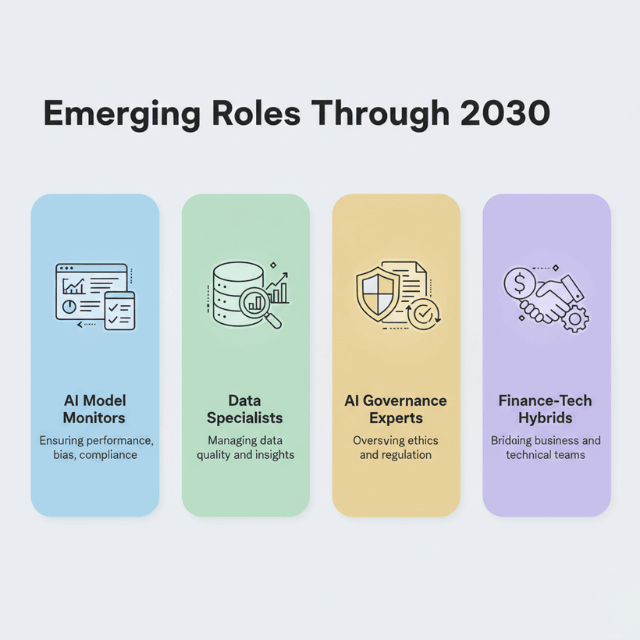
With the increase in AI adoption, new roles are emerging in all financial institutions. Banking institutions now require experts who will monitor the models of AI, where they are expected to work correctly, without discrimination, and within legal boundaries. The need to monitor performance and compliance is driving data specialists, model risk managers, and AI governance experts. Cross-functional finance-technology positions are also on the rise, with a mix of area expertise and analytics, automation, and system design. The roles in question will serve as the interpreters between technical teams and business leaders in order to make sure that AI tools are consistent with financial goals and regulatory requirements.
Skills That Will Matter Most Through 2030
Data literacy, or the know-how of data usage, interpretation, and restrictions in AI systems, will be the most desirable skill by 2030. The finance professionals will not have to code deep; however, they have to be knowledgeable about the impact that AI models have on decision-making. Reasonable risk, compliance, and regulation awareness will also be significant, particularly with more scrutiny of AI-based decisions. Human skills such as ethical judgment, critical thinking, and accountability are also necessary. With the growth of automation, career resilience will be characterized by the capacity to challenge outputs, justify decisions, and make accountable decisions.
How Banks Are Reskilling and Restructuring Workforces
Banks are reacting to the AI adoption by investing in reskilling and redesigning their workforce. Numerous organizations are initiating internal educational courses on data analytics, the basics of AI, and digital tools training for current workers. Human-in-the-loop models are emerging as the norm where AI does the work, with humans providing the supervision and finalization. Banks are also collaborating with fintechs and AI sellers to get new capabilities quicker, frequently uniting internal employees with external capabilities. This transformation is altering organizational designs, decreasing the silos available in between IT, risk, and business divisions.
Risks, Ethics & Regulatory Considerations
The use of AI in finance poses serious threats that financial institutions cannot afford to ignore. Biased algorithms may result in impartial lending or dismissal once the models are conditioned on inaccurate data. It is evident and explicable because, as regulators, they expect an explanation for why AI-driven decisions are taken to be so. Regulatory demands are becoming tougher, particularly in the area of data privacy, model governance, and responsibility. Banking is all about trust, and excessive dependence on opaque systems may undermine the confidence of the customers. Consequently, the banks have to strike a balance between innovation and responsible AI systems that are ethical and auditable in use.
What This Means for Banking & Finance Professionals
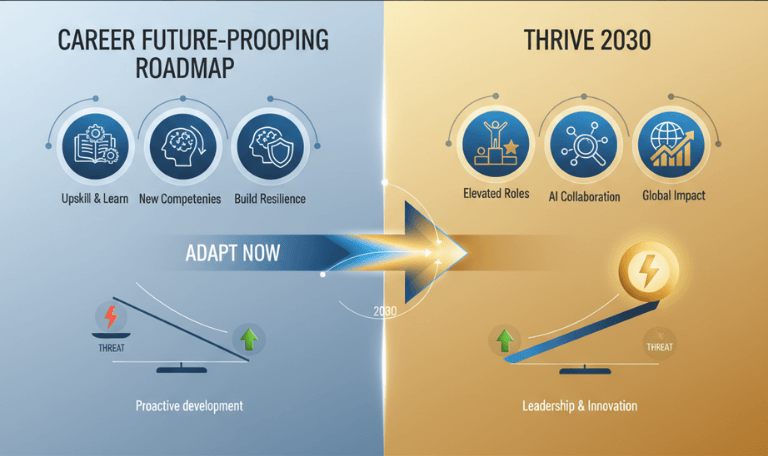
To practitioners, AI poses a threat and an opportunity. Jobs that involve repetitive and rule-oriented work are the most vulnerable to being disrupted, whereas those that deal with judgment and strategy, as well as supervision, are safer routes. The future-proofing of a career in finance requires adopting AI as an instrument instead of experiencing resistance as a way of learning to collaborate with intelligent systems. Upskilling is reasonable for those in core banking positions, whereas data, risk, or governance might be more innovative for others. It depends on timing: the sooner an adaptation takes place, the more opportunities one can have as compared to the moment when change is inevitable.
FAQs
Will AI replace bank jobs by 2030?
The AI will eliminate a few positions but typically change the occupations and will move human beings to control, decision-making, and more valuable tasks.
Which finance jobs are safest from AI?
The positions that are resistant to robots are those that entail strategy, regulation, ethics, decisions that are complex risks, and client relationships.
What skills should finance professionals start learning now?
The most significant skills to develop at the moment are data literacy, AI basics, regulatory, and critical thinking.
How fast is AI adoption happening in banks?
The adoption of AI is a steady process, and most of the large banks are continuing to adopt it annually, but not simultaneously.
Is AI more of a threat or an opportunity in finance?
AI is more of an opportunity for adaptable professionals, but a risk for those who resist skill development.
Conclusion
By the year 2030, AI will transform the banking and finance occupations within controlled yet significant proportions. Institutional changes and evolving roles should come slowly to professionals and institutions, and not abruptly. The main lesson to be learned in the coming five years is evident in the sense that scale and speed will be done by technical systems, and judgment, ethics, and accountability will be given by people. Banks that invest in reskilling and responsible AI will have a competitive edge, and the early-adapted professionals in an AI-enabled financial sector will have new and more resilient careers.
Leave a Reply