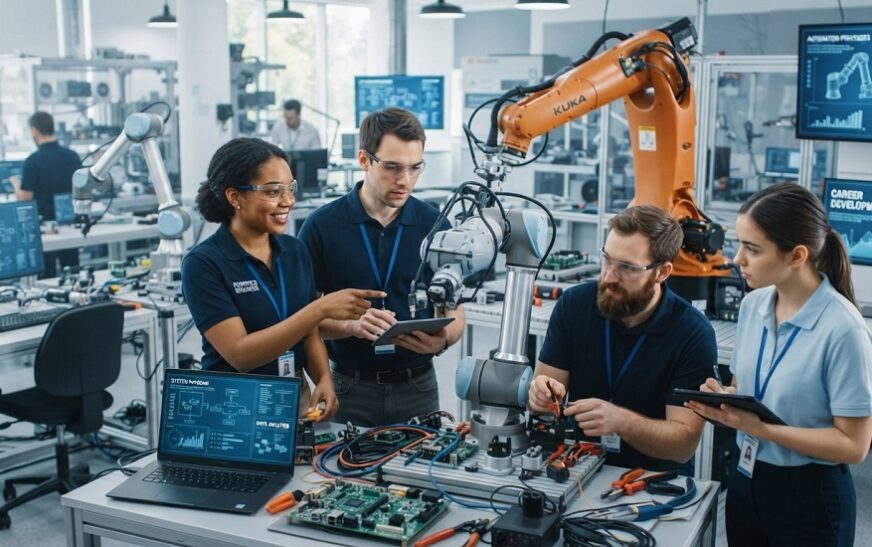
Robotics and automation are changing how factories, warehouses, laboratories, hospitals, farms, and businesses operate. As organizations automate repetitive processes and introduce increasingly capable machines, demand can grow for professionals who can design, program, install, maintain, integrate, and manage automated systems, and for a broader look at careers that are resistant to automation, explore our comprehensive guide to automation-proof careers.
That creates several different career paths.
You don’t necessarily need to become a robotics engineer to work in the industry. Opportunities can range from hands-on technician positions and PLC programming to software development, industrial engineering, robot programming, automation integration, and drone operations.
For someone considering a robotics career, the key question is not simply
“How do I become a robotics engineer?”
Instead, ask:
“Which part of the robotics and automation ecosystem matches my skills and interests?”
What Is a Robotics and Automation Career?
A robotics career involves developing or working with machines that can sense, process information, and perform physical tasks.
Automation careers are broader.
They can involve using technology to automate:
- Manufacturing
- Warehousing
- Business processes
- Inspection
- Logistics
- Agriculture
- Energy systems
- Healthcare operations
- Building systems
Some jobs focus on physical machines, while others involve software and digital workflows, and for those looking to build a broader foundation, our guide to skills that will be valuable in the future job market explores the competencies that complement technical expertise.
Robotics vs. Automation
The terms are closely related but aren’t identical.
Robotics
Robotics focuses primarily on programmable physical machines.
Examples include:
- Industrial robots
- Collaborative robots
- Autonomous mobile robots
- Drones
- Robotic arms
- Service robots
Automation
Automation refers more broadly to systems that perform tasks with limited human intervention.
It can include:
- PLC systems
- Industrial controls
- Sensors
- Manufacturing systems
- RPA software
- Automated testing
- Process-control systems
A robotics system can be part of an automation system, but automation does not always require a robot.
Major Robotics & Automation Career Paths
The industry contains several distinct job families.
1. Robotics Engineer
Robotics engineers can work on the following:
- Robot design
- Motion systems
- Sensors
- Control systems
- Robot integration
- Testing
- Autonomous systems
Depending on the employer, the role can involve mechanical engineering, electrical engineering, software, controls, or a combination.
2. Automation Engineer
Automation engineer jobs focus on designing and implementing systems that automate industrial or business processes.
Typical responsibilities may include:
- Designing control systems
- Programming PLCs
- Integrating sensors
- Configuring industrial equipment
- Troubleshooting automated systems
- Improving production processes
- Testing automation solutions
Automation engineers can work across manufacturing, logistics, energy, pharmaceuticals, food production, and other industries.
3. Automation Technician
Automation technicians are generally more hands-on.
They may:
- Install equipment
- Maintain automated machinery
- Troubleshoot electrical systems
- Test sensors
- Diagnose control problems
- Repair production equipment
- Support engineers
This can be an attractive entry point for people who prefer practical technical work over primarily theoretical engineering.
4. Robot Programmer
Robot programmer jobs involve configuring industrial robots to perform specific tasks.
Responsibilities can include:
- Programming robot movements
- Setting operating parameters
- Testing programs
- Troubleshooting errors
- Optimizing cycle times
- Integrating robots with other equipment
Robot programming is particularly relevant in manufacturing environments.
5. PLC Programmer
Programmable logic controllers, or PLCs, are fundamental components of many industrial automation systems.
PLC programmers may work with:
- Manufacturing equipment
- Conveyor systems
- Sensors
- Motors
- Safety systems
- Robotic cells
A PLC programmer salary varies significantly depending on experience, location, industry, certifications, and responsibilities.
6. Robotics Software Developer
Software engineers can enter robotics through programming.
Potential areas include:
- Robot control
- Computer vision
- Simulation
- Navigation
- Artificial intelligence
- Sensor processing
- Robotics middleware
Common programming knowledge can include languages and frameworks used in robotics and automation.
7. RPA Developer
Robotic Process Automation (RPA) is different from physical robotics.
An RPA developer career focuses on software bots that automate repetitive digital tasks.
Examples include automating:
- Data entry
- Invoice processing
- Reporting
- File transfers
- Administrative workflows
- Data extraction
RPA can therefore provide an automation career path for people who prefer software over industrial machinery.
8. Controls Engineer
Controls engineers design systems that control machines and industrial processes.
They may work with:
- PLCs
- Sensors
- Motors
- Industrial networks
- Human-machine interfaces
- Safety systems
- Robotics
Controls engineering is one of the most important bridges between engineering concepts and real-world automation.
9. Systems Integration Engineer
Robots rarely operate independently.
They must interact with:
- Conveyors
- Cameras
- Sensors
- Databases
- Safety systems
- Manufacturing equipment
Systems integrators make these components work together.
This makes integration a major career area within industrial robotics.
10. Maintenance & Reliability Careers
Automation creates a need for people who can keep automated equipment operating.
Potential roles include:
- Automation maintenance technician
- Industrial maintenance technician
- Reliability engineer
- Controls technician
- Field service engineer
As automation increases, keeping machines operational becomes increasingly important.
Robotics Careers in the USA
The U.S. robotics industry spans multiple sectors.
Manufacturing
- Automotive
- Electronics
- Aerospace
- Food production
- Pharmaceuticals
Logistics
- Warehousing
- Distribution
- E-commerce
Healthcare
- Surgical robotics
- Laboratory automation
- Medical devices
Agriculture
- Autonomous equipment
- Crop monitoring
- Precision agriculture
Defense & Aerospace
- Drones
- Autonomous systems
- Specialized robotics
Energy
- Inspection robotics
- Automated facilities
- Remote monitoring
This diversity means a robotics career doesn’t necessarily require working for a robotics company.
Industrial Robotics Careers
Industrial robotics remains one of the largest application areas.
Factories use robots for tasks such as:
- Welding
- Painting
- Assembly
- Packaging
- Material handling
- Inspection
- Palletizing
Workers supporting these systems can include:
- Robotics engineers
- Robot programmers
- Controls engineers
- Automation technicians
- Maintenance technicians
- Manufacturing engineers
Collaborative Robots (Cobots)
Collaborative robots, often called cobots, are designed to work more closely alongside humans in certain applications.
Potential applications include:
- Assembly
- Machine tending
- Packaging
- Inspection
- Pick-and-place operations
Cobots can create opportunities for professionals who understand both automation technology and human-centered manufacturing workflows.
Cobot manufacturing jobs may include programming, integration, maintenance, safety, and process engineering.
FANUC Robot Programmer Careers
FANUC is a major industrial robotics and automation company.
Professionals working with FANUC systems may develop skills in:
- Robot programming
- Industrial automation
- Robot troubleshooting
- Cell integration
- Teach pendant operation
- Production optimization
Experience with a specific robotics platform can be valuable, but professionals should also build transferable knowledge in controls, programming, safety, and automation concepts.
Robotics Engineer Salary in the USA
Robotics engineer salary USA figures can vary considerably.
Compensation depends on factors such as
- Education
- Engineering specialization
- Experience
- Industry
- Location
- Employer
- Software and controls expertise
Engineers with skills spanning multiple areas—such as mechanical systems, controls, programming, and AI—may have broader career options.
For accurate salary planning, use current U.S. labor-market data and employer-specific compensation information rather than relying on a single national estimate.
Automation Technician Salary
Automation technician compensation also varies by
- Experience
- Shift
- Industry
- Location
- Technical certifications
- Electrical expertise
- PLC knowledge
Technicians working in high-demand manufacturing environments or with specialized controls expertise may command higher compensation.
A technician can also use experience as a foundation for progression toward the following:
Automation Technician → Controls Technician → Controls Engineer
depending on education and employer requirements.
Automation Engineer vs. Robotics Engineer
These careers overlap substantially but typically emphasize different areas.
| Area | Automation Engineer | Robotics Engineer |
| Main focus | Automated processes | Robotic systems |
| PLCs | High | Moderate–high |
| Industrial controls | High | High |
| Robot programming | Moderate–high | High |
| Mechanical design | Moderate | High |
| Software | Moderate–high | High |
| Manufacturing | Very common | Very common |
| AI/autonomy | Increasing | Often important |
Neither career is universally better.
Choose based on whether you prefer broader industrial automation or deeper robotics specialization.
Skills Needed for Robotics Careers
A strong robotics professional often combines multiple technical disciplines.
Mechanical Skills
- Mechanics
- CAD
- Machine design
- Materials
- Motion systems
Electrical Skills
- Circuits
- Motors
- Sensors
- Wiring
- Electrical safety
Controls Skills
- PLC programming
- Industrial networks
- Motion control
- HMI systems
- Safety controls
Software Skills
- Programming
- Algorithms
- Simulation
- Data processing
- Computer vision
AI Skills
Increasingly relevant areas include:
- Machine learning
- Perception
- Computer vision
- Autonomous navigation
- AI-assisted control
Do You Need a Degree for a Robotics Career?
Not always.
The education requirement depends heavily on the position.
Engineering Roles
Robotics and automation engineers commonly require an engineering or related technical degree.
Technician Roles
Technician positions may accept:
- Technical certificates
- Associate degrees
- Apprenticeships
- Relevant industry experience
Programming Roles
Software-focused positions may emphasize:
- Programming ability
- Computer science
- Robotics experience
- Demonstrated projects
The industry therefore offers multiple entry points.
Best Degrees for Robotics
Potential degree paths include:
- Mechanical engineering
- Electrical engineering
- Computer engineering
- Computer science
- Mechatronics
- Industrial engineering
- Robotics engineering
Mechatronics can be particularly relevant because it combines elements of the following:
mechanical + electrical + controls + computing.
Certifications and Practical Training
Formal education isn’t the only way to develop automation skills.
Useful training areas can include:
- PLC programming
- Industrial robotics
- Electrical systems
- Controls
- CAD
- Industrial safety
- Robotics platforms
Hands-on experience can be especially valuable.
A portfolio demonstrating an automated system can sometimes communicate technical ability more effectively than a list of courses.
Build a Robotics Portfolio
You don’t need an expensive industrial robot to demonstrate interest.
A project could involve:
- A small robotic arm
- Arduino
- Raspberry Pi
- Sensors
- Computer vision
- Simulation software
- PLC training equipment
Document:
- The problem
- Your design
- Hardware used
- Software used
- Programming approach
- Testing
- Results
- What you would improve
This creates evidence of practical ability.
Automation Industry Growth
The long-term growth of automation is driven by several factors:
- Labor shortages
- Productivity goals
- Manufacturing reshoring
- E-commerce
- Aging workforces
- Safety requirements
- Demand for consistent production
- Advances in AI and robotics
However, growth isn’t guaranteed equally across every robotics occupation.
Technology adoption can vary by:
- Industry
- Company size
- Capital availability
- Labor costs
- Regulation
- Technical feasibility
Robotics and AI
AI is expanding what robots can potentially do.
Traditional industrial robots often perform predefined movements.
AI can improve capabilities such as the following:
- Object recognition
- Visual inspection
- Navigation
- Prediction
- Adaptive behavior
- Natural-language interfaces
This creates opportunities at the intersection of the following:
Robotics + AI + Data
Autonomous Systems Careers
Autonomous systems can operate with varying degrees of human supervision.
Career areas include:
- Autonomous vehicles
- Drones
- Mobile robots
- Warehouse robots
- Agricultural robotics
- Inspection systems
Professionals may work on:
- Perception
- Navigation
- Control
- Safety
- Software
- Testing
Drone Operations Careers
A drone operations career can involve more than flying drones.
Potential responsibilities include:
- Mission planning
- Data collection
- Inspection
- Mapping
- Infrastructure monitoring
- Agricultural surveying
- Emergency response
Depending on the application, professionals may combine drone operations with:
- GIS
- Photography
- Data analysis
- Engineering
- Safety
- Industry-specific expertise
Boston Dynamics and Advanced Robotics Careers
Companies developing advanced robots can offer opportunities across:
- Robotics engineering
- Mechanical engineering
- Controls
- Software
- AI
- Computer vision
- Manufacturing
- Testing
For example, Boston Dynamics careers can illustrate the range of disciplines involved in advanced robotics development.
However, the robotics industry extends far beyond high-profile robotics companies.
Many opportunities exist inside traditional manufacturers, logistics companies, engineering firms, system integrators, and industrial automation providers.
Is Robotics a Good Career?
Robotics can be attractive for people who enjoy combining the following:
- Engineering
- Programming
- Physical systems
- Problem-solving
- Technology
- Continuous learning
It can also be demanding.
Potential challenges include the following:
- Complex technical training
- Frequent troubleshooting
- Manufacturing environments
- Travel for field roles
- Shift work in some technician positions
- Rapidly changing technology
Understanding both the opportunities and challenges is important before choosing the field.
Who Is Best Suited to Robotics?
A robotics career may fit you if you enjoy the following:
- Building things
- Taking systems apart
- Programming
- Mathematics
- Engineering
- Troubleshooting
- Experimentation
- Working with machines
You don’t have to love every area.
The industry contains enough specialization to let people focus more heavily on software, mechanical design, electronics, controls, or operations.
Career Progression Examples
Technician Path
Automation Technician → Controls Technician → Senior Technician → Automation Specialist
Engineering Path
Junior Engineer → Automation Engineer → Senior Engineer → Controls/Robotics Lead
Software Path
Software Developer → Robotics Software Engineer → Senior Robotics Engineer → Robotics Architect
Operations Path
Robot Operator → Robot Programmer → Automation Specialist → Robotics Manager
Actual titles and advancement structures vary by employer.
Robotics Career Skill Stack
A particularly useful combination is the following:
Programming
+
Controls
+
Mechanical/Electrical fundamentals
+
AI/data literacy
+
Industry knowledge
You don’t need expert-level proficiency in all five.
The goal is to understand how the pieces interact.
Choosing the Right Robotics Career Path
The robotics and automation industry is broad enough to accommodate different educational backgrounds and interests. Someone who enjoys programming may prefer robotics software, while someone who likes electrical systems and hands-on troubleshooting may be better suited to controls or automation technician work.
Quick Career Match
| If you enjoy… | Consider… |
| Programming | Robotics software, RPA, robot programming |
| Electronics | Controls engineering, PLC programming |
| Mechanical systems | Robotics engineering, mechatronics |
| Hands-on troubleshooting | Automation technician |
| Manufacturing | Industrial automation |
| AI and computer vision | Autonomous robotics |
| Flying and field operations | Drone operations |
| Process improvement | Automation engineering |
| Designing complete systems | Systems integration |
Robotics Engineer Career Path
A typical robotics engineer may work across several disciplines.
Entry Level
Possible titles:
- Junior Robotics Engineer
- Robotics Engineer I
- Controls Engineer
- Mechatronics Engineer
Mid-Career
Potential progression:
- Robotics Engineer
- Senior Robotics Engineer
- Controls Engineer
- Robotics Systems Engineer
Advanced
Possible roles include:
- Robotics Lead
- Principal Robotics Engineer
- Robotics Architect
- Engineering Manager
- Director of Robotics
The exact path depends on the company’s size and specialization.
Automation Engineer Career Path
Automation engineers often work closely with production, manufacturing, maintenance, and engineering teams.
Typical responsibilities can include:
- Designing automated processes
- Developing control systems
- Programming PLCs
- Integrating robots
- Improving production efficiency
- Troubleshooting equipment
- Managing automation projects
A common progression is:
Junior Automation Engineer → Automation Engineer → Senior Automation Engineer → Automation Lead → Engineering Manager
Automation Technician Career Path
Technician roles can provide an accessible entry into industrial automation.
A technician might start by:
- Maintaining equipment
- Troubleshooting sensors
- Testing motors
- Diagnosing electrical faults
- Supporting engineers
With experience and additional education, some technicians move toward the following:
- Controls technician
- PLC programmer
- Automation specialist
- Controls engineer
This makes technician work a potentially useful route for people who want practical experience before pursuing more advanced engineering roles.
Robot Programmer Career Path
Robot programmers specialize in configuring robots for production tasks.
They may work with platforms from major industrial robotics manufacturers.
Skills can include:
- Robot programming
- Motion planning
- Teach pendant operation
- Industrial safety
- Coordinate systems
- Robot-cell troubleshooting
- Production optimization
Experience with one platform can help you enter the field, but transferable robotics and controls knowledge is important for long-term mobility.
PLC Programmer Career Path
PLC programming is one of the foundational skills in industrial automation.
A PLC programmer may develop logic controlling the following:
- Motors
- Conveyors
- Sensors
- Valves
- Safety equipment
- Robotic cells
A typical progression might look like:
Controls Technician → PLC Programmer → Controls Engineer → Senior Controls Engineer
Some employers may require an engineering degree for higher-level engineering titles, while others place more emphasis on technical experience.
RPA Developer Career
If you are interested in automation but don’t want to work with physical robots, consider RPA development.
RPA developers automate repetitive digital processes.
Examples include:
- Invoice processing
- Data transfer
- Report generation
- Form processing
- Customer-data updates
- Administrative workflows
This career path can be particularly relevant for people with backgrounds in:
- IT
- Software development
- Business analysis
- Finance
- Operations
Robotics Software Engineering
Software is increasingly central to robotics.
Robotics software engineers may work on:
- Robot operating systems
- Motion planning
- Computer vision
- Navigation
- Simulation
- Perception
- Autonomous behavior
Programming knowledge can include languages and frameworks commonly used for robotics, but employers vary in their technical requirements.
Controls Engineering
Controls engineering is a particularly useful specialization because automated equipment depends on reliable control systems.
Controls professionals may work with:
- PLCs
- HMIs
- Sensors
- Drives
- Motors
- Industrial communications
- Safety systems
Someone interested in the physical behavior of machines may find controls more appealing than purely software-oriented robotics.
Systems Integration
A robot rarely solves a manufacturing problem by itself.
A complete automated cell might require the following:
Robot + PLC + sensors + conveyor + vision + safety system + database
The systems integrator makes those pieces work together.
This requires:
- Technical breadth
- Troubleshooting
- Project management
- Customer communication
- Understanding of industrial processes
Systems integration can therefore be a strong career option for people who enjoy solving complex, real-world problems.
Industrial Robotics Career Opportunities
Industrial robotics is particularly relevant to manufacturing.
Common applications include:
Assembly
Robots perform repetitive assembly operations.
Welding
Robotic welding can improve consistency and throughput.
Palletizing
Robots move products onto pallets.
Packaging
Robotic systems can sort and package products.
Machine Tending
Robots can load and unload manufacturing equipment.
Inspection
Robotic and vision systems can identify defects.
Each application requires different combinations of programming, controls, mechanical knowledge, and manufacturing expertise.
Cobots and Human-Robot Collaboration
Collaborative robots can work in applications where humans and machines operate closer together.
This creates opportunities for:
- Cobot programming
- Application engineering
- Safety
- Integration
- Process design
- Maintenance
Cobots may be particularly useful for smaller manufacturers that cannot justify large fully automated production cells.
Robotics + Computer Vision
Computer vision allows machines to interpret images and visual information.
Applications include:
- Quality inspection
- Object recognition
- Sorting
- Pick-and-place
- Navigation
- Measurement
Career opportunities may involve:
- Computer vision engineering
- Machine learning
- Robotics software
- Image processing
- Industrial inspection
This is one of the areas where AI and robotics careers increasingly overlap.
Robotics + Artificial Intelligence
AI can expand the capabilities of robotic systems.
Traditional automation often follows predictable rules.
AI-based systems can potentially handle greater variation.
Examples include:
- Identifying unfamiliar objects
- Adapting to changing environments
- Predictive maintenance
- Intelligent inspection
- Autonomous navigation
This creates a growing intersection between:
Robotics + AI + computer vision + data
Professionals who understand multiple areas may have broader opportunities.
Robotics and Automation Salary Factors
There is no single salary for the robotics industry.
Compensation can vary based on:
- Job title
- Experience
- Location
- Industry
- Education
- Technical specialization
- Shift requirements
- Travel
- Management responsibilities
For example, a field-service technician and a robotics software engineer may both work in robotics but have very different compensation structures.
Robotics Engineer Salary USA: What Influences Pay?
When evaluating robotics engineer salary USA data, look beyond the national average.
Consider:
Location
Technology and manufacturing hubs may have different compensation levels and living costs.
Experience
Senior engineers generally command higher pay than entry-level engineers.
Specialization
Skills in areas such as:
- Controls
- AI
- Computer vision
- Autonomous systems
- Embedded software
can influence compensation.
Industry
Aerospace, advanced manufacturing, medical technology, logistics, and other sectors can have different pay structures.
Automation Technician Salary: What Influences Earnings?
Automation technician compensation can depend heavily on:
- Shift schedules
- Overtime
- Manufacturing sector
- PLC expertise
- Electrical knowledge
- Travel
- Certifications
- Location
When comparing offers, evaluate total compensation, not just base salary.
For some technician positions, overtime and shift premiums can materially affect annual earnings.
PLC Programmer Salary
PLC programming is a specialized technical skill.
Earnings can vary depending on whether the role involves:
- Basic PLC programming
- Advanced controls
- Robotics integration
- Commissioning
- Travel
- Project management
- Engineering responsibilities
A PLC programmer who can also troubleshoot electrical systems and integrate robotic equipment may have a broader skill profile.
Certifications for Robotics Careers
Certifications can be useful, particularly for technician and industrial automation positions.
Relevant training areas can include:
- PLC programming
- Industrial robotics
- Electrical systems
- Controls
- Machine safety
- Industrial networking
- CAD
- Mechatronics
However, certifications should supplement—not replace—practical experience.
Hands-On Experience Matters
Robotics is a field where practical skills can be particularly valuable.
Employers may want evidence that you can:
- Diagnose problems
- Read technical documentation
- Program equipment
- Test systems
- Work safely
- Troubleshoot failures
A small working project can demonstrate these abilities.
How to Start a Robotics Career Without Experience
Route 1: Technical Education
Consider:
- Community college
- Technical school
- Mechatronics programs
- Industrial automation programs
Then seek technician or junior technical positions.
Route 2: Engineering Degree
Study:
- Mechanical engineering
- Electrical engineering
- Computer engineering
- Mechatronics
- Computer science
Then target engineering internships and entry-level positions.
Route 3: Software Background
If you already know programming, build projects involving:
- Robotics simulation
- Computer vision
- Autonomous navigation
- Robot control
- AI
Then target robotics software positions.
Route 4: Manufacturing Experience
Workers already in manufacturing can move toward automation by learning:
- PLCs
- Controls
- Robotics
- Industrial networking
- Machine troubleshooting
This can provide a transition without completely abandoning existing industry knowledge.
Build a Robotics Portfolio Project
A strong beginner project could be a small automated sorting system.
For example:
Sensor → Controller → Motor → Robotic mechanism → Classification
Document:
- Problem
- System design
- Components
- Programming
- Testing
- Failures
- Improvements
- Final results
This demonstrates practical problem-solving.
Robotics Tools to Learn
The exact tools vary by employer, but useful categories include:
Programming
- Python
- C++
- PLC languages
Robotics
- Robot programming environments
- Simulation
- Motion planning
Controls
- PLC platforms
- HMIs
- Industrial networks
Engineering
- CAD
- Electrical design
- Mechanical design
AI
- Machine learning
- Computer vision
- Data analysis
Don’t attempt to master every technology simultaneously.
Choose tools relevant to your target career.
How to Choose Between Robotics and Automation
Ask yourself:
Do you prefer physical machines?
Consider:
Robotics engineering
Do you prefer industrial processes?
Consider:
Automation engineering
Do you like programming?
Consider:
Robotics software or robot programming
Do you prefer hands-on troubleshooting?
Consider:
Automation technician or controls technician
Do you like business processes?
Consider:
RPA development
Do you like field work?
Consider:
Systems integration or field service
Robotics vs. RPA
These fields are often confused because both use the word “robot.”
| Robotics | RPA |
| Physical machines | Software bots |
| Sensors | APIs/software interfaces |
| Motors | Digital workflows |
| Manufacturing | Administrative processes |
| Controls | Software automation |
| Mechanical systems | Business applications |
Both are legitimate automation careers, but the technical skill requirements are very different.
Robotics vs. Traditional Software
Robotics software has a unique characteristic:
It interacts with the physical world.
A software bug in a web application may cause incorrect information.
A robotics bug can cause a machine to move incorrectly.
That means robotics software often requires understanding:
- Safety
- Sensors
- Timing
- Hardware
- Real-world constraints
People who enjoy the intersection of software and physical systems may find robotics particularly rewarding.
Drone Career Opportunities
Drone operations are expanding beyond recreational flying.
Potential applications include:
- Infrastructure inspection
- Agriculture
- Construction
- Surveying
- Mapping
- Emergency response
- Media production
- Environmental monitoring
A professional drone operator can increase their value by adding industry expertise.
For example:
Drone operation + GIS
or
Drone operation + construction inspection
can be more differentiated than drone operation alone.
Advanced Robotics Companies
High-profile robotics companies can provide examples of where the industry is heading.
Companies developing advanced robots may hire:
- Mechanical engineers
- Electrical engineers
- Controls engineers
- Software engineers
- AI researchers
- Manufacturing engineers
- Test engineers
However, don’t limit your job search to famous robotics brands.
Traditional companies increasingly employ robotics professionals internally.
Where to Find Robotics Jobs
Search across multiple employer categories:
Robotics Manufacturers
Companies that design and build robots.
System Integrators
Companies that implement automation for customers.
Manufacturers
Companies that use robots in production.
Logistics Companies
Warehouses and distribution networks.
Engineering Firms
Companies designing automated systems.
Technology Companies
Organizations developing autonomous systems and robotics software.
Research Organizations
Universities, laboratories, and advanced R&D groups.
This broader search can significantly increase the number of potential opportunities.
Job Titles to Search
Don’t search only for “robotics engineer.”
Also consider:
- Robotics Engineer
- Automation Engineer
- Controls Engineer
- Robotics Software Engineer
- Robot Programmer
- PLC Programmer
- Automation Technician
- Controls Technician
- Mechatronics Engineer
- Systems Integration Engineer
- Field Service Engineer
- Robotics Technician
- RPA Developer
- Computer Vision Engineer
- Autonomous Systems Engineer
- Manufacturing Automation Engineer
Future Robotics Skills
As the industry develops, valuable skills may increasingly include:
- AI
- Computer vision
- Autonomous systems
- Industrial cybersecurity
- Advanced controls
- Digital twins
- Simulation
- Edge computing
- Data analysis
- Human-robot collaboration
The strongest professionals may combine these emerging skills with traditional engineering fundamentals.
A Practical 12-Month Robotics Career Plan
Months 1–3
Learn:
- Basic programming
- Electronics
- Sensors
- Automation concepts
Months 4–6
Choose a specialization:
- PLCs
- Robotics
- Controls
- Software
- Computer vision
Months 7–9
Build a project.
Document the complete process.
Months 10–12
Apply for:
- Internships
- Technician positions
- Junior engineering roles
- Automation roles
- Robotics support positions
At the same time, network with professionals and attend relevant industry events.
Bottom Line
A robotics career isn’t a single occupation.
It’s an ecosystem ranging from technicians and PLC programmers to engineers, software developers, system integrators, AI specialists, and drone operators.
The best path depends on your starting point.
If you already have engineering skills, specialize in robotics or controls.
If you prefer hands-on work, consider automation technician or robotics technician roles.
If you’re a software professional, robotics software, computer vision, and autonomous systems can provide a path into the physical world.
The key is to build a combination of technical skills, practical experience, and industry knowledge rather than chasing one specific job title.
Frequently Asked Questions
What are the best robotics careers in the USA?
Common robotics career paths include robotics engineer, automation engineer, controls engineer, robot programmer, PLC programmer, robotics software engineer, automation technician, systems integration engineer, and robotics technician. The best option depends on your education, technical strengths, and whether you prefer software, engineering, or hands-on work.
Is robotics a good career?
Robotics can be a strong career choice for people interested in engineering, programming, automation, and problem-solving. The industry spans manufacturing, logistics, healthcare, agriculture, aerospace, and other sectors, creating opportunities beyond traditional robotics companies.
How do I start a robotics career?
Start by choosing a specialization such as robotics engineering, PLC programming, controls, software, or automation technology. Build relevant technical skills, complete hands-on projects, and look for internships, technician positions, apprenticeships, or entry-level engineering roles.
Do I need a degree to work in robotics?
Not every robotics job requires a four-year degree. Engineering positions commonly require relevant degrees, while technician, maintenance, robot operator, and some programming positions may accept technical training, certificates, associate degrees, or demonstrated experience.
What degree is best for robotics?
Common degrees include mechanical engineering, electrical engineering, computer engineering, computer science, mechatronics, industrial engineering, and robotics engineering. The best choice depends on whether you want to focus on mechanical systems, controls, software, or autonomous technology.
What is the difference between robotics and automation?
Robotics generally focuses on programmable physical machines, while automation is a broader concept involving systems that perform tasks with limited human intervention. Industrial automation can use PLCs, sensors, software, controls, and robots.
What does an automation engineer do?
An automation engineer designs, programs, integrates, tests, and improves automated systems. Responsibilities can include PLC programming, robotics integration, controls design, troubleshooting, process improvement, and project management.
What does a robotics engineer do?
A robotics engineer can work on robot design, controls, sensors, motion systems, software, testing, and autonomous capabilities. The exact responsibilities vary between industrial robotics, research, consumer robotics, and autonomous systems.
What does a robot programmer do?
Robot programmers configure industrial robots to perform manufacturing tasks. They may program movements, test robot cells, troubleshoot errors, optimize production cycles, and integrate robots with other equipment.
What does a PLC programmer do?
PLC programmers create and maintain the control logic used by industrial equipment. PLCs can control motors, conveyors, sensors, valves, safety systems, and robotic cells.
What is an RPA developer?
An RPA developer creates software-based automation that performs repetitive digital tasks. RPA is different from physical robotics and is commonly used for administrative, financial, customer-service, and data-processing workflows.
What is a FANUC robot programmer?
A FANUC robot programmer specializes in programming and configuring industrial robots from FANUC. Relevant work can include robot-cell programming, troubleshooting, production optimization, and integration with manufacturing equipment.
How much does an automation technician make?
Automation technician compensation varies by location, industry, experience, shift schedule, overtime, technical specialization, and employer. Current salary data should be checked against the specific location and job rather than relying on a single national estimate.
How much does a robotics engineer make in the USA?
Robotics engineer salary levels in the USA vary significantly based on experience, location, specialization, industry, and employer. Engineers with expertise in controls, AI, computer vision, autonomous systems, or robotics software may have different compensation profiles from traditional manufacturing engineers.
Are PLC programming jobs in demand?
PLC programming remains an important skill in industrial automation because PLCs control many manufacturing and process systems. Demand varies by region and industry, but combining PLC skills with electrical troubleshooting, robotics, controls, and industrial networking can broaden career opportunities.
Are cobots creating new manufacturing jobs?
Collaborative robots can create demand for professionals who install, program, integrate, maintain, and optimize these systems. Cobots can also change existing manufacturing roles by shifting workers toward machine supervision, quality control, programming, and process improvement.
What skills are needed for a robotics career?
Useful skills include programming, electronics, mechanical fundamentals, controls, PLCs, sensors, industrial networking, troubleshooting, data analysis, and increasingly AI and computer vision. The ideal skill combination depends on the specific robotics role.
Can I move into robotics from another career?
Yes. Professionals can transition from manufacturing, software, electrical work, mechanical engineering, IT, or other technical fields. The easiest transition usually builds on existing expertise rather than starting completely from scratch.