

The U.S. job market is likely to look substantially different by 2030.
Artificial intelligence, automation, demographic change, healthcare demand, cybersecurity, clean energy, advanced manufacturing, and digital infrastructure are reshaping what employers need from workers.
But predicting the jobs of the future isn’t simply about identifying occupations that sound futuristic.
The more useful question is
Which occupations are likely to grow, which skills will become more valuable, and how can workers prepare for changes in the labor market?
This guide examines future jobs in the USA through 2030 and beyond, including emerging careers, technology-driven employment changes, workforce trends, and the skills future workers are likely to need.
What Are Future Jobs?
Future jobs are occupations expected to grow, evolve, or emerge as economic conditions, technology, demographics, and social needs change.
Some will be entirely new occupations.
Others will be existing jobs transformed by new technology.
For example:
- AI may change how software developers work.
- Automation may change manufacturing roles.
- Healthcare technology may expand demand for specialized health professionals.
- Renewable-energy investment may create additional technical occupations.
- Cybersecurity needs may increase as more systems become digitally connected.
Therefore, the future labor market isn’t necessarily about humans versus machines.
In many occupations, the more realistic model is
Human expertise + technology + new skills
What Will Jobs Look Like in 2030?
The jobs in 2030 in the USA will likely reflect several overlapping forces.
1. Artificial Intelligence
AI is changing:
- Software development
- Marketing
- Customer service
- Finance
- Research
- Healthcare
- Legal work
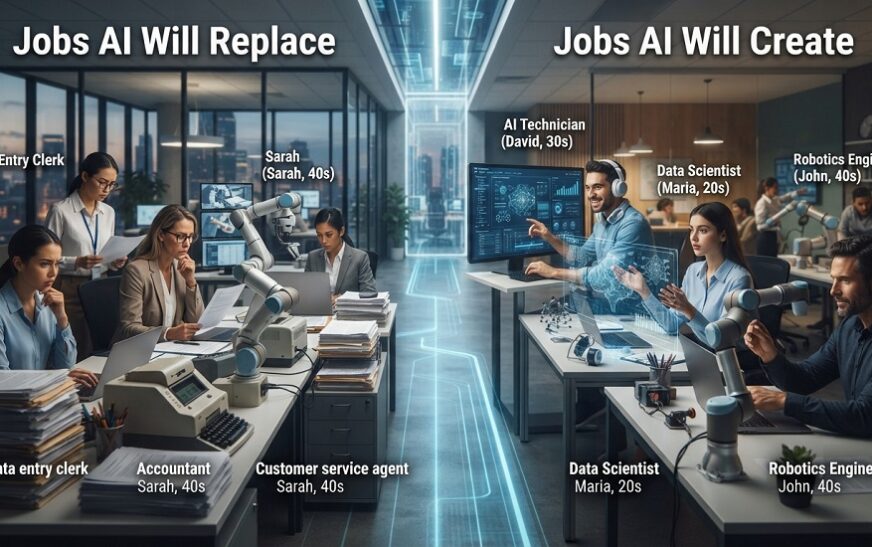
- Administrative work, and for a deeper look at how AI is reshaping the labor market, including which jobs may be replaced and which may be created, explore our comprehensive guide.
Workers who can use AI effectively may gain an advantage over workers who ignore it.
2. Automation
Automation can reduce demand for some repetitive tasks while increasing demand for people who
- Build automated systems
- Maintain technology
- Analyze outputs
- Manage exceptions
- Design workflows
- Integrate systems
This means automation can change the composition of jobs, not merely eliminate jobs.
3. Aging Population
The U.S. population is aging, increasing demand for services related to the following:
- Healthcare
- Senior care
- Medical technology
- Rehabilitation
- Home health
- Long-term care
Healthcare is therefore one of the most important areas to examine when considering future career predictions.
4. Energy Transition
Investment in renewable energy, grid infrastructure, electrification, energy efficiency, and related technologies can create demand for workers across:
- Engineering
- Construction
- Installation
- Maintenance
- Manufacturing
- Project management
- Environmental services
5. Cybersecurity
As organizations become more dependent on digital infrastructure, protecting
- Networks
- Cloud systems
- Data
- AI systems
- Connected devices
- Critical infrastructure
becomes increasingly important.
Cybersecurity is therefore likely to remain an important area of future employment.
Future Jobs USA: Major Career Categories
Rather than focusing on individual job titles, it is useful to organize the future labor market into career categories.
Artificial Intelligence & Machine Learning
Potential roles include:
- AI engineer
- Machine learning engineer
- AI product manager
- AI solutions architect
- Data scientist
- AI security specialist
- AI governance professional
- AI implementation consultant, and for a broader look at AI trends shaping the future of work, explore our comprehensive trends guide.
Not every future AI job will require a PhD.
Many organizations will need professionals who understand how to apply AI to existing business processes.
Robotics & Automation
As robotics become more capable, opportunities may grow around:
- Robotics engineering
- Robot maintenance
- Automation engineering
- Industrial systems integration
- Robotics operations
- Autonomous systems
- Human-robot interaction
The growth of robotics can also create demand for technicians who install and maintain automated equipment.
Healthcare & Biotechnology
Healthcare remains one of the strongest areas for long-term workforce demand because technology cannot eliminate the underlying need for patient care.
Potential growth areas include:
- Advanced nursing
- Medical technology
- Healthcare data
- Health informatics
- Genetic medicine
- Biotechnology
- Mental health services
- Home healthcare
- Aging-related care
The future healthcare workforce will likely combine clinical expertise with increasing technological literacy.
Cybersecurity & Digital Trust
Future digital systems will require professionals who can protect them.
Career areas include:
- Cybersecurity engineering
- Cloud security
- Identity management
- Security analysis
- Digital forensics
- AI security
- Privacy engineering
- Cyber risk management
As AI becomes more integrated into organizations, securing AI systems may become a specialized career area.
Clean Energy & Climate Technology
The energy sector is evolving beyond traditional generation and distribution.
Potential future careers include:
- Solar installation
- Wind-energy technicians
- Battery technology
- Grid modernization
- Energy storage
- Electric-vehicle infrastructure
- Environmental engineering
- Energy management
- Climate technology
The broader category of green energy job growth should therefore be considered across both technical and nontechnical occupations.
Advanced Manufacturing
Manufacturing is increasingly combining physical production with:
- Robotics
- Sensors
- AI
- Industrial software
- Data analytics
- Advanced materials
Future manufacturing jobs may require both technical and digital skills.
Potential roles include:
- Automation technician
- Robotics engineer
- Industrial data analyst
- Manufacturing systems engineer
- Quality automation specialist
- Advanced manufacturing technician
Data & Analytics
Organizations increasingly depend on data for decisions.
Future-oriented data careers can include:
- Data scientist
- Data engineer
- Business intelligence analyst
- Analytics engineer
- Data governance specialist
- Decision scientist
The most valuable professionals may be those who can connect technical analysis to actual business decisions.
Software Development
Software development is likely to change substantially because AI-assisted coding can automate portions of development.
That does not necessarily mean software developers disappear.
Instead, developers may spend more time on:
- Architecture
- System design
- Security
- Testing
- Integration
- Product requirements
- Reviewing AI-generated code
- Complex problem-solving
The skill profile of the developer may therefore evolve rather than simply vanish.
AI Impact on Employment
The AI impact on employment is one of the most important uncertainties surrounding the future job market.
AI can affect employment in several ways:
Job Creation
New products and services can create new occupations.
Job Transformation
Existing workers can use AI to complete tasks faster.
Task Automation
Certain repetitive activities may require fewer human hours.
Productivity Growth
Organizations may produce more output with the same workforce.
New Skill Requirements
Workers may need to develop AI-related capabilities.
The outcome will differ substantially by occupation.
Automation Job Displacement
Automation is most likely to affect work containing large amounts of the following:
- Repetitive tasks
- Predictable processes
- Rule-based decisions
- Structured data processing
- Routine physical activities
Jobs requiring:
- Complex judgment
- Human interaction
- Creativity
- Leadership
- Empathy
- Adaptability
- Physical dexterity in unpredictable environments
can be harder to automate completely.
However, no occupation should be treated as permanently protected from technological change.
Jobs Created by Technology
Technology can create employment through several mechanisms.
Direct Jobs
People build the technology.
Examples:
- Engineers
- Developers
- Technicians
- Researchers
Supporting Jobs
People deploy and operate the technology.
Examples:
- Implementation specialists
- Trainers
- Support professionals
- Systems administrators
New Industries
Technology creates products and services that previously didn’t exist.
Complementary Work
Human workers become more productive because technology handles some tasks.
This is why new jobs created by technology should be considered alongside automation-related displacement.
The WEF Future of Jobs Perspective
The World Economic Forum’s Future of Jobs Report is one useful source for understanding global workforce trends.
Its broader framework emphasizes changes driven by:
- Technology
- Economic conditions
- Demographics
- Geopolitical developments
- The green transition
However, global projections shouldn’t automatically be treated as forecasts for every U.S. occupation.
For U.S.-specific employment projections, workers should also examine government labor-market data.
BLS Employment Projections
The U.S. Bureau of Labor Statistics provides occupational employment projections that are particularly useful for evaluating future demand.
These projections can help answer questions such as the following:
- Which occupations are expected to grow?
- How many openings may occur?
- What education is typically required?
- What are current median wages?
- Which industries employ these workers?
A useful distinction is the following:
Employment growth ≠ number of job openings.
An occupation can have modest employment growth but still generate many openings because existing workers retire or leave the occupation.
Future Career Predictions Need Context
No forecast can perfectly predict the U.S. labor market in 2030.
Future employment depends on:
- Economic growth
- Technology adoption
- Government policy
- Immigration
- Demographics
- Consumer behavior
- Energy prices
- Global trade
- Business investment
Therefore, treat future career predictions as scenarios rather than guarantees.
Careers That May Exist in 2030
Some future occupations may not yet have standardized titles.
Potential examples include:
- AI workflow architect
- AI governance specialist
- Autonomous systems supervisor
- Robotics operations manager
- Digital trust specialist
- AI safety professional
- Synthetic biology technician
- Climate technology project manager
- Human-AI interaction specialist
- Virtual environment designer
Some of these roles may develop into established occupations, while others may remain niche specialties or evolve into different titles.
The Future of Work Is Also About Existing Jobs
A common mistake is focusing only on completely new careers.
Many of the biggest opportunities may come from existing occupations that evolve.
For example:
Accountant + AI
→ AI-assisted financial analysis
Nurse + Digital Health
→ Technology-enabled patient care
Teacher + AI
→ Personalized learning support
Electrician + Electrification
→ EV and energy-system installation
Lawyer + AI
→ AI-assisted legal research and review
Marketer + Data + AI
→ Automated personalization and analytics
The worker of 2030 may therefore be a technology-enhanced version of today’s professional.
Skills Future Workers Need
The future labor market is likely to reward a combination of technical and human capabilities.
Digital Skills
Workers increasingly benefit from understanding:
- AI tools
- Data
- Automation
- Cloud technology
- Cybersecurity
- Digital collaboration
Analytical Thinking
Important capabilities include:
- Problem-solving
- Data interpretation
- Decision-making
- Critical thinking
- Systems thinking
Human Skills
Technology doesn’t eliminate the value of
- Communication
- Leadership
- Collaboration
- Negotiation
- Empathy
- Creativity
These capabilities become especially important when workers must coordinate people, technology, and complex decisions.
AI Literacy May Become a Basic Workplace Skill
Not every worker will need to become an AI engineer.
But many professionals may benefit from understanding:
- How AI systems work at a basic level
- How to write effective prompts
- How to verify AI outputs
- How to protect sensitive information
- How to integrate AI into workflows
- When human judgment is required
AI literacy could become similar to spreadsheet or general computer literacy for many occupations.
Future Economy Careers: Follow the Infrastructure
Some of the strongest future opportunities may exist in industries supporting the broader technology economy.
Consider:
AI → Data centers → Electricity → Cooling → Construction → Semiconductor manufacturing → Cybersecurity → Infrastructure
Growth in one technology ecosystem can therefore create employment across many seemingly unrelated industries.
The Importance of Skilled Trades
The future of employment isn’t exclusively digital.
Skilled trades may remain important because physical infrastructure still requires humans to:
- Install
- Repair
- Maintain
- Inspect
- Construct
Potential areas include:
- Electricians
- HVAC technicians
- Industrial mechanics
- Construction specialists
- Equipment technicians
- Renewable-energy technicians
Technology may make these workers more productive rather than eliminate the need for them.
The Future Job Market May Reward Adaptability
One of the most important workforce future trends is that workers may need to change skills more frequently.
A career could involve:
Learn → Apply → Automate → Relearn → Specialize → Adapt
Instead of acquiring one skill set and using it unchanged for 30 years, future workers may need continuous learning.
What Education Will Matter Most?
The answer isn’t simply “get more education.”
The value of education depends on the occupation.
Future workers may benefit from combinations such as the following:
Degree + Technical Skill
Business + data analytics
Trade + Technology
Electrical work + energy systems
Healthcare + Technology
Nursing + health informatics
Liberal Arts + AI
Communication + AI-assisted research
Technical Degree + Business
Engineering + product management
The ability to combine disciplines can create valuable career differentiation.
A Future-Proof Career Strategy
No job is completely future-proof.
A better objective is to become future-ready.
Build five capabilities:
- Domain expertise
- Technology literacy
- Analytical thinking
- Communication
- Continuous learning
This combination allows workers to adapt as specific tools and job titles change.
How to Choose a Career for 2030
Before choosing a career, evaluate:
Demand
Is the underlying need growing?
Automation Exposure
How much of the work is repetitive?
Human Value
Does the role require judgment, trust, creativity, or interpersonal skills?
Technology Complementarity
Can technology make workers in this occupation more productive?
Training Requirements
How difficult is it to enter the field?
Geographic Flexibility
Are jobs available across the USA or concentrated in specific regions?
Earnings
Does compensation justify the required education and training?
Long-Term Adaptability
Can the skills transfer to adjacent occupations?
A Better Way to Think About “Future-Proof” Jobs
Instead of asking:
“Which job will never disappear?”
Ask:
“Which skills are likely to remain valuable even as the job changes?”
That shift produces a much more useful career strategy.
For example, learning how to analyze problems, work with technology, communicate decisions, and manage complex systems can remain valuable even if the specific tools change.
How to Identify High-Potential Jobs for 2030
Predicting the best jobs of the future requires more than looking at occupations with exciting technology.
A stronger approach is to evaluate five signals:
- Demand growth
- Replacement needs
- Technology complementarity
- Difficulty of automation
- Transferable skill value
A career becomes particularly attractive when several of these signals point in the same direction.
1. Look for Growing Underlying Needs
Technology changes, but human needs tend to persist.
Consider:
- Healthcare
- Housing
- Energy
- Food
- Transportation
- Security
- Education
- Infrastructure
- Business productivity
Jobs connected to expanding underlying needs can remain relevant even when technology changes the way the work is performed.
2. Look at Replacement Demand
An occupation doesn’t need explosive growth to generate employment opportunities.
Large numbers of workers eventually:
- Retire
- Change occupations
- Reduce working hours
- Leave the workforce
- Move into management
That creates replacement openings.
This is one reason official employment projections should be evaluated using both employment growth and total projected openings.
3. Identify Jobs That Work With Technology
A useful question is
Does technology replace the worker or make the worker more productive?
Consider an electrician.
Technology can improve:
- Diagnostics
- Scheduling
- Documentation
- Equipment monitoring
But physical installation and troubleshooting may still require human expertise.
The same principle applies to many professional occupations.
4. Look for Technology Complementarity
Jobs may have strong long-term potential when technology increases the value of the worker.
Examples include:
AI + Healthcare
AI can help analyze information while healthcare professionals provide care and judgment.
Robotics + Manufacturing
Automation can increase the need for technicians who maintain and manage systems.
AI + Cybersecurity
More AI adoption can create additional security challenges.
Renewable Energy + Skilled Trades
Electrification can increase demand for workers who install and maintain physical systems.
5. Don’t Ignore Physical-World Careers
Some of the most resilient future employment opportunities may exist outside traditional technology companies.
The physical economy still requires:
- Construction
- Transportation
- Electrical infrastructure
- Healthcare delivery
- Equipment maintenance
- Energy systems
- Industrial operations
The future labor market is therefore likely to include both digital careers and technology-enabled physical careers.
Emerging Career Categories to Watch
Artificial Intelligence
Potential career paths:
- AI engineer
- Machine learning specialist
- AI product manager
- AI implementation specialist
- AI governance professional
- AI safety specialist
- AI operations specialist
The opportunity isn’t limited to people who build foundational AI models.
Businesses also need professionals who can implement AI effectively.
AI Implementation Careers
One particularly important emerging category may involve helping organizations integrate AI into existing workflows.
Responsibilities could include:
- Identifying automation opportunities
- Selecting AI tools
- Designing workflows
- Training employees
- Monitoring outputs
- Establishing governance
- Measuring productivity gains
These roles can combine:
Business knowledge + technology + change management
AI Governance
As organizations deploy AI systems, they may need professionals who help manage:
- Privacy
- Security
- Compliance
- Risk
- Model performance
- Human oversight
- Responsible use
This creates opportunities at the intersection of technology, law, policy, risk, and business operations.
Robotics and Autonomous Systems
Robotics could expand beyond factories into the following:
- Warehouses
- Healthcare
- Agriculture
- Construction
- Logistics
- Transportation
Potential roles include:
- Robotics technician
- Automation engineer
- Autonomous systems specialist
- Robot fleet manager
- Robotics safety professional
Many of these positions combine software, hardware, and operational expertise.
Healthcare Technology Careers
Healthcare is likely to experience simultaneous demographic and technological change.
Potential areas include:
- Health informatics
- Clinical data
- Digital health
- Medical-device technology
- Telehealth operations
- Healthcare cybersecurity
- Remote patient monitoring
The strongest opportunities may often occur where clinical knowledge and technology overlap.
Biotechnology & Life Sciences
Advances in biotechnology may create demand in:
- Genomics
- Bioinformatics
- Drug development
- Laboratory automation
- Synthetic biology
- Medical research
These fields typically require specialized education, making the entry barrier higher than many general business careers.
Green Energy Careers
The transition toward cleaner energy can create opportunities in:
- Solar
- Wind
- Battery storage
- Electric vehicles
- Grid modernization
- Energy efficiency
- Building electrification
The employment impact isn’t limited to engineers.
It can also involve:
- Project managers
- Construction workers
- Sales professionals
- Financial analysts
- Technicians
- Operations specialists
Climate Adaptation Careers
Climate-related employment may extend beyond renewable energy.
Organizations may increasingly need professionals focused on:
- Infrastructure resilience
- Risk analysis
- Environmental planning
- Water management
- Disaster preparedness
- Climate-related insurance
- Resilient construction
These occupations address the economic consequences of changing environmental conditions.
Cybersecurity Careers
Cybersecurity is likely to remain important because organizations are continually adding digital systems.
Future opportunities may include:
- Cloud security
- Identity security
- Application security
- AI security
- Security engineering
- Cyber risk
- Incident response
Security skills can also transfer across industries, making them useful for career mobility.
Advanced Manufacturing Careers
Manufacturing employment may increasingly involve a combination of:
Machines + Software + Data + Human Expertise
Potential roles include:
- Automation technician
- Industrial engineer
- Robotics specialist
- Manufacturing data analyst
- Quality systems specialist
- Semiconductor technician
The semiconductor industry is particularly important because advanced computing depends on physical chip manufacturing infrastructure.
Semiconductor Careers
The expansion of advanced computing and AI infrastructure creates demand across:
- Semiconductor manufacturing
- Equipment maintenance
- Process engineering
- Materials science
- Quality control
- Supply-chain operations
Not all semiconductor jobs require the same level of education.
Some roles require advanced degrees, while others depend heavily on technical training and hands-on expertise.
Data Careers Will Continue to Evolve
The traditional idea of a “data job” is changing.
AI can increasingly automate portions of the following:
- Data cleaning
- Reporting
- Basic analysis
- Visualization
That can increase the value of people who can
- Ask the right questions
- Understand business context
- Validate results
- Interpret uncertainty
- Communicate decisions
The future may favor decision-oriented data professionals over people who simply produce reports.
The Future of Software Careers
Software development is likely to remain important, but the workflow may change.
AI coding tools can assist with:
- Code generation
- Debugging
- Documentation
- Testing
- Refactoring
Developers may consequently spend more time on:
- Architecture
- System design
- Security
- Requirements
- Integration
- Code review
The important distinction is
Coding tasks can be automated without eliminating the need for software engineering judgment.
Marketing Careers in an AI Economy
Marketing may become increasingly automated at the execution level.
AI can assist with:
- Content creation
- Customer segmentation
- Campaign analysis
- Personalization
- Testing
Human value can remain strong in the following:
- Brand strategy
- Positioning
- Customer insight
- Creative direction
- Market understanding
Future marketers may therefore need stronger analytical and AI skills.
Finance Careers in 2030
Finance is another field likely to experience substantial automation.
Routine activities may increasingly involve software and AI.
Professionals can differentiate themselves through:
- Strategic analysis
- Risk management
- Financial modeling
- Business partnership
- Decision support
- Regulatory knowledge
The future finance professional may spend less time producing information and more time interpreting it.
Legal Careers and AI
AI may automate portions of the following:
- Document review
- Legal research
- Contract analysis
- Information extraction
But legal work also involves:
- Judgment
- Negotiation
- Client relationships
- Strategy
- Advocacy
- Ethical responsibilities
Legal professionals who understand AI-enabled workflows may become more productive.
Education Careers
AI may change teaching without eliminating the underlying need for educators.
Potential developments include the following:
- Personalized learning
- AI tutoring
- Automated assessment
- Digital curriculum
- Learning analytics
Teachers may increasingly focus on the following:
- Mentoring
- Motivation
- Classroom management
- Social development
- Complex instruction
Future Jobs and Remote Work
Some emerging careers will be highly compatible with remote work.
Examples may include:
- Software development
- AI operations
- Data analysis
- Digital marketing
- Cybersecurity
- Consulting
- Product management
Other future careers will remain location-dependent:
- Healthcare
- Construction
- Energy installation
- Manufacturing
- Robotics maintenance
The future workforce will therefore remain a combination of digital and physical employment.
Geographic Trends in Future Jobs
Future opportunities may concentrate around regional ecosystems.
Technology Hubs
AI, software, cybersecurity, and venture-backed startups.
Manufacturing Regions
Advanced manufacturing, robotics, and semiconductor production.
Energy Regions
Renewable energy, grid modernization, and energy infrastructure.
Healthcare Hubs
Biotechnology, medical research, and healthcare services.
Job seekers should consider both the occupation and the geography where demand is developing.
Skills Future Workers Should Build
Rather than attempting to predict every job title, develop skills that can transfer across multiple future occupations.
Skill 1: AI Literacy
Learn how to:
- Use AI tools
- Evaluate AI outputs
- Automate repetitive workflows
- Protect sensitive data
- Incorporate human review
Skill 2: Data Literacy
Understand:
- Basic statistics
- Data visualization
- Metrics
- Data quality
- Analytical reasoning
You don’t necessarily need to become a data scientist.
Skill 3: Critical Thinking
AI can produce plausible answers that are wrong.
Workers need to:
- Verify information
- Identify assumptions
- Detect inconsistencies
- Evaluate evidence
- Make decisions
Skill 4: Communication
Strong communication remains valuable because organizations need people who can translate complex information into decisions.
Develop:
- Writing
- Presentations
- Negotiation
- Listening
- Storytelling
Skill 5: Adaptability
Future careers will likely require workers to learn new tools repeatedly.
Adaptability means being able to:
Learn → Apply → Measure → Improve
Build a T-Shaped Skill Profile
A useful model for future careers is the T-shaped professional.
Vertical Bar
Deep expertise in one domain.
Examples:
- Accounting
- Engineering
- Nursing
- Marketing
- Cybersecurity
Horizontal Bar
Broad capabilities across:
- AI
- Data
- Communication
- Business
- Collaboration
This combination can make professionals more adaptable than either pure specialists or pure generalists.
Don’t Chase Every Emerging Technology
A common mistake is jumping from one trend to another:
Blockchain → Metaverse → Crypto → AI → Quantum → Next Trend
Instead, develop durable capabilities.
For example:
Data analysis + business knowledge + AI literacy
can remain valuable even if individual AI tools change.
How Students Should Prepare for 2030
Students shouldn’t try to predict the exact job they’ll have at age 30.
Instead:
Choose a Strong Domain
Examples:
- Healthcare
- Engineering
- Finance
- Technology
- Energy
Add Technology Skills
Learn:
- AI
- Data
- Automation
Build Experience
Use:
- Internships
- Projects
- Research
- Apprenticeships
- Part-time work
Build Evidence
Create a portfolio demonstrating what you can actually do.
How Mid-Career Workers Can Prepare
Mid-career professionals don’t necessarily need to start over.
A better strategy is often the following:
Existing expertise + new technology
For example:
Accountant + AI automation
Nurse + health informatics
HR professional + people analytics
Electrician + EV infrastructure
Marketer + AI analytics
This can create a faster transition than abandoning an established career completely.
How Employers Will Change
The future job market isn’t only about workers.
Employers may increasingly redesign jobs around the following:
- AI-assisted workflows
- Smaller teams
- Automation
- Continuous learning
- Cross-functional roles
- Skills-based hiring
Job descriptions may therefore change faster than traditional occupational categories.
Skills-Based Hiring
Employers may increasingly focus on demonstrated capabilities rather than relying exclusively on the following:
- Degree
- Job title
- Years of experience
Evidence of skill can include:
- Portfolio projects
- Certifications
- Work samples
- Practical assessments
- Open-source contributions
- Professional achievements
This can create new pathways into emerging careers.
What Could Make a Career Vulnerable?
Potential warning signs include work that is
- Highly repetitive
- Predictable
- Rule-based
- Digitally documented
- Easy to measure
- Easy to standardize
That doesn’t mean these occupations disappear.
It means workers should consider how their responsibilities may change and which complementary skills they can develop.
A 2030 Career Resilience Framework
Evaluate your career across six dimensions:
| Dimension | Question |
| Demand | Is the underlying need growing? |
| Technology | Does technology complement or replace the work? |
| Human judgment | How much judgment is required? |
| Skills | Are the skills transferable? |
| Learning | Can I keep adapting? |
| Mobility | Can I move into adjacent careers? |
The strongest future career paths often score well across several dimensions.
2030 Career Planning Roadmap
2026–2027
Build:
- AI literacy
- Data skills
- Domain expertise
- Portfolio evidence
2028–2029
Increase:
- Specialization
- Leadership
- Cross-functional experience
- Technology integration
2030+
Focus on:
- Strategic decision-making
- Complex problem-solving
- Leadership
- Continuous adaptation
The exact timeline will differ by profession, but the principle remains useful:
Prepare before the labor market forces you to.
Final Takeaway
The most valuable jobs of the future won’t necessarily be the occupations with the most futuristic names.
They will often be jobs positioned where
Growing demand + human expertise + technology + difficult-to-automate judgment
intersect.
For workers planning toward 2030, the best strategy is not to predict one perfect career.
It is to build a career portfolio of skills that allows you to move as the economy changes.
Domain expertise + AI literacy + data + communication + adaptability is a strong foundation for navigating the future U.S. workforce.
Frequently Asked Questions
What jobs will be in demand in the USA in 2030?
Likely areas of continued demand include healthcare, cybersecurity, AI and technology, skilled trades, advanced manufacturing, clean energy, data, and other occupations connected to growing economic and demographic needs. Specific demand will vary by occupation and region.
What are the best jobs of the future?
There isn’t one universally “best” future job. Strong opportunities are likely to combine growing demand, specialized expertise, technology complementarity, human judgment, and transferable skills.
Will AI eliminate jobs by 2030?
AI is likely to automate some tasks and change many occupations, but the employment impact will vary substantially by industry and job. Some roles may shrink while others expand or emerge as organizations adopt new technology.
What jobs are most likely to be replaced by automation?
Jobs involving repetitive, predictable, highly standardized tasks generally have greater automation exposure. However, automation usually affects specific tasks rather than eliminating every responsibility associated with an occupation.
What new jobs will AI create?
Potential areas include AI implementation, AI governance, AI safety, AI operations, AI product management, AI security, and specialized roles combining AI with healthcare, finance, marketing, law, and other domains.
What skills will workers need in 2030?
Important capabilities are likely to include AI literacy, data literacy, critical thinking, communication, problem-solving, adaptability, and strong domain expertise.
Are skilled trades good future careers?
Many skilled trades may remain important because physical infrastructure requires installation, maintenance, repair, and construction. Electrification, renewable energy, advanced manufacturing, and infrastructure investment can also create new technical opportunities.
Will software developers still have jobs in 2030?
Software development is likely to evolve as AI-assisted coding becomes more capable. Developers may spend more time on architecture, system design, security, integration, requirements, and reviewing AI-generated work.
Will healthcare jobs grow in the future?
Healthcare is a major area to watch because of population aging, ongoing healthcare needs, and technological development. Demand will differ among healthcare occupations and geographic areas.
What are future green energy jobs?
Potential areas include solar and wind installation, battery technology, energy storage, grid modernization, electric-vehicle infrastructure, energy efficiency, environmental engineering, and related project and operations roles.
How can I prepare for jobs in 2030?
Develop a combination of domain expertise, technology skills, AI literacy, data skills, communication, and continuous-learning ability. Practical experience through projects, internships, certifications, or work experience can also strengthen your position.
Should students choose a career based on 2030 job predictions?
Students should use projections as one input rather than treating them as guarantees. A stronger approach is to choose a field with meaningful demand and build adaptable skills that can transfer as technology and job requirements change.
How can mid-career workers prepare for the future job market?
Rather than starting over, many professionals can combine existing expertise with emerging technology. Examples include accounting plus AI automation, nursing plus health informatics, marketing plus AI analytics, or electrical work plus EV infrastructure.