

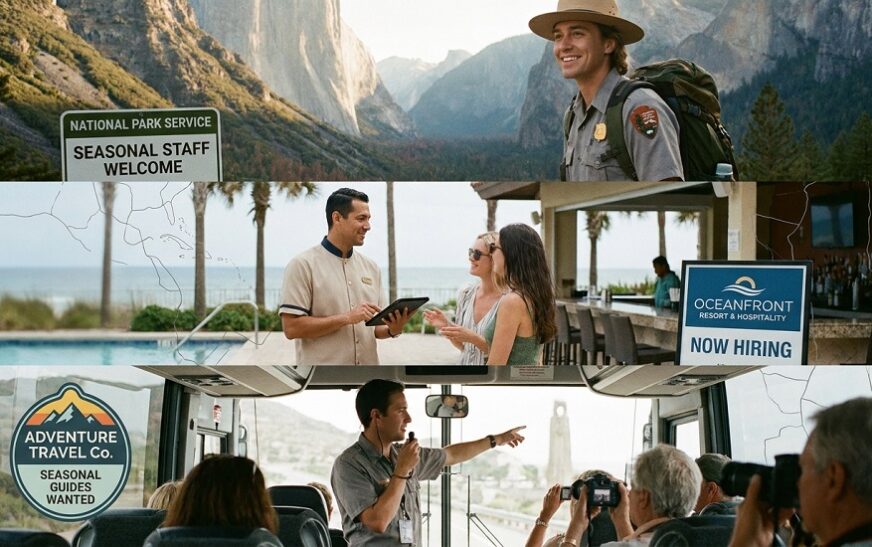
Seasonal tourism jobs provide a flexible way to enter hospitality, travel, outdoor recreation, tourism, and destination management. These positions are concentrated around periods of peak visitor demand, creating opportunities for people who want short-term work, seasonal income, travel experiences, or a pathway into permanent hospitality careers.
A seasonal tourism job can mean working at a national park lodge during summer, joining a ski resort for the winter season, working at a dude ranch, supporting a tourist attraction, or helping a destination handle peak-season visitors.
Seasonal employment can also become a career strategy. Employees who return to the same resort or destination over multiple seasons can build supervisory experience and progress toward year-round management roles.
This guide covers seasonal tourism jobs, summer resort jobs, ski resort careers, national park employment, seasonal hospitality work, CoolWorks, national park concessionaires, Vail Resorts, dude ranch jobs, seasonal cruise opportunities, and paths from seasonal employment into tourism management. For a broader look at the hospitality and travel career ecosystem across all sectors, explore our comprehensive guide.
What Are Seasonal Tourism Jobs?
Seasonal tourism jobs are positions tied to predictable periods of increased visitor activity.
Common peak seasons include:
- Summer vacation
- Winter ski season
- Holiday travel
- Spring tourism
- Fall foliage
- Festival periods
- Cruise seasons
- National park visitation periods
Employers use seasonal workers to increase staffing when visitor demand rises.
Seasonal jobs can be:
- Full-time
- Part-time
- Temporary
- Contract-based
- Live-in
- Seasonal-to-permanent
For those looking to turn seasonal work into a long-term career, entry-level hospitality positions often serve as the foundation for year-round management roles.
The exact employment arrangement depends on the employer.
Types of Seasonal Tourism Jobs
Seasonal tourism offers many different entry points.
Hotels and Lodges
- Front Desk Agent
- Housekeeper
- Guest Services Agent
- Night Auditor
- Lodge Supervisor
- Assistant Manager
Food and Beverage
- Server
- Bartender
- Line Cook
- Dishwasher
- Café Worker
- Restaurant Supervisor
Outdoor Recreation
- Lift Operator
- Ski Instructor
- Trail Crew
- Recreation Attendant
- Outdoor Guide
- Activity Coordinator
National Parks
- Visitor Services
- Campground Operations
- Lodge Staff
- Maintenance
- Interpretation
- Concessions
Ranches and Destination Resorts
- Guest Services
- Wrangler
- Activity Staff
- Housekeeping
- Food Service
- Hospitality Management
Seasonal Hospitality Work
Seasonal hospitality work is common in destinations where visitor demand fluctuates substantially.
Typical employers include the following:
- Mountain resorts
- National park lodges
- Beach resorts
- Lakeside resorts
- Wilderness lodges
- Dude ranches
- Tourist attractions
- Campgrounds
- Destination restaurants
A major advantage is that seasonal employees can gain hospitality experience without committing immediately to a long-term relocation or permanent position.
Summer Resort Jobs
Summer resorts can offer jobs in:
- Hotels
- Restaurants
- Recreation
- Golf
- Guest services
- Water activities
- Events
- Housekeeping
- Transportation
Summer employment is particularly attractive to:
- College students
- Recent graduates
- Career changers
- Travelers
- Hospitality beginners
Some employers provide housing, while others expect workers to arrange their own accommodation.
Applicants should always confirm housing terms before accepting an offer.
Ski Resort Seasonal Career
Winter ski resorts create demand for:
- Lift operators
- Ski instructors
- Guest services
- Restaurants
- Hotels
- Rental shops
- Ticketing
- Transportation
- Maintenance
- Retail
- Event staff
The industry can provide both entry-level seasonal jobs and professional management careers.
Ski Resort Seasonal Salary
Ski resort pay varies by
- Job type
- Resort
- Experience
- Location
- Skill level
- Tips
- Housing
- Season length
A tipped food-service job can have a very different income structure from a salaried resort supervisor.
Some resorts also provide employee benefits such as the following:
- Housing
- Transportation
- Recreation privileges
- Equipment discounts
- Meals
- End-of-season bonuses
These benefits can materially affect the value of a seasonal job.
Ski Resort Management Career
Seasonal resort work can become a management pathway.
A possible progression is the following:
Seasonal Associate → Lead → Supervisor → Department Manager → Resort Operations Manager
Professionals can specialize in:
- Lift operations
- Guest services
- Food and beverage
- Lodging
- Ski school
- Rental operations
- Retail
Returning for multiple seasons can help employees build trust and qualify for greater responsibility.
National Park Jobs USA
National parks provide several forms of seasonal employment.
Potential positions can include:
- Visitor services
- Interpretation
- Maintenance
- Campground operations
- Trails
- Recreation
- Administration
- Law enforcement
- Biological or scientific support
The National Park Service states that Glacier National Park, for example, hires approximately 350 summer seasonal positions across various disciplines, with its main employment season generally running from Memorial Day through Labor Day. Exact timing varies by position and location.
National park employment can therefore be an attractive option for professionals who want seasonal work in outdoor and tourism environments.
National Park Seasonal Employment
National park seasonal jobs can be available through:
- National Park Service
- Park concessionaires
- Hospitality operators
- Recreation contractors
- Transportation providers
- Nonprofit partners
Job requirements vary substantially.
Some roles prioritize customer service and practical experience, while others require the following:
- Specialized training
- Education
- Scientific expertise
- Safety qualifications
- Government hiring eligibility
National Park Concessionaire Jobs
Many visitor services within national parks are operated by concession companies rather than directly by the National Park Service.
Concessionaire roles can include:
- Hotels and lodges
- Restaurants
- Retail
- Transportation
- Tours
- Guest services
- Housekeeping
These employers can provide a relatively accessible route into national-park hospitality.
Applicants should determine whether a vacancy is with the federal government or a private concession operator because the hiring process can be different.
Glacier National Park Summer Employment
Glacier National Park provides a useful example of seasonal tourism employment.
The National Park Service indicates that the park’s main employment season generally runs from Memorial Day through Labor Day, although some positions begin earlier or extend later.
Seasonal work can involve:
- Visitor services
- Maintenance
- Operations
- Recreation
- Hospitality-related support
Some jobs involve irregular hours, including:
- Weekends
- Holidays
- Evenings
Candidates should evaluate job location and housing arrangements carefully because seasonal destinations can have limited local housing.
CoolWorks Seasonal Job Platform
CoolWorks is one of the most recognizable platforms for people looking for jobs in destination environments.
Its listings cover:
- National parks
- Ski resorts
- Summer resorts
- Dude ranches
- Lodges
- Camps
- Outdoor recreation
CoolWorks currently organizes jobs by
- Season
- State
- National park
- Employer type
- Housing availability
- Job type
Its current listings include both summer and winter positions, including resort, lodge, food-service, administrative, and outdoor roles.
How to Use CoolWorks
Job seekers can improve results by filtering for the following:
- Employer housing
- National parks
- Summer jobs
- Winter jobs
- Specific states
- Resort jobs
- Administrative positions
Read listings carefully for:
- Start date
- End date
- Housing costs
- Meals
- Transportation
- Work schedule
- Required experience
Seasonal jobs can fill quickly, particularly at popular destinations.
Vail Resorts Seasonal Hiring
Large ski resort operators provide seasonal opportunities in areas such as
- Lift operations
- Ski school
- Rentals
- Guest services
- Food and beverage
- Lodging
- Retail
- Transportation
- Mountain operations
Vail Resorts is one example of a major operator with seasonal and year-round positions.
Current seasonal hiring can vary by mountain and season, so applicants should monitor the company’s official careers site.
Vail Resorts Seasonal Careers
Working for a large resort group can provide more than a single season of employment.
Employees may gain experience in:
- Guest services
- Resort operations
- Food and beverage
- Mountain operations
- Retail
- Leadership
Returning employees may have opportunities to move into supervisory and management positions.
Large resort employers can also provide mobility between properties.
Dude Ranch Summer Jobs
Dude ranches combine hospitality, tourism, outdoor recreation, food service, and guest programming.
Seasonal jobs may include:
- Guest services
- Wrangler
- Trail guide
- Housekeeping
- Kitchen staff
- Ranch activities
- Maintenance
- Front desk
- Hospitality management
Dude ranch work can be a strong fit for people who enjoy outdoor environments and guest interaction.
Dude Ranch Career Path
A seasonal employee can progress through:
Seasonal Staff → Lead → Supervisor → Guest Experience Manager → Ranch Operations Manager
Experienced employees can return for multiple seasons and develop:
- Leadership
- Guest-service skills
- Activity coordination
- Team management
- Hospitality operations
This can become a long-term destination-hospitality career.
Seasonal Lodge Manager Career
Lodge management is one of the more advanced seasonal tourism roles.
A seasonal lodge manager may oversee the following:
- Front desk
- Housekeeping
- Food service
- Maintenance
- Guest experience
- Staffing
- Inventory
- Local vendors
Because the property operates during a defined season, managers may also be responsible for:
- Pre-opening
- Hiring
- Training
- Seasonal shutdown
- Inventory closeout
This creates a unique combination of hospitality operations and seasonal planning.
Seasonal Lodge Manager Path
A possible progression is the following:
Guest Services → Supervisor → Assistant Manager → Lodge Manager → Regional or Year-Round Hospitality Management
Professionals can strengthen their advancement prospects through:
- Budgeting
- Staff leadership
- Revenue management
- Guest experience
- Property systems
- Multi-department knowledge
Seasonal Travel Work
Seasonal travel jobs appeal to people who want to combine employment with exploration.
Common destinations include:
- National parks
- Ski towns
- Resort beaches
- Mountain communities
- Island destinations
- Ranches
- Wilderness areas
- Tourist towns
The major advantage is proximity to the destination.
The major challenge is often housing.
Housing for Seasonal Workers
Housing can be one of the most important factors when evaluating seasonal employment.
Employer arrangements may include:
- Dorm-style housing
- Shared apartments
- Employee lodges
- Cabins
- Subsidized housing
- Housing referrals
Some seasonal jobs provide no housing at all.
Before accepting an offer, confirm:
- Monthly housing cost
- Security deposit
- Room-sharing rules
- Utilities
- Transportation
- Housing availability
- Distance from the worksite
A seasonal job with free housing can have a substantially different economic value from one requiring expensive local rent.
Seasonal Tourism Pay
Seasonal compensation varies widely.
Potential pay structures include the following:
- Hourly wages
- Salaries
- Tips
- Commissions
- Bonuses
- Piece-rate compensation
- Housing benefits
Some jobs may pay relatively modest wages but provide the following:
- Housing
- Meals
- Recreation
- Transportation
These benefits can materially reduce living expenses.
Seasonal Hospitality Salary vs. Permanent Work
Seasonal jobs are not automatically lower-paying.
However, total annual income depends on:
- Length of season
- Hourly rate
- Weekly hours
- Overtime
- Tips
- Bonuses
- Unemployment or off-season plans
A worker earning a strong weekly income for four months still needs to plan for the remaining months.
Peak Season Hospitality Hiring
Hospitality employers often increase recruiting before expected peak demand.
Recruitment timing can vary by destination.
Summer Destinations
Hiring can begin months before summer operations.
Ski Resorts
Winter hiring often begins well before opening day.
National Parks
Hiring can align with seasonal visitor patterns and federal or concessionaire staffing calendars.
Holiday Destinations
Hotels and attractions may recruit ahead of major holiday periods.
The earlier a candidate applies, the more options may be available.
When to Apply for Seasonal Jobs
A practical rule is to apply several months before the desired start date.
For example:
Summer Jobs
Begin searching during winter or early spring.
Ski Season
Start applying during late summer and early fall.
Holiday Tourism
Search well before the peak holiday period.
Exact timing depends on the employer, so candidates should monitor listings rather than rely only on a fixed calendar.
Cruise Line Seasonal Deck Jobs
Cruise employment can also operate around contract periods, but shipboard work is different from traditional seasonal destination employment.
Potential deck or marine-related roles include the following:
- Deck utility
- Maritime operations
- Marine support
- Maintenance
- Safety
- Specialized deck positions
Many shipboard roles require specific maritime qualifications or experience.
Cruise applicants should distinguish between the following:
- Guest-service jobs
- Hotel jobs
- Marine jobs
- Technical positions
because requirements can be very different.
Seasonal Tourism Jobs for Students
Seasonal tourism is particularly suitable for students because employment can fit around academic schedules.
Potential options include:
- Summer resorts
- National parks
- Camps
- Tourist attractions
- Restaurants
- Hotels
- Outdoor recreation
Benefits can include:
- Work experience
- Income
- Networking
- Travel
- Resume development
Students interested in hospitality management can use seasonal employment to test different departments before committing to a career specialization.
Seasonal Resort Jobs for College Students
College students can target:
- Front desk
- Guest services
- Food and beverage
- Recreation
- Events
- Ski resort positions
- Resort activities
Students should evaluate whether housing is available, because many resort communities have limited rental inventory.
Seasonal Jobs for Career Changers
Seasonal employment can also function as a low-risk career experiment.
For example:
A professional considering hospitality management could work one season at a resort.
Someone interested in tourism could join a national-park concessionaire.
A person interested in event management could work at a destination resort.
This creates an opportunity to test the industry before committing to a permanent career change.
Seasonal Tourism Jobs Without Experience
Many seasonal tourism positions emphasize the following:
- Reliability
- Customer service
- Availability
- Adaptability
- Physical ability
- Willingness to learn
Potential beginner positions include:
- Housekeeping
- Food service
- Front desk
- Retail
- Guest services
- Recreation support
- Campground operations
Previous hospitality experience can help but is not always required.
Seasonal Tourism Career Advancement
Seasonal work can become a career when employees intentionally build responsibility.
The progression can look like:
Seasonal Associate → Lead → Supervisor → Manager → Regional or Year-Round Role
Returning for another season can be valuable because returning employees already understand:
- Property systems
- Guest expectations
- Work routines
- Safety procedures
- Destination operations
Employers may therefore trust experienced returning workers with greater responsibility.
Seasonal Employee to Full-Time Hospitality Career
A seasonal role can become permanent when the employer has year-round operations.
Possible transitions include:
Summer Resort → Year-Round Hotel
National Park Lodge → Regional Hospitality Company
Ski Resort → Multi-Season Resort
Seasonal Restaurant → Permanent Restaurant Group
Employees should communicate career goals with managers early enough to be considered for future positions.
Seasonal Tourism Resume
A seasonal resume should emphasize the following:
- Availability
- Previous seasonal work
- Customer service
- Physical work
- Guest interaction
- Teamwork
- Relevant certifications
- Leadership
For returning seasonal workers, show progression.
For example:
Summer 2025: Guest Services Associate
Summer 2026: Guest Services Lead
That demonstrates advancement.
Seasonal Tourism Job Interview
Employers often want to know the following:
Can you commit to the entire season?
Seasonal employers depend on staffing through the peak period.
Are you comfortable with destination living?
Remote destinations may have fewer conveniences.
Can you handle irregular schedules?
Peak-season hospitality may involve weekends and holidays.
Do you have housing?
If employer housing is not provided, this can become a practical issue.
Can you work in a team?
Seasonal teams often live and work closely together.
Reliable answers can strengthen an applicant’s chances.
National Park Seasonal Work vs. Resort Work
| National Park | Resort |
| Outdoor and visitor-focused | Hospitality and recreation |
| Federal or concession employer | Private employer common |
| Park mission and visitor services | Guest experience and revenue |
| Remote locations common | Destination communities |
| Seasonal visitor cycles | Summer or winter peak |
| Housing can be limited | Employer housing more common at some resorts |
Both can provide valuable destination-based experience.
Seasonal Tourism Jobs and Housing
Housing should be treated as part of the compensation package.
For each job, calculate:
Net seasonal income = wages + tips + bonuses + housing value − housing cost − transportation − food and other work-related costs
This produces a much clearer comparison.
An $18-per-hour job with subsidized housing may be financially stronger than a $22-per-hour job requiring expensive local rent.
Seasonal Work Benefits
Potential benefits include the following:
- Accommodation
- Meals
- Recreation access
- Discounted activities
- Employee travel
- Training
- End-of-season bonuses
- Networking
Not every employer provides these benefits, so candidates should verify them in writing.
Challenges of Seasonal Tourism Work
Seasonal jobs can involve:
- Irregular schedules
- Limited housing
- Remote locations
- Physical work
- Long shifts
- High guest volume
- Temporary employment
- Income gaps between seasons
People should have a plan for the off-season if the job does not transition into year-round work.
Building a Two-Season Career
Some professionals build careers by following tourism seasons.
For example:
Summer resort → Winter ski resort
or:
National park summer → Seasonal winter resort
This can create almost year-round destination employment.
Professionals can use the strategy to:
- Travel
- Build diverse experience
- Develop leadership
- Avoid long unemployment gaps
A two-season career can be particularly attractive to people who prioritize lifestyle and travel.
Seasonal Tourism Career Skills
Useful skills include:
- Guest service
- Hospitality
- Communication
- Teamwork
- Problem-solving
- Adaptability
- Scheduling
- Sales
- Food service
- Outdoor recreation
Management candidates should add the following:
- Budgeting
- Staff supervision
- Inventory
- Revenue
- Hiring
- Training
Seasonal Tourism Technology
Even seasonal tourism businesses use technology for:
- Reservations
- Point of sale
- Scheduling
- Ticketing
- Guest communication
- Inventory
- Property management
Employees who learn these systems can become more valuable and may have an easier time transitioning into permanent hospitality positions.
Seasonal Tourism Jobs and Career Mobility
Seasonal work can lead to broader careers in:
- Hotel management
- Resort operations
- Event management
- Tourism
- Guest experience
- Food and beverage
- Travel
- Destination management
The key is to treat seasonal jobs as experience-building opportunities rather than isolated short-term positions.
Best Seasonal Tourism Jobs
The right job depends on the goal.
Want an Outdoor Experience?
National parks, ranches, ski resorts, and recreation jobs.
Want hotel management?
Lodge, resort, front desk, and guest services roles.
Want food and beverage?
Seasonal restaurants, resort dining, and lodge kitchens.
Want Adventure Travel?
Outdoor guiding, recreation, and destination activity roles.
Want Management Experience?
Seasonal supervisor and lodge-management positions.
Want Travel Flexibility?
Jobs with employer housing and defined seasonal contracts.
Key Takeaways
- Seasonal tourism jobs are concentrated around predictable visitor peaks such as summer, winter ski season, holidays, and destination-specific tourism periods.
- National parks, ski resorts, lodges, dude ranches, camps, tourist attractions, and destination restaurants all hire seasonal workers.
- CoolWorks is a major seasonal-job platform with current listings spanning national parks, ski resorts, lodges, ranches, and other destination employers.
- Glacier National Park states that it hires roughly 350 summer seasonal positions, with its main season generally running from Memorial Day through Labor Day.
- Vail Resorts and other major resort operators provide seasonal opportunities across guest services, mountain operations, lodging, food and beverage, transportation, and retail.
- Housing can be one of the most important economic factors when comparing seasonal jobs, particularly in remote resort and national-park destinations.
- Seasonal employment can provide an entry point into hospitality management, tourism, recreation, and destination operations.
- Returning for multiple seasons can accelerate advancement because experienced employees already know the property and operational environment.
- A two-season strategy can allow professionals to combine summer tourism work with winter resort employment.
- Seasonal jobs can be useful for students, career changers, and people who want to test hospitality or tourism before committing to permanent employment.
- Seasonal employees should evaluate wages, tips, housing, meals, transportation, schedule, contract length, and off-season income rather than focusing on hourly pay alone.
Frequently Asked Questions
What are the best seasonal tourism jobs?
Popular options include national park jobs, ski resort work, summer resort positions, lodge jobs, dude ranch employment, tourism attractions, and seasonal food and beverage roles.
When should I apply for seasonal tourism jobs?
Start several months before the season. Summer employers often recruit during winter and spring, while ski resorts may begin recruiting in late summer and fall.
Are seasonal tourism jobs good for beginners?
Yes. Many positions prioritize reliability, customer service, availability, and willingness to learn rather than extensive industry experience.
Does CoolWorks offer seasonal jobs?
Yes. CoolWorks specializes in jobs in destination environments and currently lists opportunities across national parks, resorts, ski areas, ranches, lodges, camps, and other seasonal employers.
Do national parks hire seasonal workers?
Yes. The National Park Service and park concessionaires hire seasonal employees in visitor services, maintenance, recreation, hospitality, and other functions. Individual parks have different hiring schedules.
Does Glacier National Park hire summer employees?
Yes. Glacier National Park states that it hires approximately 350 summer seasonal positions, with the main season generally running from Memorial Day through Labor Day.
Do ski resorts provide housing?
Some do, but housing availability and cost vary significantly. Applicants should verify whether housing is guaranteed, subsidized, shared, or unavailable.
Can seasonal resort jobs become permanent careers?
Yes. Employees can transition into year-round hotel, resort, tourism, or management roles, especially when they return for multiple seasons and develop leadership experience.
Is seasonal tourism work good for college students?
It can be. Summer resorts, national parks, attractions, restaurants, and recreation businesses offer work that can fit academic schedules.
Can I work two tourism seasons in one year?
Yes. Some professionals combine summer destination employment with winter ski-resort work, creating a nearly continuous seasonal career.
How much do seasonal tourism jobs pay?
Pay varies substantially by job, destination, employer, tips, experience, and season. Housing and other benefits can materially change the effective value of an offer.
Is seasonal tourism work a good career?
It can be a strong career strategy for people who enjoy travel, hospitality, outdoor environments, and destination living. Professionals seeking long-term advancement should look for seasonal roles that offer leadership and year-round mobility.
Conclusion
Seasonal tourism jobs provide more than temporary employment. They can offer a practical entry into hospitality, tourism, recreation, destination management, and resort operations while allowing employees to experience different parts of the country.
National parks, ski resorts, lodges, dude ranches, tourist attractions, and destination businesses all create seasonal opportunities. Platforms such as CoolWorks can make these positions easier to discover, while major resort operators and national-park employers maintain their own recruitment channels.
The biggest financial consideration is often housing. A seasonal destination may offer exciting work but have limited or expensive accommodation. Candidates should compare total compensation, housing, meals, transportation, tips, bonuses, and season length rather than looking only at hourly wages.
For long-term career development, the most effective strategy is to use seasonal employment deliberately. Return for multiple seasons, take on leadership responsibilities, learn property systems, and develop transferable hospitality skills.
A seasonal position can then become a bridge to supervisor, lodge manager, resort operations, hotel management, tourism, or destination-leadership careers rather than remaining a series of short-term, unrelated jobs.