

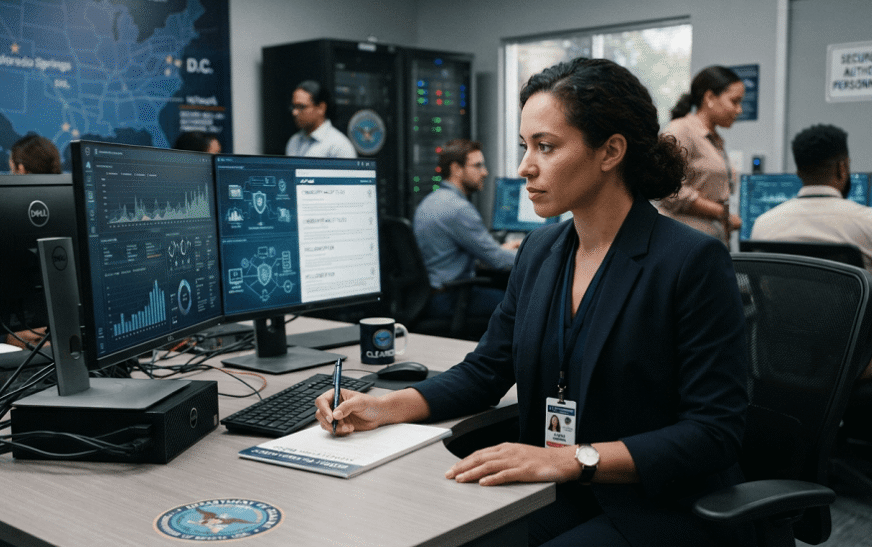
Security clearance is one of the most valuable career assets in the United States job market. Thousands of positions across the federal government, military, intelligence community, and defense industry require employees to access classified information. Because obtaining and maintaining a clearance involves an extensive background investigation, qualified candidates are often in high demand and can earn significantly higher salaries than professionals in comparable non-cleared roles.
Security-cleared professionals work on projects that support national defense, cybersecurity, intelligence gathering, aerospace, law enforcement, diplomacy, and advanced technology. These careers exist not only within federal agencies but also with private defense contractors that partner with the U.S. government.
Whether you’re interested in becoming an intelligence analyst, cybersecurity engineer, software developer, systems administrator, investigator, linguist, or project manager, understanding how the clearance process works is essential for building a successful career.
This guide explains the different levels of security clearance, how to qualify, the hiring process, salary expectations, and the industries offering the best opportunities for cleared professionals, and for a complete overview of the broader government employment landscape, explore our comprehensive guide.
What Are Security Clearance Jobs?
Security clearance jobs are positions that require employees to access classified or sensitive government information as part of their official duties.
These jobs are commonly found in:
- Federal government agencies
- Intelligence organizations
- Military support organizations
- Defense contractors
- Aerospace companies
- Cybersecurity firms
- Federal law enforcement
- National laboratories
- Homeland security organizations
- Government technology contractors
Applicants cannot usually apply for a clearance independently. Instead, an employer or government agency sponsors the clearance as part of the hiring process, and for a detailed breakdown of the government hiring process, including background investigations and security clearance procedures, explore our application guide.
Why Security-Cleared Professionals Are in High Demand
Government agencies continue expanding investments in cybersecurity, artificial intelligence, space technology, intelligence operations, and national defense.
This creates sustained demand for professionals with active clearances because employers avoid the cost and time required to sponsor new investigations.
Benefits of holding an active clearance include:
- Higher salaries
- More job opportunities
- Faster hiring
- Greater career mobility
- Access to specialized projects
- Increased demand from defense contractors
- Strong long-term career stability
Many employers actively recruit candidates who already possess an active clearance, and beyond higher salaries, cleared professionals also enjoy comprehensive government benefits, including retirement pensions and health insurance.
Types of Security Clearances
The U.S. government generally issues several levels of personnel security clearance depending on the sensitivity of the information involved.
Confidential Clearance
Typically required for positions involving information that could cause damage to national security if disclosed.
Secret Clearance
A secret clearance allows access to information that could cause serious damage to national security if improperly disclosed.
Many positions within:
- Department of Defense
- Military branches
- Defense contractors
- Homeland Security
- Federal law enforcement
require secret clearance.
Top Secret (TS)
Top Secret clearance is granted to employees requiring access to highly sensitive classified information.
TS positions often involve:
- Intelligence analysis
- National security
- Defense operations
- Advanced research
- Cybersecurity
- Military planning
TS/SCI (Top Secret / Sensitive Compartmented Information)
TS/SCI is among the highest and most sought-after security credentials.
Professionals with TS/SCI frequently work in:
- Intelligence agencies
- National security operations
- Advanced defense programs
- Signals intelligence
- Counterterrorism
- Space operations
- Cyber operations
Because of its extensive investigation requirements, TS/SCI holders often receive significant salary premiums.
Industries Hiring Cleared Professionals
Security-cleared employees work across numerous sectors.
Major employers include:
- Defense
- Aerospace
- Intelligence
- Cybersecurity
- Information Technology
- Engineering
- Telecommunications
- Federal Consulting
- Scientific Research
- Homeland Security
Many private-sector organizations perform classified government work and hire thousands of cleared professionals annually.
Common Security Clearance Careers
Popular, clear career paths include the following:
- Cybersecurity Analyst
- Software Engineer
- Systems Administrator
- Intelligence Analyst
- Data Scientist
- Network Engineer
- Cloud Engineer
- Program Manager
- Electrical Engineer
- Mechanical Engineer
- Linguist
- Counterintelligence Specialist
- Security Specialist
- Financial Analyst
- Procurement Specialist
Both technical and non-technical professionals can build successful careers in cleared environments.
Secret Clearance Careers
A secret clearance supports opportunities across many occupations.
Common secret-cleared positions include
- IT Support Specialist
- Logistics Coordinator
- Defense Analyst
- Financial Management Analyst
- Acquisition Specialist
- Contract Specialist
- Human Resources Specialist
- Engineering Technician
- Cybersecurity Technician
- Communications Specialist
Many professionals begin with secret clearance before advancing to top secret or TS/SCI positions.
Defense Contractor Jobs
Defense contractors employ hundreds of thousands of professionals supporting government missions.
Typical job functions include:
- Engineering
- Software Development
- Artificial Intelligence
- Cloud Computing
- Cybersecurity
- Logistics
- Project Management
- Intelligence Analysis
- Systems Integration
- Program Management
These organizations often offer salaries that exceed comparable government positions while allowing employees to support national security initiatives.
Intelligence Community Careers
The U.S. Intelligence Community consists of multiple organizations responsible for collecting, analyzing, and protecting national security information.
Career areas include:
- Intelligence Analysis
- Cyber Operations
- Foreign Language Analysis
- Geospatial Intelligence
- Signals Intelligence
- Human Intelligence Support
- Counterterrorism
- Counterintelligence
- Data Analytics
- Information Assurance
Many intelligence careers require Top Secret or TS/SCI eligibility.
Security Clearance Salary Premium
Professionals with active clearances frequently earn higher salaries than similarly qualified employees without clearances.
Salary premiums are influenced by:
- Clearance level
- Technical specialization
- Geographic location
- Years of experience
- Industry demand
- Government contract requirements
Employers often pay a premium because replacing cleared professionals can take many months.
TS/SCI Clearance Salary Premium
A Top Secret/Sensitive Compartmented Information (TS/SCI) clearance is one of the most valuable credentials in the U.S. job market. Because obtaining and maintaining this level of clearance requires extensive background investigations and, in many cases, additional security screening, employers often offer higher compensation to attract qualified candidates.
Factors that influence the salary premium include:
- Clearance level
- Technical expertise
- Years of experience
- Contract requirements
- Geographic location
- Demand for specialized skills
- Active versus inactive clearance status
Professionals working in cybersecurity, cloud computing, software engineering, intelligence analysis, artificial intelligence, and systems engineering often see the greatest compensation advantages.
Security Clearance Process Timeline
The clearance process varies depending on the required clearance level, agency, workload, and the complexity of an applicant’s background.
A typical process includes:
- Receive a conditional job offer.
- Employer sponsors the clearance.
- Complete required security forms.
- Submit fingerprints.
- Background investigation begins.
- Employment, education, and reference verification.
- Financial and criminal history review.
- Interview(s), if required.
- Adjudication.
- Final clearance determination.
Applicants with straightforward backgrounds often complete the process more quickly than those requiring additional investigation or adjudication.
Polygraph Jobs
Some national security positions require applicants to complete a polygraph examination as part of the security clearance process.
These positions commonly exist within:
- Intelligence agencies
- Counterintelligence programs
- Counterterrorism operations
- National security organizations
- Highly classified defense programs
The polygraph is typically used alongside background investigations and other screening methods rather than as a standalone evaluation.
Defense Contractor Careers
Private companies play a critical role in supporting U.S. national security by providing technology, engineering, cybersecurity, logistics, intelligence, and consulting services.
Common career areas include:
- Software Engineering
- Cybersecurity
- Artificial Intelligence
- Data Science
- Cloud Architecture
- Network Engineering
- Intelligence Analysis
- Program Management
- Systems Engineering
- Logistics and Supply Chain
- Finance and Contracts
- Human Resources
Many defense contractors actively recruit candidates with active Secret or TS/SCI clearances to support classified government programs.
NSA, CIA & FBI Clearance Jobs
Several federal agencies employ professionals in positions requiring security clearances.
Examples include:
National Security Agency (NSA)
Common career fields:
- Cybersecurity
- Computer Science
- Data Analytics
- Signals Intelligence
- Engineering
- Mathematics
- Foreign Languages
Central Intelligence Agency (CIA)
Career opportunities include:
- Intelligence Analysis
- Operations
- Technology
- Cybersecurity
- Science and Engineering
- Language Services
- Security
Federal Bureau of Investigation (FBI)
The FBI hires professionals in:
- Special Agent Careers
- Intelligence Analysis
- Cybersecurity
- Digital Forensics
- Accounting
- Information Technology
- Legal Support
- Administrative Services
Each agency has unique hiring requirements, and many positions require applicants to obtain and maintain a security clearance.
DISA Contractor Jobs
The Defense Information Systems Agency (DISA) supports secure communications, enterprise IT infrastructure, cybersecurity, and network services for the Department of Defense.
Contractors supporting DISA commonly work in:
- Cybersecurity
- Cloud Computing
- Network Engineering
- Systems Administration
- Software Development
- Enterprise Architecture
- Information Assurance
- Project Management
Many of these positions require secret or top-secret eligibility.
Common Reasons for Security Clearance Denial
Receiving a security clearance is not automatic. During the adjudication process, investigators evaluate whether an applicant can be trusted with access to classified information.
Potential concerns may include:
- Deliberate falsification of information
- Serious criminal conduct
- Significant unresolved financial issues
- Foreign influence or conflicting foreign interests
- Illegal drug involvement
- Security violations
- Misuse of information systems
- Failure to cooperate during the investigation
- Pattern of poor judgment or reliability
Each case is evaluated individually under the federal government’s adjudicative guidelines, considering both the concern and any mitigating factors.
Booz Allen Hamilton Careers
Booz Allen Hamilton is one of the largest consulting firms supporting U.S. government agencies and defense organizations.
Professionals commonly work in areas such as:
- Cybersecurity
- Artificial Intelligence
- Data Analytics
- Digital Engineering
- Cloud Computing
- Defense Consulting
- Intelligence Support
- Mission Engineering
- Software Development
- Enterprise Technology
Many roles either require an active security clearance or the ability to obtain one after hiring.
Security Clearance Levels Comparison
| Clearance Level | Typical Access | Common Employers |
| Confidential | Information that could cause damage to national security if disclosed | Federal agencies, military support roles |
| Secret | Information that could cause serious damage to national security | Department of Defense, defense contractors, Homeland Security |
| Top Secret | Highly sensitive classified information | Intelligence agencies, advanced defense programs |
| TS/SCI | Sensitive Compartmented Information and highly classified programs | Intelligence Community, national security organizations, specialized defense contractors |
Career Progression for Cleared Professionals
Many professionals build long-term careers by advancing through increasingly specialized and leadership-focused positions.
- Entry-Level Government or Contractor Role
- Obtain Security Clearance
- Technical or Operational Specialist
- Senior Engineer / Intelligence Analyst / Program Lead
- Project or Team Manager
- Senior Program Manager
- Executive Leadership or Government Advisory Roles
Maintaining an active clearance while continuously developing technical and leadership skills can significantly expand career opportunities.
Future Outlook for Security Clearance Careers
Demand for security-cleared professionals is expected to remain strong as government agencies and defense contractors continue investing in the following:
- Artificial intelligence
- Cybersecurity
- Cloud modernization
- Space operations
- Critical infrastructure protection
- Quantum technologies
- Secure communications
- Digital transformation
- Intelligence analysis
- National defense modernization
Professionals with in-demand technical skills and active security clearances are likely to remain highly sought after across both government agencies and private-sector defense organizations.
How to Build a Successful Security Clearance Career
A security clearance can become one of the strongest long-term career advantages in both the public and private sectors. Since many government agencies and defense contractors prefer candidates who already hold an active clearance, maintaining eligibility and continuously developing your skills can open doors to higher-paying and more specialized roles.
1. Choose an In-Demand Career Field
While security clearances are required across many occupations, some fields consistently experience the highest demand.
High-growth, cleared career paths include
- Cybersecurity
- Cloud Computing
- Software Engineering
- Artificial Intelligence & Machine Learning
- Data Science
- Systems Engineering
- Intelligence Analysis
- Information Assurance
- Network Engineering
- Program & Project Management
- Acquisition & Contract Management
- Finance & Budget Analysis
Combining technical expertise with an active clearance often leads to the strongest career prospects.
2. Maintain Clearance Eligibility
Receiving a clearance is only the beginning. Employees are expected to maintain the trust required to access classified information throughout their careers.
Best practices include:
- Report required life changes promptly.
- Protect classified and sensitive information.
- Follow employer security policies.
- Maintain financial responsibility.
- Avoid illegal drug use.
- Be truthful during investigations and reinvestigations.
- Complete required security training.
- Report foreign travel or contacts when required by your agency.
Maintaining good personal and professional conduct helps preserve clearance eligibility.
3. Continue Developing Technical Skills
Many cleared positions involve rapidly evolving technologies.
Skills that can strengthen your career include:
- Cloud platforms
- Cybersecurity frameworks
- Secure software development
- Data analytics
- Artificial intelligence
- Digital forensics
- Linux administration
- DevSecOps
- Networking
- Risk management
- Project management
- Technical communication
Professional certifications and continuing education can make you more competitive for senior cleared roles.
4. Consider Both Government and Contractor Opportunities
A security clearance provides flexibility to work in different environments.
Government Agencies
Advantages include:
- Long-term career stability
- Structured promotion systems
- Comprehensive federal benefits
- Pension and retirement programs
- Public service mission
Defense Contractors
Advantages include:
- Competitive salaries
- Performance bonuses
- Exposure to cutting-edge technologies
- Opportunities to work across multiple government programs
- Faster career progression in some organizations
Many professionals move between government agencies and contractors throughout their careers while maintaining their clearance.
5. Network Within the Cleared Community
Professional relationships often play an important role in finding new opportunities.
Consider participating in:
- Industry conferences
- Cybersecurity events
- Government technology forums
- Professional associations
- Veteran networking organizations
- Clearance-focused career fairs
- Employer recruiting events
Building a professional network can help you learn about upcoming projects and hiring opportunities.
6. Plan for Long-Term Career Growth
Security-cleared careers often provide opportunities to move into leadership, consulting, and executive positions.
Potential long-term paths include the following:
- Technical Lead
- Program Manager
- Security Manager
- Chief Information Security Officer (CISO)
- Director of Cybersecurity
- Intelligence Program Manager
- Defense Consultant
- Federal Executive
- Chief Technology Officer (CTO)
Combining leadership experience with specialized technical knowledge can significantly increase career opportunities.
Key Takeaways
- Security clearance jobs are available across federal agencies, the Intelligence Community, military organizations, and private defense contractors.
- Secret, Top Secret, and TS/SCI clearances provide access to increasingly sensitive information and often lead to higher-paying career opportunities.
- Employers sponsor security clearances as part of the hiring process; individuals generally cannot apply for a clearance independently.
- Careers in cybersecurity, cloud computing, engineering, intelligence, software development, and data science remain among the most in-demand cleared professions.
- Maintaining personal integrity, financial responsibility, and compliance with security requirements is essential for keeping an active clearance.
Frequently Asked Questions
Can I apply for a security clearance on my own?
No. In most cases, a U.S. government agency or an authorized contractor must sponsor you for a security clearance as part of a qualifying job.
What is the difference between secret and TS/SCI clearance?
A secret clearance provides access to information that could cause serious damage to national security if disclosed, while top secret/sensitive compartmented information (TS/SCI) is required for access to highly classified intelligence and compartmented programs.
Do security clearance jobs pay more?
Often, yes. Because cleared professionals are in limited supply and difficult to replace, employers frequently offer salary premiums, especially for candidates with active Top Secret or TS/SCI clearances and specialized technical skills.
How long does it take to obtain a security clearance?
The timeline varies depending on the clearance level, the applicant’s background, and the sponsoring agency. Some investigations are completed relatively quickly, while more complex cases may take considerably longer.
Can a security clearance be denied?
Yes. Clearance eligibility may be denied for reasons such as deliberate falsification of information, serious criminal conduct, unresolved financial issues, illegal drug involvement, or other concerns identified during the adjudication process. Each case is reviewed individually using federal adjudicative guidelines.
Which industries hire security-cleared professionals?
Major employers include federal government agencies, intelligence organizations, defense contractors, aerospace companies, cybersecurity firms, engineering companies, and technology consulting organizations supporting classified government programs.
Do I lose my clearance if I change jobs?
Not necessarily. If you move to another qualifying employer that requires the same level of clearance, your eligibility may be transferred or reactivated depending on agency policies and the length of time since you last held an active clearance.
Are security clearance careers expected to grow?
Yes. Continued investment in cybersecurity, artificial intelligence, cloud modernization, defense technology, and national security is expected to sustain strong demand for qualified cleared professionals.
Conclusion
Security clearance careers offer some of the most stable and rewarding opportunities in the U.S. workforce. Whether you’re interested in supporting national defense, advancing cybersecurity initiatives, contributing to intelligence operations, or working on cutting-edge technology programs, an active clearance can significantly expand your career options. By understanding the clearance process, maintaining eligibility, and continuously developing in-demand skills, you can position yourself for long-term success in both government agencies and the private defense sector.