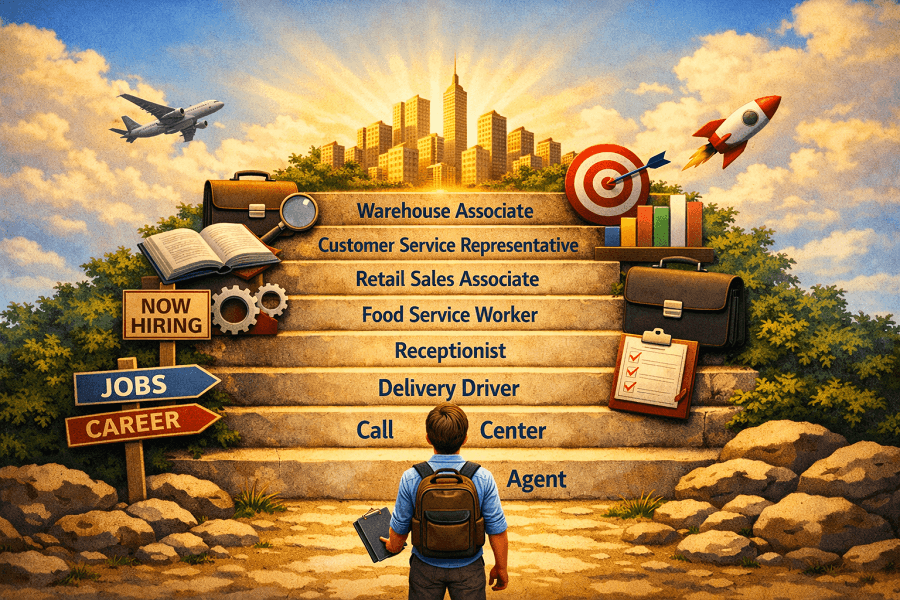


Small businesses are a major part of the U.S. economy and an important source of career opportunities.
A small business career can mean working for a local company, managing a small team, joining a family business, becoming a business operator, acquiring an existing company, or launching an independent venture.
Small businesses exist across nearly every industry:
- Construction
- Healthcare
- Professional services
- Retail
- Hospitality
- Technology
- Manufacturing
- Transportation
- Accounting
- Marketing
- Automotive services
- Skilled trades
The career experience can differ dramatically from working for a large corporation. Employees at small companies may take on broader responsibilities, interact directly with owners, and gain exposure to multiple parts of the business.
For entrepreneurs, small-business ownership provides another route: instead of building a career inside someone else’s organization, you build and manage the organization yourself. For a comprehensive guide to self-employed tax and legal setup for small business owners, including business structure, deductions, and quarterly taxes, explore our detailed guide.
The U.S. Small Business Administration’s February 2026 data identify 36.2 million small businesses, representing 99.9% of U.S. firms and employing 62.3 million private-sector workers. Small businesses account for 45.9% of private-sector employment and approximately 43.5% of GDP.
This guide covers small business careers, working at small businesses in the USA, SMB career options, small-business management, ownership, local and Main Street careers, family businesses, franchise careers, owner income, financing, failure and survival rates, SCORE mentorship, accounting, and career advancement. For a broader look at the self-employment and entrepreneurship landscape, explore our comprehensive guide.
What Is a Small Business Career?
A small-business career is a job or ownership path within an independently operated company that falls within applicable small-business size standards.
For research purposes, the SBA Office of Advocacy generally defines a small business as an independent business with fewer than 500 employees, although industry-specific size standards vary for federal programs.
Small business careers can include the following:
- Entry-level employees
- Skilled professionals
- Supervisors
- Generalists
- Department managers
- Operations managers
- Sales leaders
- Business owners
- Family-business successors
The defining feature is not a particular occupation.
It is the size and independence of the organization.
Working at a Small Business in the USA
Working for a small business can provide a different experience from working at a large corporation.
Employees may have opportunities to:
- Work directly with leadership
- Handle multiple functions
- Make decisions earlier
- See business results directly
- Develop broad skills
- Build customer relationships
- Move into management quickly
The tradeoff can be fewer formal layers, fewer specialized departments, and less standardized career progression.
Small Business vs Large Corporation
| Small Business | Large Corporation |
| Broader responsibilities | More specialized roles |
| Direct owner access | Formal management hierarchy |
| Faster decision-making | More structured processes |
| Potentially faster responsibility growth | More formal promotion ladders |
| Fewer organizational layers | More internal mobility |
| Wider skill exposure | Greater specialization |
| Company-specific benefits | Often broader benefit infrastructure |
Neither model is universally better.
A small company can be ideal for someone who wants breadth and ownership.
A large company can be better for someone who wants formal training, specialization, and established career structures.
SMB Career Options
Small and medium-sized businesses employ professionals across nearly every function.
Operations
- Operations coordinator
- Operations manager
- General manager
- Business operations specialist
Finance
- Bookkeeper
- Accountant
- Controller
- Finance manager
Sales
- Sales representative
- Account manager
- Sales manager
- Business-development specialist
Marketing
- Marketing coordinator
- Digital marketer
- Content specialist
- Marketing manager
Technology
- IT support
- Systems administrator
- Software developer
- Technology consultant
Human Resources
- HR coordinator
- Recruiter
- HR manager
- People-operations specialist
Customer Experience
- Customer-success specialist
- Customer-service manager
- Client-services manager
Small Business Generalist Career
One of the biggest advantages of a small company is the opportunity to become a generalist.
A professional may work across the following:
- Sales
- Marketing
- Operations
- Finance
- Technology
- Customer service
This can accelerate business knowledge.
A generalist who learns how different functions connect can eventually become the following:
Operations Manager → General Manager → Business Owner
Small Business Management Career
Small-business management often requires broader responsibility than managing one department at a large organization.
A manager may oversee the following:
- Employees
- Scheduling
- Customers
- Vendors
- Budgets
- Inventory
- Sales
- Operations
Potential progression can be
Supervisor → Department Manager → Operations Manager → General Manager → Owner
Small Business Operations Career
Operations professionals help the business deliver its products or services efficiently.
Responsibilities may include:
- Scheduling
- Procurement
- Inventory
- Quality
- Staffing
- Process improvement
- Customer fulfillment
Operations can be especially valuable in businesses with physical locations, field teams, inventory, or recurring service delivery.
Small Business General Manager
A general manager may function as the operational leader of a small company or location.
Responsibilities can include:
- Revenue
- Staffing
- Costs
- Customer experience
- Vendor management
- Sales
- Performance metrics
The GM role can be an excellent stepping stone toward ownership.
Small Business Sales Careers
Sales can provide an unusually direct view of how a small company makes money.
Sales professionals may manage the following:
- Lead generation
- Prospecting
- Proposals
- Negotiation
- Customer acquisition
- Account expansion
Because revenue is highly visible in a small organization, strong sales results can quickly lead to greater responsibility.
Small Business Marketing Careers
Marketing roles in small businesses can be highly generalist.
A marketer might manage the following:
- Website
- SEO
- Social media
- Advertising
- Events
- Content
- Analytics
This creates broad experience but also requires self-direction.
A small-business marketer can eventually move into the following:
Marketing Manager → Growth Lead → Fractional Consultant → Agency Owner
Small Business Accountant Career
Accounting is essential to small-business operations.
Small businesses may hire the following:
- Bookkeepers
- Staff accountants
- Tax professionals
- Controllers
- Fractional CFOs
An accountant working with small businesses can gain exposure to:
- Payroll
- Accounts receivable
- Accounts payable
- Financial statements
- Taxes
- Cash flow
- Budgeting
That broad exposure can create a path into advisory work or accounting-firm ownership.
Small Business Technology Careers
Small companies increasingly depend on technology but may not have large internal IT teams.
Potential roles include:
- IT support
- Systems administrator
- Cloud consultant
- Cybersecurity consultant
- Software developer
- Managed-service provider technician
Small-business technology work can provide broad exposure because one professional may handle multiple systems.
Local Business Career
Local businesses can provide careers connected to the community.
Examples include:
- Restaurants
- Retailers
- Contractors
- Clinics
- Automotive shops
- Professional services
- Local manufacturers
- Hospitality businesses
These businesses often depend heavily on local reputation, customer relationships, and repeat demand.
Main Street Business Career
“Main Street” businesses typically serve local customers directly.
Careers can include:
- Retail management
- Restaurant management
- Local marketing
- Accounting
- Skilled trades
- Hospitality
- Customer service
- Operations
The advantage is that employees can often see the direct relationship between their work and the local customer base.
Local Business Career Stability
Local business stability depends on factors such as the following:
- Customer demand
- Location
- Industry
- Cash flow
- Competition
- Owner management
- Economic conditions
A local business can be deeply established and resilient, but it can also be vulnerable to the following:
- Rent increases
- Local downturns
- Labor shortages
- Customer concentration
- Owner dependence
“Small” does not automatically mean unstable.
Family Business Career USA
Family businesses can provide career opportunities that differ from traditional employment.
Potential paths include the following:
Entry-Level Employee → Manager → Family Business Leadership → Ownership
Family-business professionals may gain experience across the following:
- Operations
- Finance
- Sales
- Leadership
- Succession planning
Some family businesses have multiple generations involved.
Family Business Succession
Succession can involve:
- Children
- Other relatives
- Long-term employees
- External executives
- Buyers
Successful succession requires planning around:
- Ownership
- Leadership
- Governance
- Finances
- Skills
- Family relationships
Joining a family business should be treated as a professional career decision, not simply a family obligation.
Family Business vs Corporate Career
A family business can provide:
- Strong ownership exposure
- Direct decision-making
- Long-term relationship building
- Potential future ownership
A corporate career may provide:
- Formal training
- Defined compensation bands
- Benefits
- Multiple internal roles
- More standardized promotion systems
The better choice depends on the individual’s goals.
Small Business Ownership
Owning a small business is one of the most direct entrepreneurship paths.
Common ownership models include the following:
- Starting from scratch
- Buying an existing company
- Becoming a partner
- Family succession
- Franchise ownership
Ownership can provide greater control but also greater financial responsibility.
Small Business Owner Career
A business owner may simultaneously be
- CEO
- Salesperson
- Recruiter
- Finance manager
- Operations manager
- Customer-service leader
This is why entrepreneurship requires broad skills.
As the company grows, the owner’s role may gradually become more strategic.
Small Business Owner Income
There is no universal “small business owner salary.”
Owner income depends on the following:
- Revenue
- Profit margin
- Industry
- Business size
- Debt
- Owner compensation
- Reinvestment
- Number of employees
A business generating $1 million in revenue can provide very different owner income from another business with the same sales.
Revenue vs Owner Income
Consider two companies:
Business A
- $1 million revenue
- $850,000 operating costs
- $150,000 profit
Business B
- $1 million revenue
- $600,000 operating costs
- $400,000 profit
Both have identical revenue.
They have completely different economic outcomes.
For ownership decisions, focus on:
Profit + Cash Flow + Business Value
not revenue alone.
Small Business Owner Compensation
Owners may receive economic value through:
- Salary
- Draws
- Distributions
- Retained earnings
- Business appreciation
Tax treatment varies by business structure.
A business can also reinvest profit rather than distributing it.
Small Business Career to Ownership
Employees can gradually move toward ownership by learning the following:
- Sales
- Finance
- Operations
- Hiring
- Customer acquisition
- Pricing
One potential progression is the following:
Employee → Manager → General Manager → Partner → Owner
Another is:
Employee → Industry Expert → Independent Consultant → Business Owner
Buying a Small Business
Buying an existing business can reduce certain startup risks because the company may already have:
- Customers
- Revenue
- Employees
- Equipment
- Suppliers
- Brand recognition
But buyers must evaluate the following:
- Financial statements
- Customer concentration
- Debt
- Owner dependence
- Lease terms
- Legal liabilities
- Employee retention
- Market conditions
An existing business is not automatically a safer investment.
Starting vs Buying a Small Business
| Starting | Buying |
| Lower historical valuation complexity | Existing financial history |
| Full creative control | Existing systems |
| Can start cheaply | Requires purchase capital |
| No inherited problems | May inherit problems |
| Customer acquisition starts at zero | Existing customer base may exist |
| Longer validation period | Due diligence required |
The right approach depends on available capital, skills, and risk tolerance.
Franchise Career vs Independent Business
Franchising provides a standardized business system from a franchisor.
Potential advantages include the following:
- Established brand
- Operating systems
- Training
- Marketing support
Potential disadvantages include the following:
- Franchise fees
- Royalties
- Contract restrictions
- Required suppliers
- Less independence
An independent business provides more control but requires the owner to build the system.
Franchise Career
Franchise ownership can be attractive for professionals who prefer the following:
- Structured operations
- Recognized branding
- Established customer acquisition
- Proven processes
Potential sectors include the following:
- Food
- Fitness
- Home services
- Cleaning
- Automotive
- Education
The economics vary substantially by franchise.
Review the franchisor’s disclosure documents before investing.
Franchise vs Independent Business
Choose a franchise when:
- You value systems.
- You prefer an established brand.
- You are comfortable following operating standards.
Consider an independent business when:
- You want maximum control.
- You have a strong differentiated concept.
- You want to keep the business highly flexible.
Small Business Failure Rate by Year
Small-business failure should not be summarized using one dramatic percentage.
BLS survival data show that business survival varies by the year businesses were born, geography, industry, and economic conditions.
For example, BLS historical data show five-year survival rates for selected startup cohorts ranging from approximately 49.8% for establishments born in 2006 to 57.3% for those born in 2018.
This means roughly half of those selected cohorts were no longer operating at age five, but the exact rate depends on the cohort and definition used.
One-Year Small Business Survival
One-year survival rates are generally much higher than five-year rates.
BLS business-employment data track survival patterns by establishment age and location rather than treating all businesses as a single homogeneous group.
When evaluating “failure rates,” distinguish between the following:
- Business closure
- Business failure
- Voluntary exit
- Sale
- Merger
- Dormancy
Closing a business does not necessarily mean the owner experienced catastrophic financial failure.
Why Small Businesses Fail
Common causes can include:
- Insufficient demand
- Poor cash flow
- Excessive debt
- Underpricing
- Weak financial controls
- High fixed costs
- Poor management
- Customer concentration
- Economic downturns
Strong planning does not eliminate risk, but it can reduce avoidable mistakes.
Small Business Career Stability
For employees, stability depends heavily on the health of the employer.
Assess:
- Revenue trend
- Profitability
- Customer concentration
- Cash reserves
- Industry demand
- Owner involvement
- Debt
During interviews, candidates can ask about:
- Growth
- Hiring plans
- Turnover
- Business model
- Investment
- Career progression
Career Growth in Small Businesses
Small companies may lack formal career ladders, but advancement can sometimes happen faster.
An employee may move from the following:
Coordinator → Specialist → Manager
in fewer steps than at a large corporation.
The tradeoff is that there may be fewer senior positions overall.
Negotiating Career Growth at a Small Business
Employees can ask for expanded responsibility rather than waiting for a new title.
For example:
“I would like to take ownership of customer onboarding and reporting.”
Then measure:
- Completion
- Revenue impact
- Time saved
- Customer satisfaction
Results can create leverage for:
- Promotion
- Raises
- Bonuses
- Leadership responsibilities
Small Business Employee Benefits
Benefits vary widely.
Potential benefits include the following:
- Health insurance
- Retirement plans
- Paid time off
- Bonuses
- Flexible schedules
- Professional development
Some small businesses may offer fewer benefits than large employers.
Others compete through:
- Flexible work
- Direct access to leadership
- Performance incentives
- Faster advancement
Compare the complete package.
Small Business Career vs Corporate Career
A useful decision framework is the following:
Choose Small Business if:
You value:
- Variety
- Autonomy
- Direct impact
- Broad skills
- Close leadership access
Choose Corporate if:
You value:
- Specialization
- Formal training
- Structured promotion
- Large-scale resources
- Internal mobility
Neither should be judged solely by salary.
Small Business Work-Life Balance
Work-life balance depends heavily on the specific owner and management culture.
A small business can offer:
- Flexible schedules
- Personal relationships
- Direct communication
But small teams can also mean the following:
- Fewer people to cover absences
- Broader responsibilities
- Higher dependency on individual employees
Ask about actual expectations rather than relying on company size.
Small Business Career Skills
Valuable skills include the following:
- Customer service
- Sales
- Financial literacy
- Operations
- Project management
- Communication
- Problem solving
- Technology
- Leadership
Cross-functional ability is often highly valuable.
Small Business Leadership Career
Leadership in a small business often means being close to execution.
Managers may need to:
- Solve customer problems
- Cover staffing gaps
- Review finances
- Negotiate vendors
- Improve processes
This makes small-business leadership highly practical.
Small Business Operations Manager
An operations manager may oversee the following:
- Staffing
- Scheduling
- Inventory
- Quality
- Vendors
- Customer experience
The role can be particularly valuable in:
- Restaurants
- Retail
- Construction
- Manufacturing
- Distribution
- Healthcare services
Small Business HR Career
Human-resources work can be broad in a small company.
An HR professional may manage:
- Recruiting
- Onboarding
- Benefits
- Payroll coordination
- Performance
- Policies
- Training
The role can prepare professionals for broader people-operations leadership.
Small Business Finance Career
Finance roles can include:
- Bookkeeping
- Accounting
- FP&A
- Cash-flow management
- Tax coordination
- Controller responsibilities
A small-business finance professional may have direct visibility into the entire financial system.
Small Business Accountant Career Path
A potential path is:
Bookkeeper → Accountant → Senior Accountant → Controller → Fractional CFO / Advisor
Accounting professionals can also move into:
- Business ownership
- Tax practice
- Consulting
Small Business Marketing Career Path
A possible path is:
Marketing Coordinator → Marketing Manager → Growth Lead → Fractional Marketing Consultant
Because small businesses often need generalists, marketers may gain experience across many channels.
Small Business Sales Career Path
A possible path is:
Sales Representative → Account Manager → Sales Manager → General Manager → Owner
Strong sales professionals can become attractive acquisition or ownership candidates because they understand revenue generation.
Small Business Technology Career Path
A technician can progress through the following:
IT Support → Systems Administrator → IT Manager → Technology Consultant
A small business may also allow one professional to become responsible for:
- Cloud
- Networking
- Security
- Devices
- Software
- Vendors
This can build broad technical capability.
Main Street Business Ownership
Main Street businesses can offer ownership paths in sectors such as the following:
- Restaurants
- Retail
- Personal services
- Trades
- Auto repair
- Hospitality
- Professional services
The primary advantage is often direct customer demand.
The primary challenge is often operational intensity.
Small Business Financing
Small business owners may use the following:
- Personal savings
- Business revenue
- Bank financing
- SBA-backed financing
- Investor capital
- Equipment financing
- Business credit
Financing should be matched to the use of funds.
Do not use long-term debt to cover recurring losses without a credible turnaround plan.
SBA Loan Career Start
The SBA does not generally lend money directly for ordinary startup financing; rather, it supports participating lenders through loan programs and guarantees.
SBA lending programs can support qualifying small businesses for uses such as the following:
- Working capital
- Equipment
- Real estate
- Expansion
Terms and eligibility vary by program and borrower.
Entrepreneurs should review current SBA programs and participating lenders before taking on debt.
Small Business Funding Strategy
Before borrowing, calculate:
- Amount needed
- Purpose
- Repayment capacity
- Interest cost
- Expected return
- Downside scenario
Debt should support a business model that can realistically repay it.
SCORE Mentorship Program
SCORE provides free, confidential mentoring to aspiring and existing U.S.-based business owners through one-on-one sessions and other educational resources. SCORE describes its mentors as experienced business professionals who provide guidance on topics including startup planning, growth, finance, marketing, and operations.
SCORE can be useful for:
- Business validation
- Business plans
- Pricing
- Marketing
- Financial planning
- Growth strategy
- Succession planning
The mentoring is available remotely or in person in U.S. states and territories.
Small Business Mentorship
A good mentor can help identify blind spots.
Useful mentor questions include:
- Is the business model viable?
- Is pricing high enough?
- Which costs are unnecessary?
- How much working capital is needed?
- Which customer segment is strongest?
- What should the owner do next?
The entrepreneur remains responsible for decisions.
Small Business Career Development
Employees and owners should continuously build the following:
- Financial literacy
- Leadership
- Digital skills
- Customer understanding
- Sales ability
- Process improvement
A small business career can become much more valuable when technical expertise is combined with business knowledge.
Small Business and AI
The SBA’s February 2026 data show that AI adoption among businesses remains relatively early, with 7.6% of businesses reporting AI use between September 2024 and August 2025. Small businesses with fewer than five employees had an 8.2% usage rate, while businesses with more than 250 employees had an 11.4% rate.
This creates opportunities for small-business professionals who can implement the following:
- Automation
- Customer-service AI
- Marketing workflows
- Accounting tools
- Analytics
- Productivity systems
Technology adoption can become a career differentiator.
Small Business Technology Career
Technology professionals who understand small-business constraints can provide value through:
- Low-cost automation
- Cybersecurity
- Cloud migration
- CRM implementation
- Website development
- Data reporting
The strongest technology solutions are often those that solve a specific business problem without creating unnecessary complexity.
Small Business Cybersecurity Career
Small businesses can need cybersecurity support but may lack large internal security teams.
Potential services include:
- MFA
- Endpoint security
- Backups
- Access management
- Security awareness
- Vulnerability management
- Incident-response planning
This creates opportunities for:
- MSPs
- Cybersecurity consultants
- IT providers
- Security specialists
Small Business Consultant Career
Consultants can help small companies with:
- Operations
- Finance
- Marketing
- Technology
- HR
- Strategy
A small-business consultant often needs to be practical.
Owners generally want:
Problem → Recommendation → Implementation → Result
rather than lengthy theoretical analysis.
Local Business Entrepreneurship
Local entrepreneurs can build businesses around unmet regional needs.
Examples include:
- Home services
- Healthcare services
- Food
- Transportation
- Childcare
- Elder-care services
- Specialty retail
- Repair businesses
The local advantage can come from:
- Customer trust
- Reviews
- Community reputation
- Geographic convenience
Small Business Customer Acquisition
Small businesses may rely on:
- Referrals
- Local SEO
- Reviews
- Social media
- Paid advertising
- Partnerships
- Community events
A strong local business often becomes an acquisition engine through repeat customers and referrals.
Local SEO Career
Local SEO specialists help businesses appear for searches such as the following:
- Plumber near me
- Best restaurant in [city]
- Accountant in [city]
Key areas include:
- Google Business Profile
- Reviews
- Local landing pages
- Citations
- Local links
- Customer reputation
This creates an entrepreneurial niche for digital marketers.
Small Business Career in the Trades
Skilled trades provide strong examples of employee-to-owner progression.
For example:
Apprentice → Journeyman → Lead → Contractor → Business Owner
Potential fields include:
- Electrical
- Plumbing
- HVAC
- Construction
- Welding
- Landscaping
- Roofing
The trade creates technical expertise.
Business skills create ownership potential.
Small Business Career in Hospitality
Hospitality businesses can provide paths such as the following:
Server → Supervisor → General Manager → Regional Manager / Owner
Potential roles include:
- Restaurant manager
- Hotel manager
- Event manager
- Guest-services manager
- F&B manager
Hospitality often rewards professionals who combine customer experience with operational discipline.
Small Business Career in Healthcare
Healthcare small businesses can include the following:
- Independent practices
- Dental offices
- Therapy practices
- Home-care businesses
- Medical services
- Health-related professional services
Roles vary according to licensing requirements.
Small Business Career in Professional Services
Professional-service businesses can include:
- Accounting
- Legal services
- Consulting
- Marketing
- Recruiting
- Engineering
These businesses can often be started with less physical infrastructure than retail or manufacturing.
Small Business: Career Stability vs Ownership
Employee stability and business-owner stability are different.
An employee depends on the following:
Employer health
An owner depends on:
Business health
An owner may have greater control but also greater exposure.
This makes cash reserves and risk management essential.
Small Business Succession and Exit
Owners should eventually consider:
- Who will lead the company?
- Is the business transferable?
- Are processes documented?
- Are financial statements clean?
- Does the business depend entirely on the owner?
A business that cannot operate without its founder may have lower transferable value.
Small Business Career Advancement
Employees can pursue advancement by taking ownership of measurable outcomes.
Examples:
- Reduce costs
- Increase revenue
- Improve retention
- Automate processes
- Improve scheduling
- Reduce errors
Owners can pursue advancement through:
- Hiring
- Expansion
- New locations
- New products
- Acquisitions
- Process automation
Choosing a Small Business Career
Want Broad Experience?
Join a growing small company.
Want Management?
Target operations or general-management roles.
Want entrepreneurship?
Join a business where you can learn the entire operating model.
Want Family Ownership?
Evaluate succession opportunities carefully.
Want Structure?
Consider a franchise.
Want Independence?
Start or acquire an independent business.
Want Professional Expertise?
Consider accounting, consulting, technology, or specialized services.
Key Takeaways
- Small-business careers include employee, management, ownership, family-business, franchise, and entrepreneurial paths.
- The SBA reports 36.2 million U.S. small businesses, with small businesses representing 99.9% of firms and employing 62.3 million private-sector workers as of its February 2026 profile.
- Small businesses account for 45.9% of private-sector employment and approximately 43.5% of GDP, demonstrating their importance to the U.S. economy.
- Small companies can offer broader responsibilities and faster responsibility growth than large corporations, although formal promotion systems may be less developed.
- Small-business management careers can progress through supervision, operations management, general management, partnership, and ownership.
- Family-business careers can create paths to future ownership, but succession, governance, and professional expectations should be addressed explicitly.
- Franchise ownership offers a standardized operating model and established brand, while independent ownership provides greater control but requires the entrepreneur to build the system.
- Small-business owner income is not equivalent to revenue. Profit, cash flow, owner compensation, and business value provide a more useful picture.
- BLS survival data show that business survival varies significantly by cohort and economic conditions. Historical five-year survival rates for selected cohorts ranged from roughly 49.8% to 57.3%.
- Small businesses can still create substantial career stability when they have recurring demand, healthy cash flow, diversified customers, and disciplined management.
- SCORE offers free business mentoring to U.S.-based aspiring and existing business owners, including remote or in-person mentoring.
- SBA resources can help entrepreneurs with business planning, startup preparation, funding, registration, and operating considerations.
- AI adoption among businesses is still relatively early, creating opportunities for professionals who can help small companies implement practical automation and technology.
- The strongest small-business career strategy combines industry skill + customer understanding + financial literacy + operational ability + leadership.
Frequently Asked Questions
What are small business careers?
Small-business careers include jobs and leadership roles within independently operated companies, as well as paths into ownership, family-business succession, franchising, and entrepreneurship.
Is working for a small business a good career?
It can be. Small companies can provide broader responsibilities, closer access to leadership, and faster skill development. The tradeoff can be fewer formal career ladders and benefits that vary more by employer.
How many small businesses are in the USA?
The SBA’s February 2026 profile reports approximately 36.2 million small businesses in the United States.
What percentage of U.S. businesses are small businesses?
The SBA reports that small businesses comprise 99.9% of U.S. firms.
How much does a small business owner make?
There is no standard owner salary. Income depends on business revenue, expenses, profitability, debt, owner compensation, reinvestment, and business structure.
What is the small-business failure rate?
There is no single universal annual failure rate. BLS survival data vary by business cohort, location, industry, and economic period. Historical five-year survival rates for selected cohorts ranged from approximately 49.8% to 57.3%.
Is a franchise better than an independent business?
Neither is universally better. A franchise provides an established system and brand but typically comes with fees and operating restrictions. An independent business provides greater control but requires the owner to build the operating model.
Can I go from employee to small business owner?
Yes. Common paths include employee → manager → general manager → partner → owner, or employee → specialist → independent operator → business owner.
Is a family business a good career?
It can be, especially when the business offers real responsibility and a credible succession plan. Treat the opportunity as a professional career and clarify compensation, authority, and ownership expectations.
What is SCORE?
SCORE is a nonprofit organization that provides free business mentoring, training, and resources for aspiring and existing U.S. small-business owners.
Is SCORE mentoring really free?
SCORE states that mentoring is free for the life of the business and is available through remote or in-person interactions.
Can I get an SBA loan to start a business?
SBA-backed financing can support qualifying businesses through participating lenders, but eligibility and financing terms vary by program and borrower. Review current SBA programs and lender requirements before borrowing.
What skills help small business managers?
Useful skills include financial literacy, sales, operations, customer service, employee management, technology, negotiation, and problem-solving.
Can accounting lead to small-business ownership?
Yes. Accountants can move from bookkeeping or accounting into controller, fractional-CFO, advisory, or accounting-practice ownership roles.
Can I work at a small business before becoming an entrepreneur?
Yes. Working inside a small business can be a practical way to learn sales, operations, finance, staffing, customer acquisition, and the economics of running a company before taking ownership risk.
Are local businesses stable careers?
Some are highly resilient, particularly when they have loyal customers and healthy financials. Others are vulnerable to local economic conditions. Assess the actual business rather than assuming every local company has the same stability.
Conclusion
Small-business careers provide one of the broadest pathways from employment to leadership and, eventually, ownership.
An employee can start in the following:
Sales → Operations → Finance → Marketing → Technology → Customer Service
and build enough cross-functional knowledge to become a manager or general manager.
From there, ownership can become an option:
Employee → Manager → Partner → Owner
A small-business career is particularly valuable for people who want to understand how organizations actually work.
Instead of seeing only one department, employees can see the following:
Customer → Sale → Delivery → Expense → Cash Flow → Profit
That understanding becomes especially powerful for future entrepreneurs.
The SBA’s 2026 data show just how large the small-business economy is: 36.2 million small businesses represent 99.9% of U.S. firms and employ 62.3 million private-sector workers.
The sector is large enough to support careers across nearly every industry.
However, small-business careers require realistic expectations.
Businesses can close, owners can struggle with cash flow, and career structures can be less formal than at large corporations. BLS survival data demonstrate that business survival changes across economic cycles and cohorts.
That makes financial literacy and operational skills extremely valuable.
For professionals considering ownership, there are several paths:
Start a company.
Buy an existing business.
Join a family business.
Buy a franchise.
Become a partner.
Each approach carries different levels of control, capital requirements, and risk.
Resources such as SCORE can reduce some of the information gap by providing free mentoring and practical business resources to entrepreneurs throughout the life of their business.
The most valuable small-business professionals are not necessarily the ones with the narrowest expertise.
They are often the people who can connect:
Customers + People + Operations + Technology + Finance
That combination can lead from an entry-level job to management, ownership, consulting, or entrepreneurship.
For anyone considering a career at a small business, the best question is not simply
“How much does this job pay?”
It is:
“What will I learn, what responsibility can I earn, and can this experience eventually give me leverage?”
That leverage may become management experience, industry expertise, business ownership, or the ability to start a company of your own.