
Transportation and trucking careers are a major part of the U.S. supply chain, moving freight between manufacturers, warehouses, distribution centers, retailers, ports, businesses, and consumers.
A trucking career can begin with commercial driving and develop into specialized freight, dispatching, fleet management, transportation operations, brokerage, compliance, or supply chain leadership. The industry also offers opportunities for people who do not want to drive, including logistics coordinators, freight brokers, dispatchers, fleet managers, transportation analysts, and compliance professionals.
For professionals researching transportation jobs, the field combines hands-on work with increasingly sophisticated technology. Modern fleets rely on transportation-management systems, GPS, telematics, electronic logging systems, route optimization, safety software, and real-time shipment data.
This guide covers CDL driver careers, trucking salaries, freight logistics, owner-operator income, transportation management, dispatching, freight brokerage, fleet management, intermodal logistics, last-mile delivery, and transportation compliance. For a broader look at the supply chain career ecosystem across all functions, explore our comprehensive guide.
What Is a Transportation Career?
Transportation careers focus on moving people or goods safely and efficiently.
In freight transportation, common activities include:
- Trucking
- Freight brokerage
- Dispatching
- Fleet management
- Transportation planning
- Routing
- Intermodal transportation
- Last-mile delivery
- Carrier management
- Transportation compliance
Transportation is closely connected to logistics and supply chain management, but it has its own specialized career paths, and for those interested in the warehouse side of the supply chain, warehouse and distribution operations offer complementary career opportunities that often coordinate closely with transportation functions.
Types of Transportation Jobs
The industry includes both frontline and professional positions.
Driving Careers
- Class A CDL Driver
- Regional Truck Driver
- Long-Haul Driver
- Local Delivery Driver
- Specialized Freight Driver
- Tanker Driver
- Flatbed Driver
Transportation Coordination
- Logistics Coordinator
- Dispatcher
- Transportation Coordinator
- Load Planner
- Routing Specialist
Commercial and Brokerage Roles
- Freight Broker
- Carrier Sales Representative
- Transportation Account Manager
- Freight Operations Specialist
Management
- Fleet Manager
- Transportation Manager
- Terminal Manager
- Dispatch Manager
- Logistics Manager
- Director of Transportation
Compliance and Safety
- DOT Compliance Specialist
- Fleet Safety Manager
- Transportation Compliance Manager
- Driver Qualification Specialist
Trucking Career
Truck driving remains one of the most visible transportation careers in the United States.
Heavy and tractor-trailer drivers typically need a commercial driver’s license and professional training. The work can include:
- Local routes
- Regional routes
- Long-haul routes
- Dedicated routes
- Specialized freight
- Retail distribution
- Manufacturing freight
- Food and beverage transportation
The best trucking path depends on lifestyle preferences, income goals, schedule flexibility, and tolerance for time away from home.
CDL Class A Driver Career
A Class A commercial driver’s license is widely associated with operating combination vehicles such as tractor-trailers.
Drivers pursuing a first Class A or Class B CDL generally have to meet federal and state requirements, including applicable entry-level driver training and testing requirements.
Before choosing a CDL program, candidates should verify:
- State licensing rules
- Training-provider registration
- Employer requirements
- Endorsements
- Medical requirements
- Driving-record standards
Requirements can vary by state and type of commercial driving.
CDL Driver Salary USA
Heavy and tractor-trailer truck drivers had a $57,440 median annual wage in May 2024, according to the U.S. Bureau of Labor Statistics.
Actual trucking compensation can differ substantially because drivers may be paid through the following:
- Mileage
- Hourly wages
- Percentage of freight revenue
- Per-load rates
- Bonuses
- Safety incentives
- Delivery incentives
- Overtime where applicable
BLS projects employment of heavy and tractor-trailer truck drivers to grow 4% from 2024 to 2034, with about 237,600 openings per year on average.
CDL Class A Salary USA
Class A driver compensation depends on the following:
- Experience
- Route type
- Freight type
- Geographic region
- Employer
- Driver status
- Schedule
- Endorsements
Long-haul, specialized, and dedicated routes can have different compensation structures from local delivery work.
Candidates should compare total annual earnings rather than only the advertised cents-per-mile or hourly rate.
Local vs. Regional vs. Long-Haul Trucking
| Career Type | Typical Lifestyle | Main Consideration |
| Local | Home more frequently | More frequent shifts |
| Regional | Regular multi-state routes | Moderate time away |
| Long-haul | Longer distances | More time away from home |
| Dedicated | Consistent customer or route | Predictability |
| Specialized | Specialized freight | Additional skills or requirements |
A higher-paying route is not automatically better if the schedule does not fit your lifestyle.
Long-Haul Trucking Career
Long-haul drivers transport freight across large geographic areas.
Potential advantages include the following:
- Broad travel experience
- Access to large freight networks
- Multiple employer options
- Potential compensation incentives
- Opportunities to specialize
Challenges can include:
- Time away from home
- Irregular schedules
- Long periods of driving
- Traffic
- Weather
- Parking constraints
- Physical fatigue
Long-haul trucking is best suited to people comfortable with an extended time-on-road lifestyle.
Owner-Operator Trucker Career
An owner-operator owns or leases a truck and operates as an independent transportation business.
Revenue can come from:
- Freight loads
- Dedicated contracts
- Brokered freight
- Specialized transportation
But gross revenue is not the same as personal income.
Owner-operators are responsible for expenses such as the following:
- Truck payments
- Fuel
- Maintenance
- Tires
- Insurance
- Permits
- Tolls
- Taxes
- Repairs
- Compliance
- Administrative costs
Owner-Operator Trucker Income
Owner-operator income can vary dramatically from one business to another.
Important factors include:
- Revenue per mile
- Deadhead miles
- Fuel prices
- Financing
- Maintenance
- Insurance
- Freight type
- Route selection
- Broker fees
- Truck utilization
A high gross-revenue figure can produce relatively modest take-home income when operating costs are high.
Anyone considering ownership should build a complete business budget rather than comparing gross load revenue with employee-driver salary.
Company Driver vs. Owner-Operator
| Company Driver | Owner-Operator |
| The employer provides the truck. | Owns or leases equipment |
| Lower business risk | Higher business risk |
| More predictable pay structure | Variable business revenue |
| The employer handles many operating costs | The owner pays operating expenses |
| Less administrative responsibility | More control |
| Limited equipment choice | Greater equipment control |
Company driving can be an effective way to build experience before considering ownership.
Freight Logistics Career
Freight logistics connects shippers, carriers, warehouses, brokers, and customers.
Professionals may coordinate:
- Pickup appointments
- Delivery schedules
- Carriers
- Documentation
- Freight rates
- Tracking
- Exceptions
- Customer communication
Freight logistics is a strong option for professionals who enjoy fast-paced coordination without driving commercially.
Logistics Coordinator Trucking Career
Transportation and logistics coordinators may spend much of the day managing shipment information and resolving exceptions.
Responsibilities can include:
- Scheduling pickups
- Tracking shipments
- Communicating with drivers
- Updating customers
- Handling delivery issues
- Managing documentation
- Coordinating carriers
Technology skills are increasingly important because transportation coordination is highly data-driven.
Truck Dispatcher Career
Dispatchers coordinate drivers, loads, routes, schedules, and customer requirements.
Typical responsibilities include:
- Assigning loads
- Communicating with drivers
- Monitoring routes
- Managing delivery schedules
- Handling delays
- Coordinating equipment
- Updating transportation systems
Dispatching can be an attractive career for people who enjoy logistics, communication, and rapid problem-solving.
Dispatcher Trucking Salary
Dispatcher compensation varies according to:
- Fleet size
- Geographic market
- Employer
- Experience
- Dispatch complexity
- Shift
- Industry
Some dispatchers work for carriers, while others work for private fleets, logistics companies, brokers, or third-party transportation providers.
Experience with transportation management systems can improve career mobility.
Freight Broker Career Path
Freight brokers connect shippers with transportation providers.
A freight broker may:
- Find carriers
- Quote freight
- Negotiate rates
- Coordinate shipments
- Monitor loads
- Communicate with customers
- Resolve service issues
The role combines sales, logistics, negotiation, and customer management.
How to Build a Freight Broker Career
Useful skills include:
- Sales
- Negotiation
- Customer service
- Freight pricing
- Carrier relationships
- Transportation knowledge
- Problem-solving
Professionals can start in:
- Logistics coordination
- Carrier sales
- Freight operations
- Customer service
and move into brokerage management or transportation sales leadership.
Freight Broker Income
Freight brokers can be compensated through salary, commission, or combinations of both depending on the employer and business model.
Independent brokers operate differently from employees because they carry business expenses and revenue risk.
Income can be affected by:
- Freight volume
- Customer acquisition
- Margin
- Lane knowledge
- Carrier network
- Market conditions
A strong broker understands both the customer’s transportation needs and the carrier’s operating economics.
Fleet Manager Career
Fleet managers oversee a company’s vehicles, drivers, maintenance, and transportation performance.
Responsibilities may include:
- Vehicle utilization
- Driver performance
- Maintenance coordination
- Safety
- Fuel management
- Scheduling
- Compliance
- Fleet costs
Fleet managers may work for:
- Trucking companies
- Private fleets
- Retailers
- Manufacturers
- Utilities
- Government organizations
- Construction companies
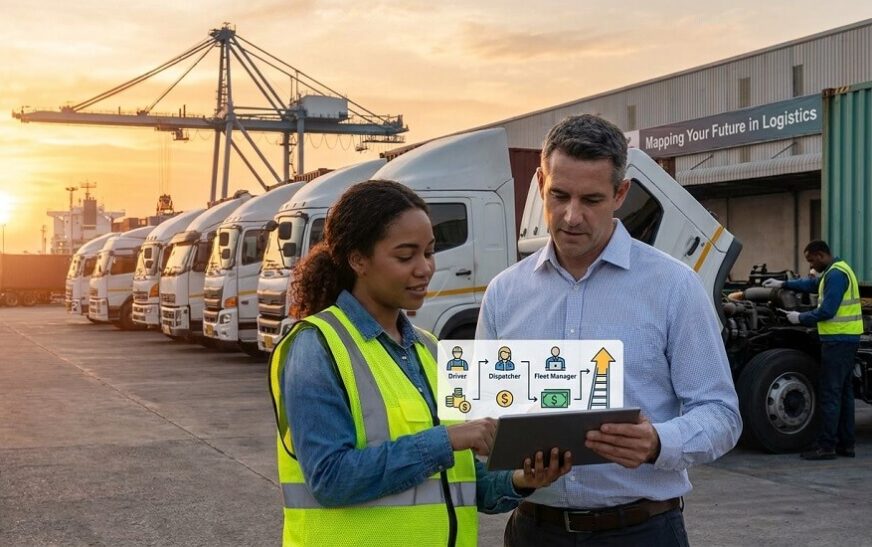
Fleet Manager Career Path
A fleet-management career can begin with the following:
- Dispatcher
- Transportation coordinator
- Fleet administrator
- Logistics specialist
From there, professionals can move into the following:
- Fleet supervisor
- Fleet manager
- Senior fleet manager
- Transportation manager
- Director of transportation
Knowledge of telematics and fleet-management software is increasingly valuable.
Transportation Manager Career
Transportation managers coordinate the movement of goods across a transportation network.
Their responsibilities may include:
- Carrier management
- Route planning
- Transportation budgets
- Fleet operations
- Driver management
- Service levels
- Compliance
- Performance reporting
BLS reported a $102,010 median annual wage for transportation, storage, and distribution managers in May 2024.
Employment in that broader management occupation is projected to grow 6% from 2024 to 2034.
Transportation Manager Skills
Strong transportation managers typically need the following:
- Logistics knowledge
- Budget management
- Carrier negotiation
- Data analysis
- Safety awareness
- Driver management
- Technology skills
- Communication
- Problem-solving
Senior managers increasingly need to understand how transportation decisions affect:
- Customer service
- Inventory
- Cash flow
- Cost
- Supply-chain resilience
Supply Chain Transportation
Transportation is a core function of supply chain management.
Transportation decisions affect:
- Freight costs
- Delivery speed
- Inventory
- Customer satisfaction
- Working capital
- Supplier reliability
Supply chain professionals with transportation expertise can move into the following:
- Transportation planning
- Logistics management
- Supply chain management
- Network design
- Procurement
- Operations management
Intermodal Logistics Career
Intermodal transportation combines multiple transportation modes, often using standardized containers.
Common combinations include:
- Truck and rail
- Truck and ocean
- Rail and ocean
- Truck, rail, and port operations
Intermodal professionals may coordinate:
- Containers
- Terminals
- Rail schedules
- Drayage
- Port movements
- Delivery appointments
This career area is especially relevant to professionals interested in large-scale freight networks.
Intermodal Logistics Jobs
Potential positions include the following:
- Intermodal Coordinator
- Drayage Coordinator
- Intermodal Operations Specialist
- Transportation Planner
- Terminal Operations Manager
- Intermodal Account Manager
Intermodal knowledge can open opportunities within ports, railroads, carriers, logistics providers, importers, and exporters.
Last-Mile Delivery Career
Last-mile logistics focuses on the final movement between a distribution point and the end customer.
Careers include:
- Delivery Operations Manager
- Route Planner
- Last-Mile Coordinator
- Dispatch Manager
- Delivery Driver
- Fleet Manager
- Last-Mile Analyst
E-commerce has made last-mile performance increasingly important because customers often expect the following:
- Fast delivery
- Accurate tracking
- Flexible time windows
- Easy returns
Last-Mile Logistics Management
Last-mile professionals manage challenges such as the following:
- Traffic
- Route density
- Driver availability
- Delivery windows
- Fuel
- Customer preferences
- Failed deliveries
Data and route-optimization technology can play an important role.
DOT Compliance Manager Trucking
Transportation companies need professionals who understand federal and state transportation requirements.
A DOT compliance professional may work on the following:
- Driver qualification
- Safety records
- Vehicle inspections
- Hours-of-service requirements
- Drug and alcohol testing programs
- Documentation
- Audits
- Compliance training
The exact responsibilities depend on the employer, fleet, and regulatory environment.
Transportation Compliance Career
Compliance professionals can work in:
- Trucking
- Logistics
- Private fleets
- Freight brokerage
- Intermodal transportation
- Warehousing
- Government transportation
Relevant skills include:
- Regulatory research
- Documentation
- Auditing
- Risk assessment
- Training
- Recordkeeping
Compliance can provide a path from transportation operations into specialized professional work.
Transportation Technology Careers
Modern transportation networks rely heavily on technology.
Common systems include:
- Transportation management systems
- GPS
- Telematics
- Electronic logging systems
- Fleet-management software
- Route optimization
- Freight-matching platforms
- Warehouse systems
Technology creates roles for professionals who understand both transportation operations and digital systems.
Transportation Management Systems Career
Transportation management systems help organizations:
- Plan shipments
- Select carriers
- Optimize routes
- Track freight
- Manage costs
- Analyze carrier performance
Potential career titles include:
- TMS Analyst
- Transportation Systems Analyst
- Logistics Systems Specialist
- Transportation Technology Manager
These positions can provide a bridge between transportation and supply chain technology.
Trucking Career Without Experience
Entry into trucking usually requires the appropriate commercial licensing and training rather than years of prior trucking experience.
Potential starting paths include:
- Truck-driving school
- Employer-sponsored training
- Entry-level company-driver positions
- Local delivery
- Regional driving
Candidates should investigate:
- Training costs
- Contract obligations
- Pay during training
- Equipment
- Home-time policy
- Benefits
- Advancement
The lowest initial pay is not necessarily the cheapest long-term career route if training conditions are poor.
Transportation Careers Without Driving
Driving is only one part of the transportation sector.
People who prefer office or operational careers can consider:
- Dispatcher
- Logistics coordinator
- Freight broker
- Fleet manager
- Transportation analyst
- Transportation planner
- Compliance specialist
- Carrier account manager
- Transportation manager
This makes transportation accessible to people with different strengths.
Transportation Career Advancement
Transportation professionals can develop along several paths.
Driver Path
Driver → Experienced Driver → Specialized Driver → Driver Trainer or Operations Role
Coordination Path
Coordinator → Senior Coordinator → Dispatcher → Transportation Supervisor
Management Path
Supervisor → Transportation Manager → Senior Manager → Director
Specialist Path
Transportation Analyst → TMS Specialist → Transportation Systems Manager
The best route depends on whether you prefer driving, coordination, analytics, technology, or leadership.
Transportation Career Skills
Important capabilities include:
- Route planning
- Freight coordination
- Dispatching
- Carrier management
- Data analysis
- Customer service
- Negotiation
- Safety
- Regulatory compliance
- Transportation software
For management positions, add:
- Budgeting
- Team leadership
- Performance management
- Strategic planning
- Network optimization
Transportation Jobs by Industry
Transportation professionals work across many industries.
| Industry | Transportation Focus |
| Retail | Distribution and delivery |
| Manufacturing | Raw materials and finished goods |
| E-commerce | Last-mile fulfillment |
| Food | Refrigerated and time-sensitive freight |
| Pharmaceuticals | Regulated transportation |
| Construction | Heavy equipment and materials |
| Automotive | Parts and finished vehicles |
| Energy | Specialized industrial freight |
| Government | Fleet and public logistics |
| Import/Export | Ports and intermodal transportation |
Industry specialization can influence schedule, compensation, and career progression.
CDL Endorsements and Specialization
Certain types of freight can require additional qualifications or endorsements.
Examples can include:
- Tank vehicles
- Hazardous materials
- Passenger vehicles
- Combination or specialized equipment
The requirements depend on the type of vehicle and cargo.
Drivers should confirm current federal and state rules before pursuing an endorsement.
Transportation Career and Lifestyle
Transportation careers can vary widely in schedule.
Possible arrangements include the following:
- Local daytime work
- Regional routes
- Overnight shifts
- Long-haul schedules
- Weekend schedules
- Rotating dispatch shifts
- On-call management
Lifestyle should be considered alongside compensation.
For drivers, the most important questions often include the following:
- How often will I be home?
- Who controls my route?
- How are delays handled?
- How is pay calculated?
- What are the equipment expectations?
- What happens during breakdowns?
How to Choose a Transportation Career
Prefer Driving?
Consider CDL and specialized trucking careers.
Prefer coordination?
Consider dispatch, logistics coordination, or freight brokerage.
Prefer sales?
Consider freight brokerage or carrier sales.
Prefer Technology?
Consider TMS, telematics, route optimization, or transportation analytics.
Prefer leadership?
Consider fleet, transportation, terminal, or logistics management.
Prefer regulation?
Consider DOT compliance and transportation safety.
Key Takeaways
- Transportation careers range from CDL driving and freight coordination to fleet management, brokerage, intermodal logistics, compliance, and senior transportation leadership.
- Heavy and tractor-trailer truck drivers had a $57,440 median annual wage in May 2024, with approximately 237,600 annual openings projected on average from 2024 to 2034.
- Transportation, storage, and distribution managers had a $102,010 median annual wage in May 2024.
- Owner-operator income must be evaluated after fuel, maintenance, insurance, truck financing, taxes, and other operating costs.
- Freight brokerage combines transportation knowledge with sales, negotiation, and customer management.
- Dispatching and logistics coordination provide transportation careers for professionals who do not want to drive.
- Fleet management combines transportation operations with safety, maintenance, driver management, and cost control.
- Intermodal transportation provides specialized careers connecting trucking with rail, ports, and other freight modes.
- Last-mile delivery is an important growth area because of e-commerce and customer expectations around delivery speed and tracking.
- DOT compliance provides a specialized path for professionals interested in regulations, safety, documentation, and risk.
- Transportation technology, including TMS, telematics, routing, and fleet software, is creating additional career opportunities at the intersection of logistics and technology.
Frequently Asked Questions
Is trucking a good career?
Trucking can be a strong career for people who value relatively direct entry into the transportation industry and are comfortable with driving, schedules, and time on the road. Lifestyle and compensation vary significantly by route and employer.
How much do CDL truck drivers make?
BLS reported a $57,440 median annual wage for heavy and tractor-trailer truck drivers in May 2024. Individual earnings vary according to route, freight, experience, employer, pay structure, and bonuses.
What is a Class A CDL?
A Class A CDL is a commercial driver’s license category associated with operating certain combination vehicles. Exact licensing and testing requirements depend on federal and state rules.
Is owner-operator trucking more profitable than being a company driver?
Not automatically. Owner-operators can generate higher gross revenue but also assume significant costs and business risks. Net income depends on freight rates, utilization, fuel, financing, maintenance, insurance, and other expenses.
What does a truck dispatcher do?
A dispatcher coordinates drivers, loads, routes, schedules, customers, and operational changes to keep freight moving efficiently.
How do I become a freight broker?
Common foundations include freight and logistics experience, sales ability, carrier relationships, and knowledge of transportation operations. Independent brokerage also requires understanding applicable registration, financial, and regulatory requirements.
What does a fleet manager do?
A fleet manager oversees vehicles, drivers, maintenance, safety, utilization, scheduling, and transportation costs.
Can transportation lead to supply chain management?
Yes. Experience in transportation can lead into logistics, supply chain planning, operations, network management, and broader supply chain leadership.
What is intermodal logistics?
Intermodal logistics coordinates freight using multiple transportation modes, often combining truck, rail, ocean, and terminal operations.
Can I work in transportation without becoming a truck driver?
Yes. Dispatching, logistics coordination, freight brokerage, transportation analysis, fleet management, compliance, and transportation management are all non-driving career paths.
Is transportation management a high-paying career?
Management-level transportation careers can provide strong compensation. BLS reported a $102,010 median annual wage for transportation, storage, and distribution managers in May 2024, although individual transportation-manager salaries vary substantially.
Conclusion
Transportation and trucking careers provide a wide range of entry points into the U.S. logistics and supply chain economy. Driving is the most visible path, but professionals can also build careers in dispatching, freight brokerage, fleet management, transportation planning, intermodal logistics, last-mile delivery, technology, compliance, and management.
For drivers, the right career choice depends heavily on route, home time, freight type, pay structure, equipment, and long-term goals. A company-driver position can be a practical way to build experience before considering specialized freight or owner-operator work.
For non-driving professionals, transportation offers equally diverse opportunities. Dispatchers and coordinators can progress into operations, while technology-oriented professionals can work with transportation-management systems, telematics, analytics, and route optimization.
The strongest long-term transportation careers combine operational knowledge with technology, safety, regulatory awareness, financial understanding, and leadership. As freight networks become more complex and e-commerce continues to place pressure on speed and visibility, professionals who can connect transportation execution with broader supply chain strategy can position themselves for long-term advancement.