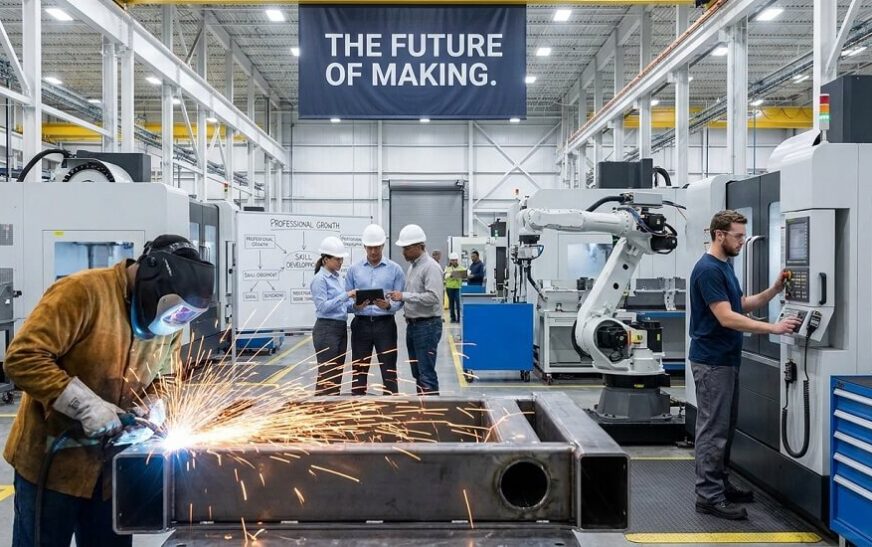
Welding and manufacturing careers combine technical skill, equipment operation, precision, problem-solving, quality control, and hands-on production work. The field includes welders, fabricators, CNC operators, machinists, inspectors, production technicians, manufacturing supervisors, and specialized professionals working in aerospace, automotive, energy, construction, defense, and industrial production.
A welding career can begin with technical training or an entry-level production position and develop into specialized welding, inspection, supervision, quality assurance, fabrication management, or manufacturing leadership.
A manufacturing career can follow a similar progression. Someone may start as a machine operator, assembler, CNC trainee, or production worker and advance into setup, programming, quality, maintenance, supervision, or operations management.
This guide covers welding careers, welder salaries, welding certifications, CNC operator careers, pipe welding, industrial manufacturing, AWS credentials, Certified Welding Inspector careers, TIG and MIG specialization, underwater welding, ironworker welding, aerospace welding, and long-term manufacturing advancement. For a broader look at the skilled trade career ecosystem across all occupations, explore our comprehensive guide.
What Is a Welding Career?
Welding involves joining, cutting, or repairing metal using specialized processes and equipment.
Professional welders may work with:
- Steel
- Stainless steel
- Aluminum
- Nickel alloys
- Specialty metals
- Structural components
- Pipe
- Industrial machinery
Welding careers exist in:
- Manufacturing
- Construction
- Shipbuilding
- Energy
- Aerospace
- Automotive
- Infrastructure
- Repair
- Industrial maintenance
The work can be performed in factories, workshops, construction sites, shipyards, plants, or specialized environments.
What Is a Manufacturing Career?
Manufacturing careers involve producing, assembling, inspecting, maintaining, or managing products and industrial systems.
Potential roles include:
- Production Worker
- Welder
- Fabricator
- CNC Operator
- Machinist
- Tool and Die Maker
- Quality Inspector
- Manufacturing Technician
- Maintenance Technician
- Production Supervisor
- Manufacturing Manager
Manufacturing is increasingly technical, with workers interacting with:
- CNC equipment
- Robotics
- Automation
- Sensors
- Digital controls
- Computer-aided manufacturing
- Quality systems
Welding Career Path
A typical welding career can progress through the following:
Entry-Level Welder → Certified Welder → Senior Welder → Lead Welder → Welding Supervisor → Welding Inspector or Manager
Some professionals specialize instead of moving into management.
Specialization can include:
- TIG
- MIG
- Stick
- Flux-cored
- Pipe welding
- Structural welding
- Aerospace
- Pressure-vessel work
- Underwater welding
The strongest path depends on whether you prefer technical specialization, leadership, inspection, or production management.
How to Become a Welder
There is no single national route to welding.
Common pathways include:
- Complete a welding certificate or technical program.
- Enter an employer training program.
- Start as a welding helper or production worker.
- Learn safety and welding fundamentals.
- Develop proficiency in specific welding processes.
- Complete required or employer-requested qualification tests.
- Build experience in a specific industry.
- Progress into specialized or supervisory work.
Some employers value hands-on experience as much as formal classroom education.
Welding Training Programs
Training programs can cover the following:
- Welding fundamentals
- Blueprint reading
- Welding symbols
- Metal properties
- Electrical principles
- Joint preparation
- Safety
- Welding processes
- Inspection basics
Common training environments include:
- Community colleges
- Technical schools
- Workforce programs
- Employer training
- Apprenticeships
- Union training centers
For a detailed comparison of welding training and apprenticeship options versus trade school programs, including costs, timelines, and career outcomes, explore our comprehensive guide.
Before enrolling, compare tuition, equipment access, lab hours, employer connections, and certification preparation.
Welder Salary USA
Welding compensation varies considerably by:
- Industry
- Experience
- Location
- Welding process
- Certification
- Shift
- Overtime
- Working conditions
The U.S. Bureau of Labor Statistics reported a $51,000 median annual wage for welders, cutters, solderers, and brazers in May 2024.
The highest 10% earned more than $75,850.
Industry also matters. BLS reported a May 2024 median wage of $57,310 in specialty trade contractors, compared with $49,740 in manufacturing.
These figures are broad occupational benchmarks rather than guarantees for specific welding specialties.
Welder Pay Factors
A welder’s income can change substantially with specialization.
Factors include:
Welding Process
Some processes require more advanced technical skill.
Material
Specialty alloys can require additional knowledge and qualification.
Industry
Aerospace, energy, shipbuilding, defense, and specialized manufacturing can have different pay structures.
Certification
Some projects require specific welding qualifications.
Shift
Night and weekend work can create shift differentials or overtime.
Travel
Some specialized welders travel to industrial or construction projects.
Pipe Welder Salary in the USA
Pipe welding is a specialized area that can offer strong earning potential.
Pipe welders may work on:
- Industrial plants
- Refineries
- Power facilities
- Manufacturing
- Chemical facilities
- Commercial systems
- Pipeline projects
Compensation varies widely based on:
- Pipe material
- Welding process
- Position qualification
- Industry
- Travel
- Overtime
- Union status
A pipe welder should therefore evaluate the specific project and qualification requirements rather than relying on a single national salary estimate.
Pipe Welder Career
Pipe welding requires precision because poor welds can affect systems that operate under pressure or carry critical materials.
Professionals may develop skills in:
- Pipe positioning
- Root passes
- Filler passes
- Specialized processes
- Blueprint interpretation
- Welding codes
- Inspection preparation
Pipe welding can lead to:
- Senior pipe welder
- Welding foreman
- Welding inspector
- Welding supervisor
- Welding superintendent
TIG Welding Career
TIG, or tungsten inert gas welding, is known for precision and control.
It is commonly associated with:
- Stainless steel
- Aluminum
- Thin materials
- Specialty fabrication
- Aerospace
- High-quality visible welds
TIG welding can require significant hand control and attention to detail.
Professionals who specialize in TIG may work in higher-precision manufacturing and fabrication environments.
MIG Welding Career
MIG, or gas metal arc welding, is widely used in production and fabrication.
Advantages can include:
- High productivity
- Ease of automation
- Broad industrial applications
- Efficient production
MIG welding is common in:
- Manufacturing
- Automotive
- Structural fabrication
- General metal production
A welder who understands both production speed and quality control can become particularly valuable in manufacturing environments.
Stick Welding Career
Stick welding remains useful in the following:
- Construction
- Repair
- Heavy equipment
- Outdoor work
- Structural projects
- Industrial maintenance
Its portability can make it practical for environments where equipment and weather conditions limit other welding processes.
Welding Specialty Careers
Welding specialists may focus on:
- TIG
- MIG
- Stick
- Flux-cored
- Pipe
- Structural
- Underwater
- Aerospace
- Pressure vessels
- Robotic welding
Specialization can increase career value when the skill is difficult to find and relevant to a high-value industry.
AWS Certified Welder Credential
The American Welding Society Certified Welder credential is a performance-based certification in which candidates demonstrate their ability to produce an acceptable weld under a defined welding procedure or specification.
AWS certifications can help employers verify welding competency for particular processes and positions.
The value depends on:
- Employer requirements
- Welding code
- Industry
- Specific procedure
- Qualification needed
A welding certification should therefore be viewed as proof of a defined skill rather than a universal license to perform every type of welding.
AWS Certification Path
AWS offers several professional credentials and certification programs serving different stages of welding careers.
Professionals may pursue paths related to:
- Welder qualification
- Welding inspection
- Welding supervision
- Welding engineering
- Welding technology
A welding career can therefore evolve from hands-on production into technical inspection or management.
Certified Welding Inspector Career
A certified welding inspector, commonly called a CWI, evaluates welding-related work and helps verify compliance with applicable requirements.
Responsibilities can include:
- Visual inspection
- Documentation
- Procedure review
- Weld quality
- Code compliance
- Inspection reporting
A CWI career can be attractive to experienced welders who want to move from production into quality and inspection.
Welding Inspector Career Path
A possible path is:
Welder → Senior Welder → Welding Technician → CWI → Senior Inspector → Quality Manager
Inspection requires strong attention to detail and understanding of the following:
- Welding processes
- Codes
- Specifications
- Documentation
- Quality systems
It can also provide a route toward less physically intensive work.
Welding Supervisor Career
Welding supervisors coordinate people and production.
Responsibilities can include:
- Assigning work
- Monitoring quality
- Reviewing production schedules
- Training workers
- Coordinating materials
- Managing productivity
- Enforcing safety
Supervisors need both technical welding knowledge and people-management skills.
Ironworker Welder Career
Ironworkers can work with structural steel and other large metal systems.
A welding-oriented ironworker may work on:
- Structural steel
- Bridges
- Buildings
- Industrial structures
- Towers
The work can involve:
- Height
- Outdoor conditions
- Heavy materials
- Rigging
- Specialized safety requirements
Ironworker welding can be a strong fit for people who prefer construction environments over factory work.
Underwater Welder Career
Underwater welding is one of the most specialized forms of welding.
Work can involve:
- Marine structures
- Ships
- Docks
- Offshore systems
- Underwater repairs
The career may require separate commercial-diving qualifications in addition to welding expertise.
Because of the technical and safety demands, underwater welding should not be viewed simply as a quick route to high income.
Training, diving skill, welding qualification, safety, and experience are all important.
Underwater Welder Income
Underwater welding compensation varies heavily based on
- Diving qualification
- Project type
- Offshore work
- Location
- Experience
- Contract structure
- Travel
- Risk
- Working conditions
Claims about exceptionally high underwater-welder salaries are often based on specialized offshore assignments rather than typical earnings.
Candidates should evaluate actual job offers rather than relying on sensationalized salary figures.
Aerospace Welder Career
Aerospace welding involves highly controlled production environments.
Professionals may work with:
- Specialized alloys
- Thin materials
- Precision components
- Aircraft structures
- Engine-related components
Aerospace employers often place strong emphasis on:
- Precision
- Documentation
- Traceability
- Inspection
- Process control
- Clean manufacturing environments
Aerospace welding can therefore be a strong specialization for welders who prefer precision over high-volume structural work.
Aerospace Welder Salary Premium
Aerospace welding does not automatically guarantee a salary premium.
Higher compensation can result from combinations of:
- Specialized qualifications
- Tight tolerances
- Advanced materials
- Inspection requirements
- Security requirements
- Experience
- Industry location
Professionals should compare the actual role, required qualifications, overtime, and benefits.
Manufacturing Career
Manufacturing careers include both production and technical roles.
Potential positions include the following:
- Production Operator
- Fabricator
- Welder
- CNC Operator
- Machinist
- Maintenance Technician
- Quality Technician
- Manufacturing Technician
- Production Supervisor
- Manufacturing Engineer
- Operations Manager
A manufacturing worker can specialize or move into management.
Manufacturing Career Path
A potential progression is the following:
Production Worker → Skilled Technician → Lead → Supervisor → Production Manager → Manufacturing Manager
Another route is:
CNC Operator → Setup Technician → CNC Programmer → Manufacturing Specialist
A third path is:
Welder → Welding Inspector → Quality Manager
The industry provides multiple routes depending on interests and technical ability.
CNC Operator Career
CNC operators run computer-controlled manufacturing equipment that produces precision parts.
Responsibilities may include:
- Loading material
- Setting tools
- Monitoring machining
- Inspecting parts
- Adjusting offsets
- Reading technical drawings
- Maintaining production standards
CNC operators can work with:
- Mills
- Lathes
- Multi-axis machines
- Automated production systems
CNC Machinist Career
Machinists perform more advanced setup, machining, and precision work.
Responsibilities can include:
- Machine setup
- Tool selection
- Workholding
- CNC operation
- Measurement
- Troubleshooting
- Program adjustment
A machinist career can progress into the following:
- CNC programmer
- Setup specialist
- Manufacturing technician
- Quality
- Production leadership
CNC Machinist Salary
BLS reported a $56,150 median annual wage for machinists in May 2024.
The highest 10% earned more than $78,760.
Tool and die makers had a higher $63,180 median annual wage, with the highest 10% earning more than $87,660.
Industry also matters. Machinists in transportation-equipment manufacturing had a May 2024 median wage of $60,320.
CNC Operator vs Machinist
| CNC Operator | Machinist |
| Runs established processes | More setup and troubleshooting |
| Monitors production | Precision machining |
| Loads material | Tool selection |
| Performs inspections | Adjustments and problem-solving |
| Often entry-level | More advanced technical responsibility |
Titles vary by employer, but the distinction is useful when planning a manufacturing career.
CNC Programming Career
CNC programmers translate design requirements into machine instructions.
They may work with:
- CAD
- CAM
- G-code
- Toolpaths
- Machine parameters
- Simulation
CNC programming can provide a career path for people who enjoy both manufacturing and computer-based technical work.
Manufacturing Automation Career
Manufacturing is increasingly automated.
Technicians may work with:
- Robotics
- Sensors
- Automated inspection
- CNC systems
- Programmable controls
- Production software
This creates career opportunities at the intersection of manufacturing and technology.
Workers who understand both physical production and automation can be particularly valuable.
Industrial Manufacturing Career
Industrial manufacturing includes the following:
- Machinery
- Automotive
- Aerospace
- Electronics
- Heavy equipment
- Energy equipment
- Fabricated metal products
The work often requires:
- Quality systems
- Production planning
- Equipment knowledge
- Safety
- Continuous improvement
Industrial experience can provide a pathway toward supervisory and operations roles.
Manufacturing Quality Career
Quality professionals make sure products meet specifications.
Potential roles include:
- Quality Inspector
- Quality Technician
- Quality Engineer
- Quality Supervisor
- Quality Manager
Responsibilities can include:
- Measurement
- Inspection
- Documentation
- Nonconformance
- Root-cause analysis
- Corrective action
Welding experience can be especially valuable in welding inspection and fabrication quality.
Manufacturing Maintenance Career
Industrial manufacturing depends on equipment reliability.
Maintenance professionals work with:
- Motors
- Conveyors
- Pneumatics
- Hydraulics
- Electrical systems
- Automated machinery
A welding or fabrication worker can potentially transition toward maintenance if they develop mechanical and electrical troubleshooting skills.
Production Supervisor Career
Production supervisors coordinate manufacturing teams.
Responsibilities can include:
- Shift scheduling
- Production targets
- Quality
- Safety
- Labor
- Equipment
- Training
This can be an important advancement step because it requires moving from individual production work into team leadership.
Manufacturing Manager Career
Manufacturing managers oversee broader production operations.
Responsibilities can include:
- Production planning
- Labor
- Quality
- Maintenance
- Safety
- Cost control
- Process improvement
- Capacity planning
At this level, managers need both technical understanding and business judgment.
Manufacturing and Lean Careers
Lean manufacturing focuses on improving flow and reducing waste.
Common concepts include:
- Standard work
- Continuous improvement
- 5S
- Root-cause analysis
- Process mapping
- Pull systems
- Waste reduction
Manufacturing professionals can add Lean skills to increase their ability to move into leadership or process-improvement roles.
Welding and Manufacturing Certifications
Potential credentials depend on career direction.
Welding
- AWS Certified Welder
- Welding inspection credentials
- Employer-specific qualifications
Machining
- CNC training
- CAD/CAM credentials
- Measurement and inspection training
Quality
- Quality certifications
- Inspection training
- Industry-specific credentials
Manufacturing Leadership
- Lean credentials
- Six Sigma
- Project management
Certifications are most valuable when they directly match the job you want.
Welding Certification vs Experience
A certification can demonstrate tested knowledge or performance, but it does not replace experience.
Employers may still evaluate the following:
- Work history
- Welding quality
- Productivity
- Safety
- Reliability
- Blueprint reading
- Troubleshooting
The strongest welding profiles combine recognized qualifications with actual production experience.
Welding Safety
Welding can expose workers to:
- Fumes
- Heat
- Sparks
- Intense light
- Noise
- Electrical hazards
- Confined spaces
Proper safety practices can include:
- Welding helmets
- Respiratory protection where required
- Heat-resistant gloves
- Protective clothing
- Ventilation
- Hearing protection
- Fire prevention
- Equipment inspection
Safety is a core career skill, not simply a compliance requirement.
Manufacturing Safety
Manufacturing workers can face:
- Moving machinery
- Sharp materials
- Noise
- Chemicals
- Heat
- Forklifts
- Electrical hazards
Professionals should understand:
- Lockout/tagout
- PPE
- Machine guarding
- Hazard communication
- Safe material handling
A strong safety record can support long-term career advancement.
Welding Tools and Equipment
Common welding equipment includes:
- Welding machines
- Gas equipment
- Grinding tools
- Clamps
- Measuring tools
- Positioners
- Welding tables
Specialized environments may also use:
- Robotic welding systems
- Automated positioners
- Inspection equipment
- Digital monitoring
Tool investment can vary significantly depending on whether the employee or employer supplies equipment.
Manufacturing Technology Skills
Workers who want long-term career mobility can develop the following:
- CNC
- CAD
- CAM
- Robotics
- PLCs
- Metrology
- Digital inspection
- Manufacturing execution systems
Technology skills can help workers move from production into the following:
- Programming
- Process improvement
- Automation
- Quality
- Manufacturing technology
Welding Automation Career
Automated welding systems can improve productivity in repetitive production.
Workers may operate or support:
- Robotic welders
- Automated cells
- Programmable systems
- Vision systems
- Positioning equipment
The growth of automation does not eliminate welding knowledge.
Instead, it can shift some jobs toward the following:
- Setup
- Programming
- Quality
- Maintenance
- Process control
Is Welding a Good Career in 2026?
Welding can be a strong career for people who enjoy technical hands-on work, but the occupation has a mixed outlook.
BLS projects only about 2% employment growth for welders from 2024 to 2034, slower than the overall average.
However, BLS still projects approximately 45,600 openings per year, largely because workers leave the occupation or retire.
That means welders should focus on skill quality and specialization rather than assuming general welding demand alone will guarantee strong income.
Is Manufacturing a Good Career?
Manufacturing remains a major employer of skilled technical workers.
Even when overall employment in a specific occupation is flat or declining, replacement demand can create opportunities.
Workers can also improve their long-term prospects by developing skills in:
- CNC
- Automation
- Maintenance
- Quality
- Welding
- Programming
- Technical inspection
The manufacturing worker of the future is increasingly expected to understand technology as well as physical production.
Manufacturing Career Without College
Many production and technical manufacturing jobs can be entered without a four-year college degree.
Potential routes include the following:
- Employer training
- Technical school
- Apprenticeship
- Community college
- Industry credentials
This does not mean training is unnecessary.
Manufacturing increasingly rewards technical skills that may require substantial classroom and hands-on preparation.
Welding Career Without College
Welding can often be entered without a bachelor’s degree.
Typical preparation can involve:
- High school education or equivalent
- Welding school
- Employer training
- Apprenticeship
- Qualification testing
Experienced welders can then move toward:
- Pipe welding
- Inspection
- Aerospace
- Fabrication supervision
- Quality
- Manufacturing management
Career Advancement for Welders
The strongest long-term progression often comes from adding skills beyond welding itself.
Technical Specialization
Learn a difficult or highly regulated process.
Inspection
Develop welding code and quality knowledge.
Leadership
Become a lead or supervisor.
Manufacturing Technology
Learn CNC, automation, or process control.
Project Skills
Develop estimating, scheduling, and coordination.
Business
Move into fabrication or welding company ownership.
Welder to CWI Career
An experienced welder may move toward inspection by developing the following:
- Welding-code knowledge
- Inspection techniques
- Documentation
- Quality systems
- Testing knowledge
A possible path is:
Welder → Senior Welder → Welding Inspector Trainee → CWI → Quality Supervisor
Inspection can reduce physical demands while increasing responsibility.
Welder to Manufacturing Manager
A welding professional can also move into manufacturing management by adding the following:
- Production planning
- Labor management
- Quality
- Cost control
- Scheduling
- Safety
- Lean processes
A possible path is:
Welder → Lead → Production Supervisor → Manufacturing Manager
This route requires learning the broader business of production.
Manufacturing Career and Overtime
Manufacturing facilities may operate
- Multiple shifts
- Nights
- Weekends
- Holiday schedules
Overtime can increase compensation, particularly during high-demand production periods.
But workers should distinguish between the following:
Base salary or hourly wage
and
Variable income from overtime and shift premiums
A job with a slightly lower base wage but substantial skill progression can sometimes provide greater long-term value.
Manufacturing Career in Aerospace
Aerospace manufacturing can provide specialized opportunities in:
- Welding
- Machining
- Fabrication
- Quality
- Assembly
- Inspection
The industry often emphasizes the following:
- Precision
- Traceability
- Documentation
- Tight tolerances
- Process control
Professionals may find the work more regulated and documentation-heavy than general manufacturing.
Aerospace Welding Career Skills
Important abilities can include:
- Precision welding
- Blueprint reading
- Material knowledge
- Inspection
- Documentation
- Process consistency
Aerospace workers may need to maintain strict quality standards because component failures can have serious consequences.
Welding in Defense Manufacturing
Defense manufacturing can employ:
- Welders
- Fabricators
- Machinists
- Quality inspectors
- Manufacturing technicians
Projects can involve:
- Specialized alloys
- Heavy structures
- Components
- Vehicles
- Equipment
Security requirements and project-specific qualifications may apply to some positions.
Manufacturing Career in Automotive
Automotive manufacturing employs:
- Welders
- CNC operators
- Machinists
- Robotic technicians
- Quality technicians
- Production supervisors
Automation is particularly important in automotive production.
Workers who understand both welding and automation can access specialized roles supporting robotic manufacturing cells.
Manufacturing Career in Energy
Energy-related manufacturing can involve:
- Fabrication
- Pipe welding
- Industrial machinery
- Equipment assembly
- Quality
- Maintenance
Projects may include:
- Industrial equipment
- Power-generation components
- Renewable-energy systems
- Energy infrastructure
Specialized technical qualifications can increase opportunities.
Key Takeaways
- Welding and manufacturing offer multiple career routes from entry-level production work into technical specialization, inspection, supervision, CNC, quality, and management.
- BLS reported a $51,000 median annual wage for welders, cutters, solderers, and brazers in May 2024, with the highest 10% earning more than $75,850.
- BLS projects about 45,600 annual openings for welders from 2024 to 2034 despite only 2% employment growth, largely because of replacement demand.
- CNC machinists had a $56,150 median annual wage in May 2024, while tool and die makers had a $63,180 median.
- TIG, MIG, pipe, structural, aerospace, industrial, and underwater welding offer different technical requirements and working conditions.
- AWS certification can help validate welding competence, while welding inspection credentials can provide a pathway away from full-time production work.
- A CWI career can lead from welding into inspection, quality, supervision, and management.
- Manufacturing increasingly depends on CNC, robotics, automation, digital inspection, and computer-controlled systems.
- CNC careers can progress from machine operation to setup, programming, process improvement, or manufacturing technology.
- Specialized aerospace, defense, energy, and industrial work can provide additional opportunities for experienced professionals with relevant qualifications.
- Underwater welding can be highly specialized but should not be viewed as a guaranteed high-income shortcut; commercial-diving qualifications, experience, project conditions, and safety requirements matter.
- Welders and manufacturing workers can build long-term careers without a traditional four-year degree through technical programs, apprenticeships, employer training, and industry credentials.
- The strongest long-term careers combine technical skill + certification + specialization + technology + quality + leadership.
Frequently Asked Questions
Is welding a good career?
Welding can be a strong career for people who enjoy hands-on technical work. The national outlook is relatively modest, but replacement demand creates substantial annual openings, and specialization can improve career options.
How much do welders make?
BLS reported a $51,000 median annual wage in May 2024 for welders, cutters, solderers, and brazers. Pay varies substantially by industry, specialization, location, experience, overtime, and qualifications.
What is the highest-paying welding specialty?
There is no universal highest-paying specialty. Pipe, aerospace, industrial, underwater, and specialized structural welding can offer higher compensation in certain markets, but income depends heavily on qualifications, project conditions, and experience.
Is the AWS Certified Welder worth it?
It can be useful when employers or projects require evidence of welding competency. Its value is strongest when the credential matches the specific welding process and qualification needed.
What does a certified welding inspector do?
A CWI evaluates welding quality and compliance with applicable requirements, performs inspections, reviews documentation, and helps organizations maintain quality standards.
Can a welder become a CWI?
Yes. Experienced welders can build inspection knowledge and pursue the applicable CWI credential and requirements.
How much do CNC machinists make?
BLS reported a $56,150 median annual wage for machinists in May 2024. Tool and die makers had a $63,180 median. Actual pay varies by industry, skill, location, and experience.
Is CNC a good manufacturing career?
CNC can be a strong option for people who enjoy precision, machinery, technical drawings, measurement, and computer-controlled production. Workers can advance into setup, programming, quality, or manufacturing technology.
What is the difference between a CNC operator and a machinist?
CNC operators often run established production processes, while machinists generally have greater responsibility for setup, tool selection, precision work, troubleshooting, and adjustments.
Can welders work in aerospace?
Yes. Aerospace manufacturing employs specialized welders and fabricators, although the work can involve strict tolerances, documentation, inspection, and qualification requirements.
Is underwater welding really a six-figure career?
Some specialized offshore or high-risk assignments may produce high income, but there is no universal salary guarantee. Commercial-diving qualifications, welding expertise, project conditions, and experience are critical.
Can I enter welding without college?
Yes. Welding can often be entered through technical school, employer training, apprenticeship, or qualification-based pathways without a four-year degree.
Can manufacturing workers become managers?
Yes. Production workers, welders, CNC operators, and other technical employees can progress into lead, supervisor, quality, production, and manufacturing-management roles by building leadership and business skills.
Conclusion
Welding and manufacturing careers provide a broad technical pathway for people who prefer practical work, machinery, fabrication, precision, and production.
Welding can begin with foundational training and develop into specialized pipe, TIG, aerospace, structural, industrial, or inspection careers. Manufacturing can begin with production or machine operation and progress into CNC setup, programming, quality, automation, supervision, or management.
The key to long-term success is specialization. A general welding skill set can provide entry into the industry, but advanced processes, inspection, industrial knowledge, automation, or high-precision manufacturing can create additional value.
Manufacturing is also becoming more digital. CNC systems, robotics, automated inspection, computer-controlled production, and connected manufacturing environments increasingly reward workers who combine hands-on skills with technology.
For professionals seeking advancement, the strongest options include moving toward specialized welding, inspection, CNC programming, quality, automation, production supervision, or manufacturing management.
The most durable careers combine technical skill, recognized credentials, practical experience, safety, quality, technology, and leadership.
A welder can become an inspector. A CNC operator can become a programmer. A machinist can become a manufacturing specialist. A production worker can become a supervisor.
That flexibility makes welding and manufacturing valuable components of the broader U.S. skilled-trades economy.