

In 2026, the most sought-after skills are those involved in fintech as the financial services market moves at a high rate towards digital-first, data-driven, and automated models. Banks, startups, and international businesses are spending a lot on blockchain, artificial intelligence, online payments, and regulatory technology. The list is targeted at students, working professionals, founders, and career switchers seeking practical skills to prepare them for the future. These courses have been chosen due to their relevance in the industry, credibility of the provider, and functional consequences. The content prepares the students to work in actual fintech jobs, and not only the theory.
What Fintech Skills Matter Most in 2026
In 2026, employers in the fintech sector will focus on the skills that are a combination of technology, data, and regulations, combined with existing knowledge of finance. The highest value professionals may be able to comprehend financial systems as they construct, examine, or operate digital solutions that grow safely and conform to international standards.
Key fintech skills employers hire for:
- Digital payments & payment gateways
- Blockchain & decentralized finance (DeFi)
- AI and machine learning in finance
- Risk management & regulatory compliance (RegTech)
- Financial data analysis & APIs
- Product management for fintech platforms
- Cybersecurity and fraud detection
How to Choose the Right Fintech Course
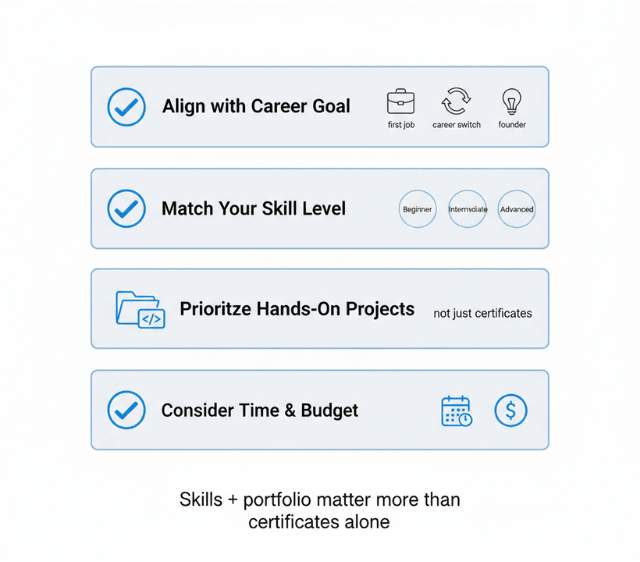
To select the proper fintech course, it is necessary to first align it with your career objective, such as getting your first fintech job, changing careers, or starting a business. Novices are better served by generalized courses, whereas specialized or advanced courses are more advantageous to professionals. Go deeper than certificates and consider the inclusion of as much hands-on, project-based learning as possible. Time commitment, flexibility, and total cost, as well, are to be considered. A shorter, practical course is likely to give a more sensible payoff compared to a long and overly academic course.
13 Best Fintech Courses to Learn in 2026
Course #1: FinTech Foundations and Overview
- Provider / Platform: Coursera
- Skills covered: Payments, blockchain basics, fintech ecosystems
- Best for: Beginners and students
- Duration & cost: 4–6 weeks, affordable subscription
The course provides a good introduction to the concept of fintech, but it is not technical. It discusses the technology that transforms Banking, lending, insurance, and payment. It works best with those learners who prefer to gain clarity on what they are getting before making a selection on which specialization to take.
Course #2: Blockchain and Cryptocurrency Explained
- Provider / Platform: edX
- Skills covered: Blockchain architecture, crypto assets, DeFi
- Best for: Finance professionals and tech learners
- Duration & cost: 6–8 weeks, moderate cost
This course goes into the depths of the role of blockchain in contemporary finance. Students learn about the principles of distributed ledgers, the importance of cryptocurrencies, and why DeFi is threatening default financial intermediaries. It is most applicable to jobs at crypto companies, banks, and Web3 startups.
Course #3: AI in Finance and Financial Analytics
- Provider / Platform: Udacity
- Skills covered: Machine learning, credit scoring, fraud detection
- Best for: Data analysts and engineers
- Duration & cost: 3–4 months, premium pricing
This initiative is aimed at implementing AI models in financial scenarios. Students collaborate on projects with the prediction of risks and the analysis of transactions. It works best in situations where one is trying to reach high-paying fintech jobs where data and automated processes are used to make decisions.
Course #4: Digital Payments and Fintech Innovation
- Provider / Platform: FutureLearn
- Skills covered: Mobile payments, wallets, payment regulations
- Best for: Product managers and founders
- Duration & cost: 4 weeks, low cost
The course examines the impact that digital payments have on the way business is conducted in the world. It discusses payment infrastructure, user experience, and compliance issues. Product professionals and founders learn about scalable payment solution building.
Course #5: Fintech: Foundations, Payments, and Regulations
- Provider / Platform: Wharton Online
- Skills covered: Payments, policy, fintech strategy
- Best for: Business leaders and consultants
- Duration & cost: 6 weeks, higher cost
This course is the creation of one of the best business schools and combines fintech innovation, regulation, and strategy. It is perfect with professionals who require executive-level knowledge but not so many skills in coding.
Course #6: RegTech and Financial Compliance
- Provider / Platform: Coursera
- Skills covered: AML, KYC, compliance automation
- Best for: Risk and compliance professionals
- Duration & cost: 5 weeks, affordable
The current course is about regulatory technology, which is one of the most rapidly expanding fintech sectors. Students delve into the aspects of AI and automation, decreasing the cost of compliance and enhancing the accuracy of financial institutions.
Course #7: Fintech Product Management
- Provider / Platform: Product School
- Skills covered: Product lifecycle, UX, fintech roadmaps
- Best for: Aspiring product managers
- Duration & cost: 6–8 weeks, mid-range cost
It educates on product design, launch, and scaling of fintechs. Special focus is given on user trust, compliance, and iteration, which are absent in generic product courses.
Course #8: Python for Financial Analysis
- Provider / Platform: Udemy
- Skills covered: Python, data analysis, financial modelling
- Best for: Beginners in data-driven finance
- Duration & cost: Self-paced, low cost
It is a practical course that teaches finance-specific code. It offers a solid entry point to learners who are moving towards the field of finance to enter fintech analytics roles.
Course #9: Decentralized Finance (DeFi) Essentials
- Provider / Platform: Blockchain Council
- Skills covered: Smart contracts, DeFi platforms
- Best for: Web3 enthusiasts
- Duration & cost: 4 weeks, moderate cost
This course is focused on DeFi systems, which describe lending protocols, yield farming, and governance models. It is helpful for people joining crypto startups or blockchain consulting.
Course #10: Fintech Risk Management
- Provider / Platform: edX
- Skills covered: Risk modelling, cyber risk, operational risk
- Best for: Finance and audit professionals
- Duration & cost: 6 weeks, moderate cost
Students acquire the means to recognize and avoid risks specific to fintechs. It is a balanced course between theory and practical fintech failures and lessons.
Course #11: Open Banking and APIs
- Provider / Platform: FutureLearn
- Skills covered: APIs, data sharing, fintech ecosystems
- Best for: Developers and product teams
- Duration & cost: 3 weeks, low cost
The course describes the functionality of open banking and why APIs are at the heart of the fintech expansion. It particularly works well with SaaS and platform-based fintech positions.
Course #12: Fintech Startup and Innovation Strategy
- Provider / Platform: Harvard Online
- Skills covered: Innovation, scaling, fintech business models
- Best for: Founders and executives
- Duration & cost: 6 weeks, premium cost
It is dedicated to the creation and expansion of fintech projects, including regulation, financing, and market access. Best suited to the entrepreneur desiring to introduce fintech products.
Course #13: Financial Data Science
- Provider / Platform: DataCamp
- Skills covered: Data science, analytics, finance, and datasets
- Best for: Analysts and career switchers
- Duration & cost: Flexible, subscription-based
The course provides excellent analytical basics for a fintech career. It focuses on actual data, dashboards, and insights of current financial companies.
Free vs Paid Fintech Courses: What’s Worth It?
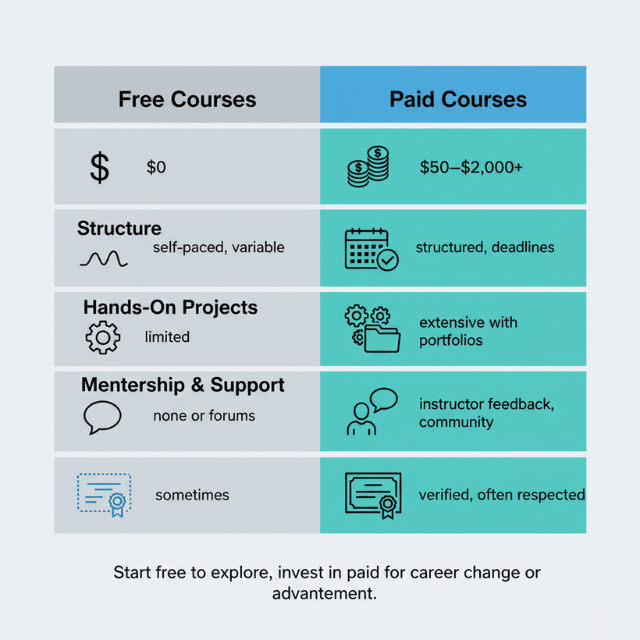
Free fintech courses are the best place to start and explore the basics, the terminology, and the interest. Nevertheless, the paid ones tend to be more structured, practical projects, mentorship, and certifications. Paid programs can be more advantageous if you wish to advance or change your role in your career. However, certifications are essential, whereas in the hiring process, skills application and portfolio projects are more important.
How These Courses Can Impact Your Career
With the courses, beginners are able to join the fintech world at a faster pace because they are equipped with the relevant skills. Mid-career workers will be able to switch to future-resistant, better-paid jobs. Founders get sanity on compliance, technology, and scaling strategies. All in all, fintech expertise opens superior remuneration, international prospects, and the possibility to tap into rapidly expanding digital finance ecosystems.
FAQs
Do I need a finance background to learn fintech?
No, several courses are accessible to beginners and teach finance basics and technology.
Are online fintech courses respected by employers?
Yes, in particular, together with applied projects and practical skills.
Which fintech skill is most in demand in 2026?
AI dominates employer demand in finance, blockchain, and digital payments.
How long does it take to become job-ready in fintech?
Typically, 3–9 months with focused, practical learning.
Can these courses help me start a fintech startup?
Yes, many courses cover regulation, product design, and scaling.
Conclusion
In order to choose the most profitable fintech course, it is necessary to begin with your career objective and the level of your current skills. Focus on learning through practical learning rather than certification. Select a course, be consistent, and develop projects with learning. Fintech in 2026 rewards action-takers; start today, learn smart, and place yourself in the future of finance.
Leave a Reply