

Old chatbots might have been promised to be faster and cheaper, but in 2026, their drawbacks are difficult to overlook. Customers want actual problem resolution and not canned responses. The difference between 2025-2026 is the emergence of AI agent systems capable of reasoning, performing and making decisions and performing actions on their own. This change is significant to organizations that need to be efficient, product teams that are developing smarter systems and customers who prefer results over dialogues. AI agents are a radical innovation: an acceleration of the shift toward not reactive chat tools but more proactive digital workers that actually accomplish tasks.
What Are Traditional Chatbots & Why They’re Failing
Conventional chatbots are primarily rule-based systems or flow systems, which respond to a set of predefined queries. They use decision trees, keywords, and fixed scripts; thus, they are fragile when applied to a real-world conversation. Chatbots tend to break down or go in circles when users make minor deviations as per the input expectations.
These systems do not scale well in terms of maintenance. Each new use case has to be updated manually, new rules have to be created, and repeatedly tested. This increases the cost of operation and user frustration, particularly in customer care settings where the problems are complicated.
Chatbots remain effective in applying to simple tasks such as FAQs, order status queries or basic routing. Nevertheless, they fail in cases where reasoning, multi-step problem solving or real decision-making is needed, precisely where automation is most urgently needed in modern businesses.
What Are AI Agents?
AI agents are autonomous systems that can understand goals, reason through steps, use tools, and take actions to complete tasks. Unlike chatbots, they are not limited to conversation—they operate across systems, data sources, and workflows.
The primary distinction is in capability. AI agents are able to strategize, recall context and adjust depending on feedback. They are able to make API calls, modify records, invoke workflows and even cooperate with other agents.
Single-agent systems also manage end-to-end tasks in isolation, whereas multi-agent systems share work among specialized agents which interact with one another. This ensures they are much more scalable and suitable for complex business activities.
Core Differences: AI Agents vs Traditional Chatbots
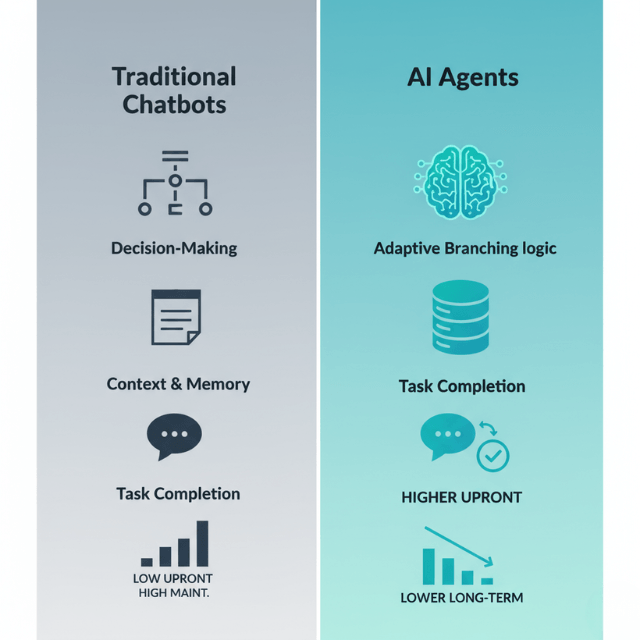
Decision-Making vs Scripted Responses
Conventional chatbots use pre-written scripts and decision trees and only address the predefined input. In comparison, the agents of AI consider situations dynamically, reason about options, and determine actions in relation to goals instead of having a set of rules.
Context Handling and Memory
Chatbots generally lose context when a session is over or after a couple of turns. The AI agents have both long-term and short-term memory, which enables AI agents to keep a history of the user, past use, and goal changes in interactions.
Task Completion vs Conversation Only
Chatbots concentrate on the dialogue, and they are likely to delegate work to humans. AI agents are aimed at completing tasks, solving tickets, updating systems, scheduling, and closing loops without human intervention.
Cost and Operational Impact
Although chatbots appear cheaper in the short run, their maintenance and low effectiveness make them costly in the long run. AI agents have a greater cost of setting up, but a much lower cost of operation due to automation and increased resolution rates.
Why 2026 Is the Tipping Point
By 2026, with the development of large language models and agent systems, AI agents will be reliable at scale. Agents can think, act and interact with business systems by using frameworks based on technologies of other organizations, such as OpenAI and tooling ecosystems such as LangChain.
Firms are now requiring automation other than chat, actual deliveries, rather than denials. Better cost-effectiveness, quantifiable ROI, and the increased customer demands to get issues addressed instantly have driven AI agents out of experimentation and towards mainstream implementation.
Real Business Use Cases Replacing Chatbots
In the customer care sector, AI resolution agents now identify problems, visit knowledge bases, take actions, and close tickets without needing escalation. This will decrease the handling time significantly and enhance customer satisfaction.
Sales teams use AI agents to do lead scoring, direct follow-ups, CRM updates, and pipeline washing, which previously used to be performed using several tools and manually.
In its internal functions, AI agents can automate processes, including onboarding, reporting, approvals, and work across teams. The agents in DevOps and IT can be used to monitor systems, respond to incidents, query logs, and automatically address common problems.
Implementation Considerations for Businesses
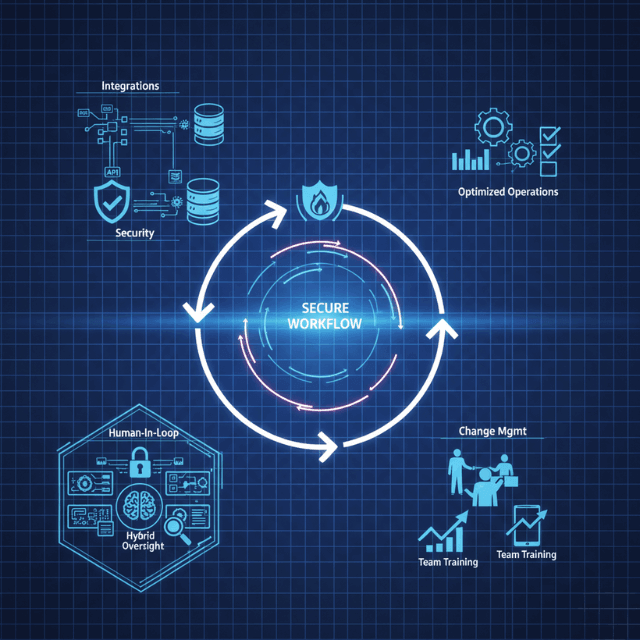
Implementation of AI agents is a challenging task that demands strong integration with internal tools and data. The agents require regulated access to databases, ticketing systems, CRMs, and APIs. Permission and security are paramount. Strict access controls and audit trails should be in place, and guardrails should establish what agents can and cannot do.
The models based on human-in-the-loop are not to be ignored in sensitive decisions, exceptions, and learning stages. Change management is a crucial element that is not given maximum attention. Agents have to be trusted by the teams, and they have to know their role and adjust the workflows to cooperate with AI-driven systems.
Costs, Risks & Limitations of AI Agents
AI agents are characterized by increased initial expenditures in the form of installation, integration and training. Nevertheless, they are usually outsmarted by long-term savings in the form of lower labour expenses and increased productivity.
The issue of reliability is present. Agents may make wrong decisions when there is a lack of data or when the systems evolve without the intention to do so. Good monitoring, fallback and ongoing assessment are necessary.
The issues of compliance and governance are also important, particularly in regulated industries. Simple FAQs and other low-thinking, high-volume situations might continue to be the more appropriate answer with a traditional chatbot.
How to Transition from Chatbots to AI Agents
The process of change should start by audit of present chatbot operations to determine where traffic is being lost or requires more human interaction. These points are likely to reveal agent-ready opportunities. Second, identify actions which require reasoning, access to the system or multi-step actions.
The most common way most businesses begin with hybrid models is to have chatbots to answer simple questions and AI agents to do complex tasks in the background. Measurement should not be on the volume of conversation alone but on an outcome measure that is successful, such as resolution rate, time saved, cost reduction and customer satisfaction.
What This Means for the Future of Conversational AI
The outcome-based service, as opposed to a scripted customer experience, will be implemented in the customer experience. The users will be more demanding that the systems do not repeat any explanation and handoff.
The support and operations functions will transform into more supervisory, exception planning and management rather than mindless work. Firms should be prepared to make AI agents their digital colleagues and not tools.
FAQs
Are AI agents completely replacing chatbots in 2026?
No. Chatbots remain effective on simple and low-risk interactions, but AI agents are substituting them in more complex and outcome-oriented cases.
Do AI agents require more data than chatbots?
Yes, but they also use data more effectively by reasoning, connecting systems, and learning from outcomes.
Are AI agents more expensive to run?
Initial costs are higher, but long-term operational savings and efficiency gains often deliver better ROI.
Can small businesses use AI agents?
Yes. The adoption is available to small groups with limited resources due to modern platforms and agent frameworks.
What skills do teams need to manage AI agents?
Teams require systems integration, timely design, monitoring, governance, and workflow design skills as opposed to scripting.
Conclusion
The transition to an AI agent as opposed to traditional chatbots is a significant change in conversational AI. Chatbots are talkers, agents are doers. The most important lesson that can be given to the decision-makers is that those businesses will provide a better experience, reduce costs, and improve their operational performance when they implement AI agents in a strategic manner. Replacing everything at once is not the next step, but the beginning of providing something that is real and measurably valuable today by agents.
Leave a Reply