
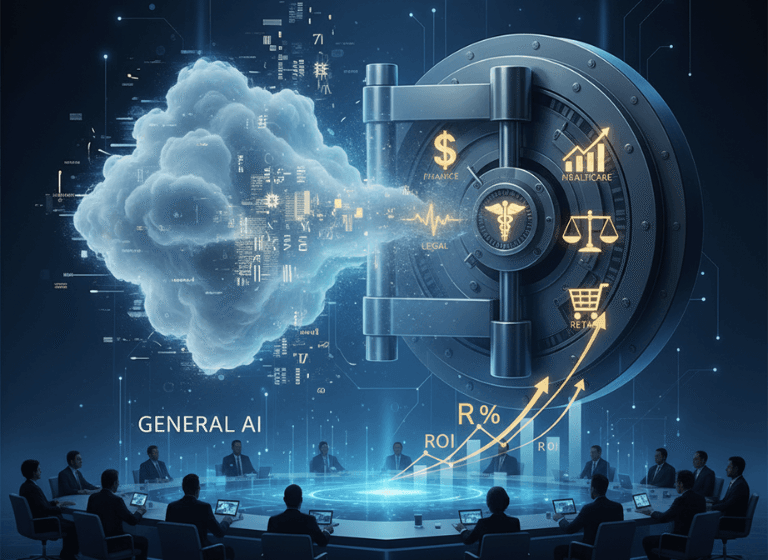
Enterprises quickly adopted general-purpose AI models, although most are currently facing constraints in the real world. Although general AI systems are effective in open-ended tasks, they tend to be inaccurate, uncompliant, and unrelated to business within the framework of complex organisations. This has given rise to increased interest in domain-specific AI models systems trained and optimised to a single industry or business task. Enterprises are reconsidering their AI strategies as the regulatory pressure grows and the expectations of the ROI become higher. Domain-specific AI can also provide precision, control, and reliability that cannot be reliably supplied by generalised models at scale.
What Are Domain-Specific AI Models?
Domain-specific AI models are artificial intelligence systems designed, trained, and optimised for a specific industry, business function, or problem space. They are based on filtered internal information, industry terms, processes, and legal restrictions in an enterprise scenario. In comparison with general-purpose foundation models that are trained on general internet data, domain-specific models are narrow in their scope and concentrate on what is essential to the business. They are applications such as fraud detectors in finance, clinical decision support in healthcare, demand forecasting in retail and customer intelligence systems in SaaS platforms. This is due to the speciality that allows them to know more, be more accurate and consistent in performance.
The Limits of General-Purpose AI in Enterprises
General-purpose models can be misleading as they create false or fabricated information. In business settings, minor errors may cause losses of money, some form of breaking the law or losing customer confidence. Such models usually lack industry-related terminology, regulations, and edge cases. In the absence of a profound domain context, the outputs can be irrelevant, incomplete or do not match actual business processes.
Businesses have to satisfy strict standards of regulations and audits. General AI models do not have data lineage, explainability, and policy enforcement firmly embodied within them as required in regulated businesses. Continued training of big foundation models is costly. Companies have a high inference cost on those capabilities that are not necessary, which decreases overall return on investment.
Why Enterprises Are Moving Toward Domain-Specific Models
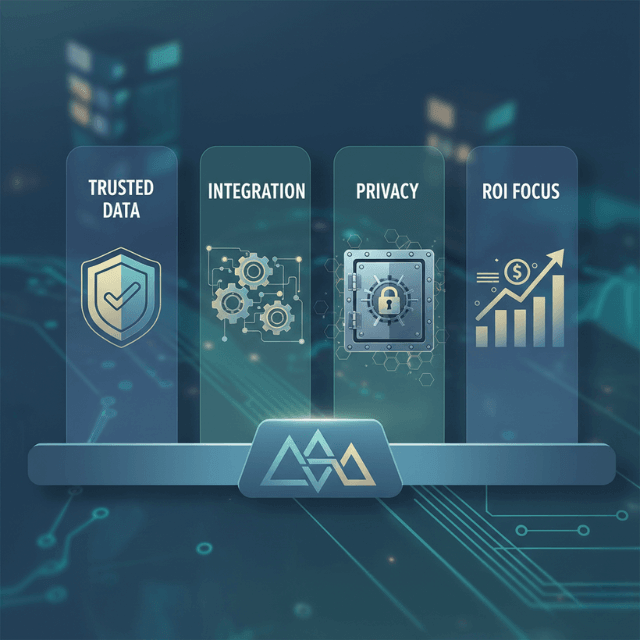
Special models are trained on trusted and relevant data. This effectively decreases hallucinations and enhances trust in outputs to be used to make decisions and automation. Domain-specific AI is directly integrated with current tools, processes, and systems, enabling the teams to build up and trust AI-informed insights.
Companies have access to confidential information. The models may be implemented privately, and they facilitate data residency, encryption, and internal access policies. Focused models provide focused outcomes and quantified change. There is a reduced forecasting of costs, and performance is in tandem with set business objectives.
Key Enterprise Use Cases Driving Adoption
Customer Support and Knowledge Systems
Domain-specific AI enables correct responses based on an internal knowledge base, policies, and documentation, which will decrease the time of resolution and enhance customer satisfaction.
Risk, Compliance, and Decision Support
Specialised models examine regulatory rules, transactions and risk signals in order to facilitate audits, fraud detection, and compliance decisions.
Operations and Process Automation
All these operations are automated through AI models that identify anomalies, repetitive tasks, and optimise workflows with little human supervision.
Product Intelligence and Analytics
Domain AI assists enterprises in deriving insights about product usage data, customer behaviour and market indicators to make roadmap decisions.
How Domain-Specific Models Are Built and Deployed
Subject matter experts collect, clean and label high-quality domain data. This facilitates the model to learn the correct patterns and business logic. Fine-tuning puts domain knowledge into the actual model, whereas RAG retrieves trusted enterprise information in real-time, minimising hallucinations and increasing accuracy. Models can be installed on-premise, on personal clouds or safe AI platforms. It is essential to be integrated with enterprise solutions such as CRM, ERP, and analytics.
Costs, Risks & Trade-Offs
The preliminary expenses are the preparation of the data, infrastructure, and skills. But in the long term, there is a long-term saving of efficiency and a decrease in reliance on costly general models. Domain knowledge evolves. The models should be tracked and updated as the performance might be degraded due to the changing data or business environment.
The creation of targeted AI involves a team of talented engineers, data scientists, and domain experts, as well as scalable infrastructure. General-purpose AI can also be adequate and less expensive in generic tasks such as brainstorming or basic content generation.
How Enterprises Should Approach Adoption
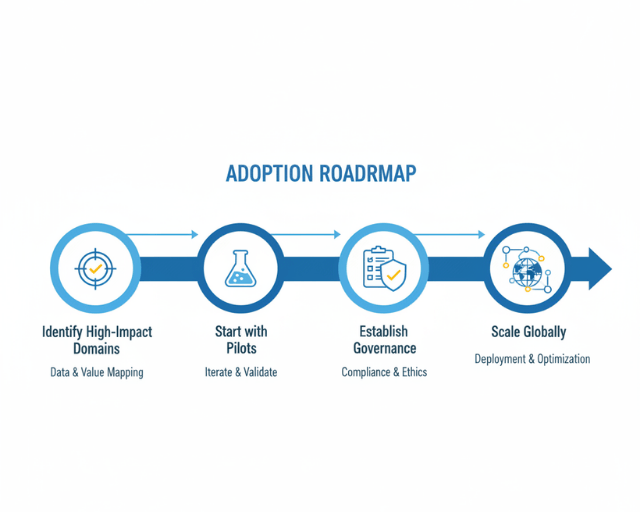
Identifying High-Impact Domains
The high-impact domains are usually customer support, finance, legal, operations, and analytics. Before choosing a domain, leaders must evaluate the availability of data, business risk and quantifiable results.
Starting with Pilots
Smaller pilots enable the teams to experiment with assumptions, test performance, and polish the data strategies until full deployment.
Governance, Monitoring, and Evaluation
Well-built governance systems will guarantee transparency, monitoring bias, compliance, and continuous performance review.
Scaling Across Teams and Regions
Once validated, models can be adapted and scaled across departments and geographies with localised data and controls.
What This Shift Means for the Future of Enterprise AI
Enterprise AI is shifting towards systems of production. Domain-specific models assist organizations to create stable AI solutions which can be utilised in the centre of business operations. Specialisation, proprietary data, and excellence in execution will become the source of competitive advantage instead of generic models that are increasingly scarce. In the long run, AI strategies will become stacked ecosystems of general intelligence with particular domain models.
FAQs
Are domain-specific models always better than general AI models?
No. However, they are more efficient in specialised tasks, whereas general models can be used in low-risk, broad, or creative situations.
Do domain-specific AI models require more data?
They need quality and relevant information, and not vast amounts of generic information.
How do domain-specific models reduce hallucinations?
They rely on curated domain data and structured retrieval, limiting unsupported or fabricated outputs.
Are domain-specific AI models more expensive?
Initial expenses can be increased, whereas the operational costs and risks in the long run can be reduced.
Can enterprises combine general and domain-specific models?
Yes. Many enterprises use hybrid architectures combining both for flexibility and efficiency.
Conclusion
Domain-specific artificial intelligence models currently signify a critical change in the manner in which companies apply artificial intelligence. Providing accuracy, governmental control, and commercial applicability, these models address the shortcomings of general-purpose AI. The point that emerges to the leaders of an enterprise is simple: specialisation leads to trust, value, and scalability. The second thing to do is to determine high-impact areas, invest in quality data and develop AI systems that are not only impressive but also capable of functioning in the real world.
Leave a Reply