
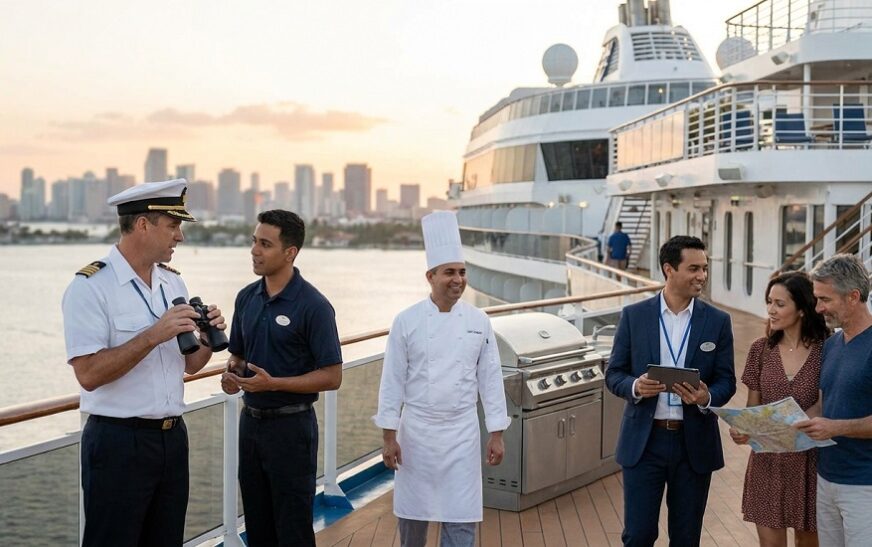
Cruise and travel careers combine hospitality, tourism, customer service, transportation, sales, entertainment, operations, and international experiences. The industry offers opportunities both on board cruise ships and on land through travel agencies, destination-management companies, cruise companies, airports, tourism businesses, and corporate travel organizations.
A cruise line career can range from guest services and food and beverage to entertainment, shore excursions, hotel operations, sales, marine operations, and management. On land, the travel industry offers careers in travel advising, reservations, destination management, corporate travel, tourism, cruise sales, and customer experience.
This guide covers cruise ship jobs, cruise salaries, travel agent careers, cruise director roles, shipboard employment, Royal Caribbean, Norwegian Cruise Line, Carnival, destination management, remote travel consulting, cruise-port operations, and career advancement. For a broader look at the hospitality and travel career ecosystem, explore our comprehensive guide.
What Is a Cruise Line Career?
Cruise companies operate like a combination of a hotel, restaurant, entertainment venue, transportation business, and travel company.
A cruise ship can employ professionals in the following:
- Hotel operations
- Guest services
- Food and beverage
- Housekeeping
- Entertainment
- Retail
- Spa and wellness
- Shore excursions
- Sales
- Marine operations
- Safety
- Medical services
- Information technology
- Administration
Large cruise companies also employ thousands of professionals in land-based corporate roles.
Cruise Ship Jobs
Shipboard employment can include:
Guest Services
- Guest Services Agent
- Guest Relations Officer
- Concierge
- Front Desk Supervisor
- Guest Services Manager
Food and Beverage
- Server
- Bartender
- Restaurant Supervisor
- Restaurant Manager
- Food and Beverage Manager
- Executive Chef
Hotel Operations
- Housekeeping
- Rooms Operations
- Laundry
- Hotel Administration
Entertainment
- Cruise Staff
- Entertainment Host
- Activity Manager
- Production Staff
- Performer
- Technical Crew
For those interested in entertainment and event coordination on cruise ships, our event management guide explores how cruise ship entertainment programming overlaps with event planning and production.
Retail and Commercial
- Retail Associate
- Retail Manager
- Shore Excursion Specialist
- Revenue Specialist
- Sales Professional
Marine and Technical
- Deck Operations
- Engineering
- Electrical
- Marine Safety
- Environmental Operations
The right path depends heavily on whether you want guest interaction, hospitality management, technical work, entertainment, or business operations.
On-Ship Employment
Shipboard employment is different from conventional hotel work because employees live where they work for the duration of an assignment.
Cruise companies commonly structure employment around contracts or assignment rotations rather than permanent residence on the vessel.
For example, Norwegian Cruise Line states that many shipboard assignments range from approximately four to nine months depending on the position and brand.
Shipboard employees may work intensive schedules while on assignment and then receive a larger period of time off after the contract ends.
Cruise Ship Work Schedule
Cruise careers can involve demanding schedules.
Depending on position and vessel, employees may work the following:
- Long shifts
- Seven-day workweeks
- Holidays
- Weekends
- Early mornings
- Late nights
- Split assignments
The lifestyle can provide international travel and unique professional experience but may require extended periods away from home.
People considering shipboard careers should evaluate the complete lifestyle rather than focusing only on salary or travel benefits.
Cruise Line Salary
There is no single cruise line salary because shipboard compensation varies by
- Position
- Cruise company
- Experience
- Department
- Ship
- Contract
- Nationality and employment arrangement
- Tips or service charges
- Management responsibility
A senior hotel manager and an entry-level crew member can have completely different compensation arrangements.
Some shipboard positions may also include accommodation and meals, which changes the overall value of the employment package.
Cruise Ship Salary Package
A cruise employment package can include the following:
- Base pay
- Tips or service charges for eligible roles
- Accommodation
- Meals
- Transportation associated with assignment, depending on employer
- Medical or insurance provisions
- Crew facilities
- Training
Benefits differ substantially by company and position.
Applicants should review the written employment terms carefully rather than assuming that all cruise lines provide identical benefits.
Cruise Director Career
The cruise director is one of the most visible leadership positions on a cruise ship.
The role can involve:
- Guest communication
- Entertainment programming
- Event coordination
- Public announcements
- Activity scheduling
- Entertainment staff
- Guest experience
- Daily onboard programming
A cruise director needs strong
- Public speaking
- Leadership
- Organization
- Customer service
- Entertainment awareness
- Crisis-management ability
Cruise Director Career Path
A potential route can include:
Cruise Staff → Senior Cruise Staff → Assistant Cruise Director → Cruise Director
Professionals may also enter from the following:
- Hospitality
- Entertainment
- Events
- Hotel management
- Broadcasting
- Guest experience
The career path varies considerably by cruise company.
Cruise Hotel Management Career
Cruise ships have hotel operations similar to large resorts.
Potential positions include the following:
- Guest Services Manager
- Housekeeping Manager
- Food and Beverage Manager
- Hotel Director
- Executive Housekeeper
- Restaurant Manager
Professionals who already have hotel experience may find cruise operations a natural extension of their hospitality career.
Cruise Hotel Director Career
A hotel director or hotel operations leader can be responsible for a large share of the guest experience.
Areas may include:
- Guest services
- Food and beverage
- Housekeeping
- Entertainment
- Retail
- Revenue
- Service standards
This can be a significant management role because cruise ships combine several hospitality businesses in one location.
Royal Caribbean Careers
Royal Caribbean provides career opportunities both onboard ships and through land-based operations.
Potential areas include:
- Guest services
- Hotel operations
- Food and beverage
- Entertainment
- Marine operations
- Technology
- Sales
- Corporate functions
Large cruise companies can offer internal mobility between ships, departments, and shore-based roles.
Candidates should use official company career channels to verify current openings, requirements, and recruitment procedures.
Norwegian Cruise Line Careers
Norwegian Cruise Line provides both shipboard and land-based employment.
Current career materials identify shipboard opportunities across a large range of hospitality and operational roles, as well as corporate opportunities.
Norwegian also warns applicants about recruitment scams and states that legitimate hiring partners do not charge application, processing, or agency fees.
This is especially important for international cruise employment, where fraudulent recruiters may falsely request money or immigration documents.
Carnival Careers
Carnival’s career ecosystem includes the following:
- Ship operations
- Hotel operations
- Marine and technical positions
- Entertainment
- Revenue management
- Marketing
- Commercial operations
- Corporate roles
Carnival’s current careers platform separates ship-based and land-based opportunities, demonstrating how a cruise company can provide both hospitality careers at sea and traditional corporate careers on land.
Cruise Line Corporate Careers
Cruise companies need corporate professionals in areas such as the following:
- Finance
- Marketing
- Technology
- Human resources
- Procurement
- Sales
- Revenue management
- Travel services
- Supply chain
- Legal
- Communications
These careers are often more similar to conventional corporate jobs than shipboard employment.
Professionals can therefore work in the cruise industry without living at sea.
Cruise Port Operations Career
Cruise ports manage the movement of passengers, ships, baggage, transportation, and vendors.
Potential careers include:
- Port Operations Coordinator
- Cruise Operations Manager
- Terminal Manager
- Passenger Services Manager
- Port Logistics Specialist
- Shore Operations Manager
These positions connect tourism with transportation and logistics.
Cruise Port Operations Skills
Important capabilities include:
- Scheduling
- Transportation coordination
- Customer service
- Security awareness
- Vendor management
- Logistics
- Communication
- Operations planning
Professionals with backgrounds in airports, logistics, hospitality, or transportation can potentially transfer their skills into cruise-port operations.
Shore Excursions Career
Shore excursions help cruise passengers experience destinations during port calls.
Professionals may coordinate:
- Tour operators
- Excursions
- Transportation
- Guides
- Passenger schedules
- Vendor relationships
Potential roles include:
- Shore Excursion Specialist
- Destination Manager
- Excursion Manager
- Shore Operations Manager
This is a strong intersection between cruise work and tourism.
Destination Management Company Career
Destination management companies, commonly called DMCs, provide local services to travelers, groups, and organizations.
Services can include:
- Tours
- Transportation
- Event logistics
- Dining
- Activities
- Local guides
- Group experiences
DMC careers can include:
- Destination Coordinator
- Destination Manager
- Tour Operations Manager
- Event Manager
- Account Manager
This can be an attractive alternative for professionals who enjoy travel but prefer land-based employment.
Travel Industry Career
The broader travel industry includes the following:
- Travel agencies
- Cruise companies
- Tour operators
- Destination-management companies
- Hotels
- Airlines
- Travel technology
- Corporate travel
- Tourism organizations
Potential careers include:
- Travel Advisor
- Travel Consultant
- Corporate Travel Manager
- Travel Operations Specialist
- Destination Specialist
- Tour Operator
- Travel Sales Manager
- Travel Product Manager
Travel Agent Career
Travel agents and advisors help clients research, organize, and book trips.
Work can include:
- Destination research
- Hotels
- Flights
- Cruises
- Tours
- Travel insurance
- Itineraries
- Changes and cancellations
- Client support
BLS reported a $48,450 median annual wage for travel agents in May 2024.
The highest 10% earned more than $74,160, and compensation can include commissions and service fees.
Travel Agent Income 2026
Travel agent income varies considerably because many professionals earn through a combination of
- Salary
- Commissions
- Service fees
- Incentives
- Supplier programs
Independent travel advisors may have a completely different income structure from employees of agencies.
Income can be affected by:
- Niche
- Client volume
- Average trip value
- Commission rates
- Repeat clients
- Business expenses
- Travel expertise
Luxury, cruise, group, corporate, and specialty travel can each have different economics.
Cruise Travel Agent Career
Cruise sales can be a specialized travel-advisor niche.
Cruise-focused advisors may develop expertise in the following:
- Cruise lines
- Ships
- Cabins
- Itineraries
- Ports
- Onboard experiences
- Travel insurance
- Group cruises
Because cruises can involve significant planning decisions, experienced advisors can add value through personalized recommendations and problem resolution.
AAA Travel Agent Career
AAA provides travel services through its member organization and related travel operations.
Travel professionals associated with AAA can work with clients on the following:
- Cruises
- Hotels
- Tours
- Vacation planning
- Destination advice
A large travel organization can provide more structured systems and training than starting an independent travel-advisor business from scratch.
The specific career opportunities available through AAA vary by location and organization.
Travel Consultant Remote Career
Travel consulting can be compatible with remote work because much of the job can be handled through the following:
- Video meetings
- Phone
- Booking systems
- Travel platforms
- Digital itineraries
Remote travel consultants may specialize in:
- Cruises
- Luxury travel
- Corporate travel
- Family travel
- Destination weddings
- Group travel
Client relationships and specialized knowledge become particularly important when working remotely.
Remote Travel Consultant Skills
Important skills include:
- Destination knowledge
- Sales
- Communication
- Customer service
- Research
- Booking technology
- Negotiation
- Problem-solving
Strong consultants also learn how to manage changes, cancellations, delays, and unexpected travel disruptions.
Travel Career Without a Degree
Many travel careers do not require a four-year degree.
BLS reports that travel agents typically enter with a high school diploma, while employers may prefer candidates with sales experience or relevant certification or education.
Useful entry-level skills include:
- Customer service
- Sales
- Communication
- Geography
- Booking systems
- Technology
Experience can become increasingly valuable as a travel professional develops a client base and specialty.
Cruise Careers Without Experience
Shipboard employers recruit for many departments, but requirements vary substantially by position.
Entry-level opportunities may exist in:
- Hospitality
- Food and beverage
- Guest services
- Housekeeping
- Retail
- Entertainment support
Specialized roles may require:
- Professional qualifications
- Certifications
- Previous experience
- Maritime credentials
- Security documentation
- Medical clearance
Applicants should always verify the requirements for the specific position.
Cruise Careers and English Language Skills
Because cruise ships serve international passengers and employ multinational crews, communication skills are important.
Many guest-facing positions require strong English.
Other positions may benefit from additional languages.
Language skills can be especially valuable in:
- Guest services
- Shore excursions
- Concierge
- Entertainment
- Sales
- International travel consulting
Cruise Ship Life
Working aboard a cruise ship provides a unique living arrangement.
Employees typically:
- Live onboard
- Share crew facilities
- Work within a multinational environment
- Follow ship schedules
- Spend extended periods away from home
The benefits can include:
- Travel
- International experience
- Housing
- Meals
- Professional networking
The tradeoffs include the following:
- Long work periods
- Limited privacy
- Shared accommodation for some roles
- Time away from family
- Highly structured schedules
People who enjoy travel but require predictable home time may prefer land-based travel careers.
Cruise Career Advancement
Cruise careers can provide multiple advancement routes.
Guest Services
Guest Services Agent → Supervisor → Guest Services Manager → Hotel Leadership
Food and Beverage
Server → Supervisor → Restaurant Manager → F&B Manager → Hotel Director
Entertainment
Cruise Staff → Senior Staff → Assistant Cruise Director → Cruise Director
Shore Excursions
Excursion Specialist → Excursion Manager → Shore Operations Leadership
Corporate
Coordinator → Analyst → Manager → Director → Executive
The largest opportunities typically come with increasing responsibility and cross-functional experience.
Cruise Line Management Careers
Senior cruise management can involve the following:
- Hotel operations
- Marine operations
- Revenue
- Guest experience
- Entertainment
- Commercial strategy
Professionals can eventually move from shipboard management to shore-based corporate leadership.
Cruise-company experience can, therefore, become a broader hospitality or travel-management credential.
Travel Management Company Careers
Travel-management companies serve the following:
- Corporate travelers
- Businesses
- Government
- Groups
- Organizations
Potential roles include:
- Corporate Travel Consultant
- Travel Account Manager
- Travel Operations Manager
- Implementation Manager
- Client Services Manager
- Travel Program Manager
Corporate travel requires a strong understanding of:
- Policy
- Booking
- Traveler support
- Expense
- Risk
- Reporting
Corporate Travel Career
Corporate travel professionals manage business travel rather than leisure vacations.
Responsibilities may involve:
- Booking
- Travel policy
- Supplier contracts
- Travel support
- Traveler tracking
- Reporting
- Cost management
Experienced professionals can move into travel-program management and corporate travel leadership.
Cruise and Hospitality Technology
Cruise and travel companies increasingly depend on technology.
Systems may support:
- Reservations
- Guest accounts
- Payments
- Itineraries
- Revenue
- Customer service
- Digital experiences
- Booking
- Analytics
This creates roles for professionals with technology backgrounds who want to work in travel.
Potential careers include:
- Travel Technology Analyst
- Product Manager
- CRM Specialist
- Revenue Analyst
- Data Analyst
- Digital Experience Manager
Travel Sales Career
Travel sales professionals work with consumers, businesses, groups, and partners.
Potential positions include the following:
- Travel Sales Consultant
- Cruise Sales Specialist
- Account Manager
- Business Development Manager
- Group Travel Sales
Sales skills can significantly affect income in commission-based travel environments.
Travel Operations Career
Travel operations professionals coordinate the delivery of booked experiences.
They may manage:
- Vendors
- Guides
- Transportation
- Hotels
- Excursions
- Customer communication
- Schedule changes
This can be a strong career for people who prefer operational coordination over direct sales.
Cruise Port and Tourism Operations
Cruise ports connect several industries:
- Maritime transportation
- Hospitality
- Tourism
- Ground transportation
- Retail
- Food and beverage
Professionals can therefore build careers that sit between cruise operations and tourism development.
Cruise and Travel Career Skills
Strong professionals often develop:
- Customer service
- Sales
- Communication
- Operations
- Scheduling
- Problem-solving
- Travel technology
- Vendor management
- Cultural awareness
- Leadership
Management roles add the following:
- Budgeting
- Financial analysis
- Staff development
- Commercial strategy
- Risk management
Travel Career and Work-Life Balance
Travel careers provide different lifestyle models.
Shipboard
Extended time away from home, but with accommodation and travel during assignments.
Travel Agency
Potentially more predictable land-based schedules.
Corporate Travel
Often office- or remote-based with business-hours structure.
Destination Management
Can involve seasonal schedules and local travel.
Tour Operations
May involve irregular hours and destination-based work.
Choose based on lifestyle as well as salary.
Travel Career Advancement
Travel professionals can progress through the following:
Travel Consultant → Senior Consultant → Team Lead → Manager → Director
Specialists can also move into:
- Sales
- Corporate travel
- Luxury travel
- Cruise management
- Destination management
- Travel technology
Independent advisors can develop their own businesses instead of following a corporate ladder.
Independent Travel Advisor Career
Independent advisors can build businesses around specialized clients.
Potential niches include the following:
- Cruises
- Luxury
- Family travel
- Adventure
- Corporate travel
- Group travel
- Destination weddings
A niche can make it easier to build expertise and referrals.
The business may earn through commissions, service fees, and supplier relationships.
Building a Cruise-Focused Travel Business
A cruise-focused travel advisor can differentiate through the following:
- Ship knowledge
- Cabin expertise
- Cruise-line comparisons
- Itinerary knowledge
- Port advice
- Group bookings
- Repeat customers
Strong client service can be particularly valuable because cruises are often purchased well in advance and may involve substantial trip planning.
Travel Industry Careers for Career Changers
Travel can attract professionals from:
Hospitality
Hotel and guest-service experience transfers naturally.
Sales
Sales professionals can move into travel advising and cruise sales.
Customer Service
Service experience is useful for travel support.
Events
Event planners can move into group travel and destination management.
Logistics
Logistics professionals can transition into cruise port and travel operations.
Marketing
Marketing professionals can move into destination marketing and travel brands.
Key Takeaways
- Cruise and travel careers include shipboard hospitality, guest services, entertainment, food and beverage, shore excursions, marine operations, travel advising, destination management, and corporate travel.
- Cruise ship employment usually involves living and working onboard for an assignment period, making it substantially different from conventional hotel work.
- Cruise compensation varies by position, contract, company, seniority, and whether tips or other allowances apply.
- Norwegian Cruise Line currently describes many shipboard assignments as lasting roughly four to nine months depending on position and brand.
- Royal Caribbean, Norwegian Cruise Line, and Carnival offer both shipboard and land-based career opportunities across hospitality, operations, commercial, technology, and corporate functions.
- Cruise director careers combine entertainment, guest communication, event programming, and leadership.
- Cruise-port operations can provide land-based careers that connect tourism, transportation, and logistics.
- Travel agents had a $48,450 median annual wage in May 2024, according to BLS, with income for many agents influenced by commissions and service fees.
- Travel-agent employment is projected to grow 2% from 2024 to 2034, while personalized travel advice and problem-solving continue to support demand.
- Remote travel consulting can be a practical career model because much of the work can be performed through digital booking, communication, and client-management systems.
- A four-year degree is not universally required for travel careers; travel agents typically enter with a high school diploma, while sales experience, certification, or education can improve competitiveness.
- Cruise and travel careers can lead to management through guest services, food and beverage, entertainment, shore operations, sales, destination management, or corporate travel.
Frequently Asked Questions
What are the best cruise ship jobs?
Strong options include guest services, food and beverage management, entertainment, shore excursions, hotel operations, retail, revenue, and specialized technical roles. The best choice depends on your skills and desired lifestyle.
How much do cruise ship workers make?
Cruise compensation varies widely by department, position, experience, cruise company, contract, and compensation structure. Candidates should compare the complete package rather than relying on one cruise-industry salary average.
Do cruise ship jobs include housing?
Many shipboard roles include crew accommodation because employees live onboard, but the specific arrangement varies by position and employer.
How long do cruise ship employees stay onboard?
Assignment length depends on the company, brand, and position. Norwegian Cruise Line states that many assignments range from approximately four to nine months.
Is working on a cruise ship worth it?
It can be attractive for people who want international exposure, onboard accommodation, travel, and hospitality experience. The tradeoff is intensive work schedules and extended periods away from home.
How do I become a cruise director?
Potential routes include cruise staff, entertainment, hospitality, events, or guest-experience positions. Strong communication, leadership, public-speaking, and event-management skills are important.
Can hotel workers move into cruise careers?
Yes, hotel operations, guest services, food and beverage, housekeeping, and revenue management experience can transfer well to cruise hotel operations.
What is a destination management company?
A destination management company provides local services such as tours, transportation, events, activities, and destination experiences for travelers and groups.
Can I become a travel agent without a degree?
Yes. BLS states that a high school diploma typically is required, while employers may prefer sales experience or relevant certification or education.
How much do travel agents make?
The BLS median annual wage was $48,450 in May 2024. Many travel agents also earn commissions and service fees.
Can travel agents work remotely?
Yes. Many travel-advisor activities can be performed remotely, including research, bookings, client communication, itinerary development, and trip support.
Can cruise careers lead to corporate travel jobs?
Yes. A cruise experience can build transferable skills in hospitality, customer experience, sales, operations, and travel that can support transitions into travel-management companies or corporate travel roles.
Are cruise-line recruitment fees legitimate?
Applicants should be cautious about requests for application or recruitment payments. Major cruise employers warn candidates about recruitment scams and direct applicants to official hiring channels and authorized partners.
Conclusion
Cruise line and travel industry careers provide several distinct ways to build a career around hospitality, tourism, transportation, and travel.
Shipboard employment is the most immersive option, allowing professionals to live and work onboard while gaining international experience. Guest services, food and beverage, entertainment, housekeeping, shore excursions, and hotel operations can all lead to management positions.
Land-based travel careers offer a different lifestyle. Travel advisors, destination-management professionals, corporate travel specialists, cruise-port operations teams, and travel-technology professionals can build careers without living at sea.
The best career path depends on your priorities. People who enjoy travel and intensive hospitality environments may thrive onboard. Professionals who prefer predictable home life may find stronger alignment in travel agencies, corporate travel, destination management, or cruise-company corporate offices.
The strongest long-term career strategy is to combine travel expertise, customer service, sales or operational skills, technology, and leadership. Cruise and travel experience can also transfer into broader hospitality, tourism, logistics, events, and customer operations careers.
For aspiring professionals, the industry offers both traditional employment and entrepreneurial opportunities. A travel advisor can build a specialized client business, while an experienced cruise employee can progress into shipboard management, shore operations, or corporate leadership.