
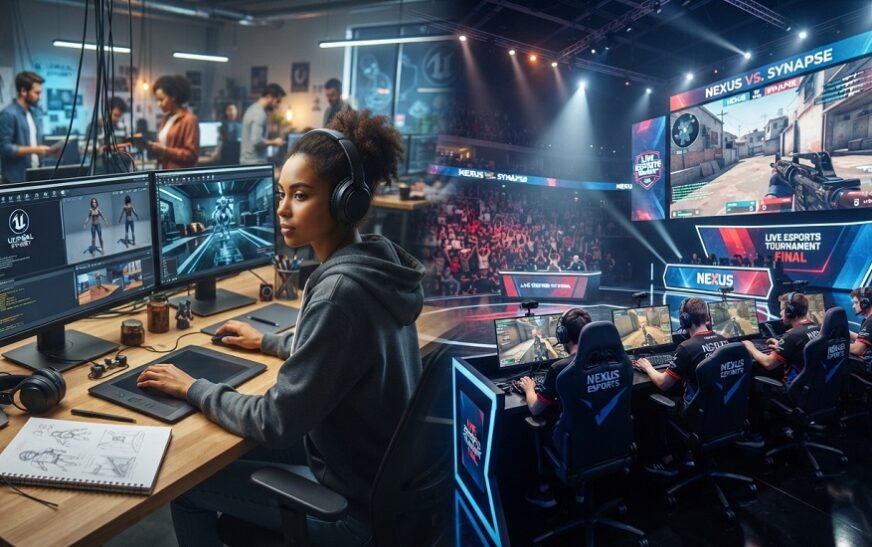
The U.S. gaming industry has grown into a large technology and entertainment ecosystem spanning programming, game design, art, animation, audio, writing, production, quality assurance, publishing, marketing, community management, and esports. For a broader look at the creative career in the USA across all roles and settings, explore our comprehensive guide.
A gaming industry career does not require every professional to become a programmer. Someone interested in storytelling can pursue game narrative, while an artist can work in environment design or animation. Business professionals can move into publishing or esports, and project managers can build careers as game producers.
The industry also includes both major publishers and independent studios. That creates different career environments, from highly specialized positions at large companies to broader responsibilities at smaller studios.
Types of Gaming Industry Careers
The game industry includes several major career families. For those interested in the broader entertainment sector, our entertainment industry careers guide explores opportunities in film, television, and production that often overlap with game development.
Game Development
Development roles include:
- Gameplay Programmer
- Engine Programmer
- Tools Programmer
- Network Programmer
- Technical Artist
- Game Designer
- Level Designer
- Game Producer
Art and Animation
Creative roles include:
- Concept Artist
- Character Artist
- Environment Artist
- 3D Artist
- Animator
- Technical Artist
- VFX Artist
- UI Artist
Writing and Narrative
Potential roles include:
- Narrative Designer
- Game Writer
- Story Editor
- Dialogue Writer
- Localization Writer
Quality Assurance
QA professionals test games to identify the following:
- Bugs
- Performance problems
- Gameplay issues
- User-interface problems
- Compatibility issues
Business and Publishing
Game companies also hire:
- Product Managers
- Marketing Specialists
- Community Managers
- Business Development Professionals
- Publishing Managers
- User Acquisition Specialists
- Data Analysts
Esports
Esports careers can include:
- Esports Manager
- Tournament Producer
- Team Manager
- Player Operations
- Broadcast Producer
- Partnerships Manager
- Community Manager
Game Developer Jobs
A game developer can work on the technical systems behind games.
Depending on the specialty, developers may build the following:
- Gameplay systems
- Physics
- Artificial intelligence
- Rendering
- Networking
- User interfaces
- Tools
- Game engines
- Online infrastructure
Programming languages and technical requirements differ by position, but common areas include C++, C#, scripting, mathematics, software engineering, and game-engine development.
Game Programming Career
Game programming is one of the most technically demanding gaming careers.
Potential specialties include the following:
Gameplay Programming
Builds mechanics, player interactions, combat, movement, progression, and other interactive systems.
Engine Programming
Works on rendering, physics, performance, memory, and core engine technology.
Graphics Programming
Focuses on visual rendering, shaders, lighting, materials, and graphical performance.
Network Programming
Develops multiplayer communication, synchronization, online services, and networking systems.
Tools Programming
Builds software that enables designers, artists, and other developers to work efficiently.
A programmer who develops transferable software-engineering skills can also move into non-gaming technology careers.
Game Developer Salary USA
Game developer compensation varies considerably because “game developer” covers multiple technical occupations.
Factors include:
- Programming specialization
- Experience
- Studio size
- Geographic market
- Technical complexity
- Seniority
- Management responsibilities
Many game developers fall within broader software-development occupations in labor statistics, while others work in art, animation, production, or design categories.
For this reason, candidates should compare salary data for the specific occupation rather than assume one universal game-developer salary.
Game Designer Career
A game designer focuses on how the game works and feels to the player.
Responsibilities can include:
- Game mechanics
- Rules
- Levels
- Progression
- Difficulty
- Player incentives
- Economy systems
- User experience
Game designers collaborate closely with programmers, artists, producers, writers, and product teams.
Game Designer Salary
Game designer compensation depends on:
- Experience
- Studio size
- Genre
- Location
- Specialty
- Seniority
Designers with specialized skills in areas such as:
- Systems design
- Economy design
- Technical design
- Level design
- Multiplayer systems
may have different career opportunities from generalist designers.
Game Design Career Path
A typical progression might include:
Junior Game Designer → Game Designer → Senior Game Designer → Lead Designer → Design Director
Career advancement generally requires demonstrated ability to design successful systems rather than simply years of experience.
Portfolio projects can be particularly useful for people entering the industry.
Unity and Unreal Engine Jobs
Unity and Unreal Engine are two major game-development platforms used across different types of interactive projects.
Unity-related roles can involve:
- Gameplay programming
- Tools
- Technical art
- Mobile development
- XR
- Simulation
Unreal-related roles can involve:
- Gameplay programming
- Rendering
- Technical art
- Virtual production
- Level design
- Environment development
Engine proficiency can make candidates more employable, but employers typically care about what candidates can actually build with the technology.
Unity’s current careers platform lists opportunities across engineering, data, AI and machine learning, sales, project management, and other functions.
Unity Developer Career
Unity developers often work with C# and Unity’s development ecosystem.
Possible projects include:
- Console games
- Mobile games
- PC games
- Virtual reality
- Augmented reality
- Simulation
- Interactive experiences
The engine is also used outside traditional gaming, which can provide additional career flexibility.
Unreal Engine Career
Unreal Engine professionals may work in the following:
- Game development
- Film
- Virtual production
- Architecture
- Simulation
- Training
- Interactive media
Unreal expertise can therefore provide opportunities across both gaming and broader 3D digital production.
Game QA Tester Jobs
Quality assurance is an important entry point for some gaming professionals.
QA testers may:
- Test game builds
- Reproduce bugs
- Verify fixes
- Test different platforms
- Check user interfaces
- Test game progression
- Document issues
QA is more than simply “playing games.”
Professional testers need:
- Attention to detail
- Documentation
- Patience
- Communication
- Reproducibility
- Technical understanding
QA Tester to Game Developer Path
QA can sometimes provide exposure to game development, but it does not automatically lead to programming or design roles.
Professionals seeking advancement should build additional skills in areas such as the following:
- Programming
- Game design
- Technical art
- Production
- Tools
Creating independent projects can help demonstrate readiness for a development position.
Game Narrative Writer Career
Narrative designers and game writers help create the story and emotional structure of games.
Their work may include:
- Dialogue
- Character development
- Quest writing
- Lore
- Cutscenes
- Story structures
- Worldbuilding
Narrative roles often require collaboration with designers because game stories must work within interactive systems.
Narrative Designer vs Game Writer
These roles can overlap but are not identical.
| Game Writer | Narrative Designer |
| Focuses heavily on written content | Designs how narrative works within gameplay |
| Dialogue and scripts | Story systems and player experience |
| Character writing | Narrative structure |
| Scene writing | Quest and progression integration |
| Writing-heavy | Cross-functional design |
The exact distinction depends on the studio.
Game Producer Career
A game producer manages the development process and helps teams deliver projects.
Responsibilities can include:
- Schedules
- Budgets
- Milestones
- Team coordination
- Risk management
- Dependencies
- Production planning
- Stakeholder communication
Producers can come from:
- Game development
- Project management
- QA
- Design
- Publishing
- Operations
Game Producer Career Path
A potential progression is the following:
Production Coordinator → Associate Producer → Producer → Senior Producer → Executive Producer
Senior producers may oversee large teams, multiple projects, or entire production portfolios.
Project management, communication, organization, and business judgment become increasingly important as responsibility grows.
Esports Career
Esports has developed its own professional ecosystem around competitive gaming.
Potential roles include:
- Esports Manager
- Team Manager
- Tournament Organizer
- Event Producer
- Broadcast Producer
- Partnerships Manager
- League Operations
- Player Operations
- Sponsorship Manager
- Community Manager
Esports can also create adjacent careers in media, marketing, broadcasting, social content, and event production.
Esports Manager Career
An esports manager may oversee the following:
- Teams
- Players
- Schedules
- Tournament participation
- Travel
- Partnerships
- Sponsorships
- Operations
The role combines sports management, entertainment, gaming knowledge, and business development.
Esports Manager Salary
Esports compensation varies considerably.
Factors include:
- League
- Organization size
- Game title
- Location
- Management responsibilities
- Sponsorship revenue
- Tournament scale
- Experience
A manager for a major professional organization may operate under very different conditions from an entry-level coordinator at a smaller esports company.
Because the esports market is relatively specialized, job-specific salary research is more useful than assuming one national salary figure.
Riot Games Careers
Riot Games is one example of a large gaming employer with careers across multiple disciplines.
Its current career listings include roles in areas such as the following:
- Software engineering
- Esports
- Production
- Brand management
- Operations
- Security
- Art
- Business development
Riot’s career system allows candidates to search by craft, product, and location.
This demonstrates the range of professional backgrounds that can lead into major game companies.
Activision Careers
Large publishers such as Activision and its broader corporate ecosystem employ professionals across:
- Game development
- Engineering
- Art
- Design
- Production
- Marketing
- Publishing
- Business operations
- Quality assurance
Applicants should look beyond the title “game developer” because large publishers employ substantial teams in business and operational roles.
Game Industry Jobs Beyond Development
People sometimes assume every gaming job requires programming skills.
That is not the case.
Gaming companies also need:
- Account managers
- Marketing professionals
- Community managers
- Recruiters
- Finance professionals
- Legal professionals
- Data analysts
- Product managers
- User researchers
- Customer-support specialists
This makes gaming accessible to professionals from many educational and occupational backgrounds.
Indie Game Developer Career
Independent game development allows individuals or small teams to create and publish their own projects.
An indie developer may handle:
- Programming
- Design
- Art
- Audio
- Marketing
- Publishing
- Community management
This means indie development can require broader skills than working within a large studio.
Professionals may work independently or as part of small teams.
Indie Game Developer Income
Indie-game income is highly unpredictable.
Revenue can come from:
- Game sales
- Digital storefronts
- Subscriptions
- Downloadable content
- In-game purchases
- Licensing
- Crowdfunding
Some independent games become commercially successful, while many generate limited revenue.
This makes indie development better understood as an entrepreneurial career rather than a predictable salary path.
Game Development Jobs USA
The U.S. game industry has a substantial employment ecosystem, although employment can fluctuate.
The Entertainment Software Association’s 2026 industry report identified more than 250,800 total U.S. jobs supported by the video-game industry, including direct and indirect employment. The report also noted changes in employment between its 2023 and 2025 databases, demonstrating that industry size and hiring conditions can shift significantly.
Professionals should therefore evaluate both long-term industry demand and current studio hiring conditions.
Game Industry Career Locations
Major game development employment markets have historically included the following:
- California
- Washington
- Texas
- New York
- Massachusetts
- North Carolina
- Georgia
- Florida
Remote work has also expanded the geographic options available to some game professionals, although studios increasingly differ in their remote and hybrid policies.
Skills for Gaming Careers
The skills required depend on the role.
Programming
- C++
- C#
- Software engineering
- Mathematics
- Debugging
- Algorithms
Design
- Game systems
- Level design
- User experience
- Prototyping
- Player psychology
Art
- 2D design
- 3D modeling
- Texturing
- Animation
- Lighting
Production
- Project management
- Scheduling
- Communication
- Risk management
Narrative
- Writing
- Storytelling
- Dialogue
- Worldbuilding
- Interactive narrative
Game Industry Portfolio
A portfolio is especially important for competitive game-development roles.
Depending on the career, candidates can show the following:
Programmer
Playable prototypes, technical projects, and code samples.
Designer
Game systems, level designs, prototypes, and design documents.
Artist
Character, environment, animation, or technical-art portfolios.
Writer
Interactive scripts, dialogue, narrative samples, and game-writing projects.
Producer
Projects delivered, responsibilities managed, timelines, and measurable outcomes.
A portfolio should make your individual contribution clear.
Game Career Without a Degree
A degree can be useful, particularly for technical and specialized roles, but not every game career requires one.
Alternative pathways can include the following:
- Self-directed learning
- Game jams
- Mod development
- Independent projects
- QA experience
- Internships
- Bootcamps
- Portfolio development
- Community projects
The most important question is whether you can demonstrate job-ready capability.
Game Jams and Entry-Level Experience
Game jams can be valuable because they teach professionals to:
- Work under deadlines
- Collaborate
- Prototype quickly
- Communicate across disciplines
- Finish projects
A finished small game can sometimes demonstrate more practical ability than an incomplete large project.
For job seekers, a portfolio of completed projects can help hiring teams evaluate real skills.
AI Impact on Gaming Careers
AI is affecting game development in areas such as the following:
- Asset generation
- Dialogue assistance
- Prototyping
- Testing
- Animation
- Localization
- Development tools
- Procedural content
The effect differs by occupation.
Some repetitive tasks may become faster or more automated, while creative direction, systems thinking, technical leadership, and quality control remain important.
Professionals who understand both AI tools and game-development fundamentals may be better positioned as workflows evolve.
Remote Gaming Careers
Some gaming roles can be performed remotely, particularly:
- Programming
- QA
- Art
- Writing
- Production
- Community management
- Marketing
- Analytics
Other roles may require studio access, specialized equipment, or in-person collaboration.
Candidates should verify each company’s current remote policy rather than assuming a gaming position is remote.
How to Get a Gaming Industry Job
A strong approach is to choose one specialty and build evidence around it.
Programmer
Build playable projects using Unity or Unreal.
Designer
Create playable prototypes and explain your design decisions.
Artist
Develop a focused portfolio around characters, environments, UI, or technical art.
Writer
Create interactive narrative samples.
Producer
Document projects, schedules, team coordination, and completed deliverables.
QA
Develop professional testing, documentation, and bug-reporting skills.
Gaming Industry Career Advancement
Gaming careers can develop through both specialist and leadership paths.
For example:
Junior Programmer → Programmer → Senior Programmer → Lead Programmer → Technical Director
Junior Designer → Game Designer → Senior Designer → Lead Designer → Design Director
QA Tester → Senior QA → QA Lead → QA Manager → QA Director
Associate Producer → Producer → Senior Producer → Executive Producer
Progression usually comes through responsibility, specialized expertise, project results, and leadership ability.
Key Takeaways
- The gaming industry includes programming, design, art, animation, narrative, production, QA, publishing, marketing, community, and esports careers.
- Game development jobs are not limited to programmers; large studios also need business, legal, finance, communications, and operations professionals.
- Unity and Unreal Engine skills can create opportunities across game development and related interactive-media work.
- QA can provide industry experience, but professionals need additional technical or design skills to transition into development roles.
- Game narrative careers combine writing with interactive design and worldbuilding.
- Game producers manage schedules, teams, risks, milestones, and project delivery.
- Esports offers management, production, partnerships, broadcasting, and operations careers in addition to professional player roles.
- Indie development provides entrepreneurial opportunities, but income can be highly unpredictable.
- Game-industry portfolios and completed projects can be particularly valuable when entering programming, design, art, writing, and production roles.
- AI is changing game-development workflows, making technology literacy increasingly useful while increasing the importance of creative judgment and technical expertise.
Frequently Asked Questions
Is gaming a good career?
Gaming can be a strong career for people who enjoy technology, storytelling, design, programming, art, or production. The industry is competitive, so specialization and portfolio quality are important.
What is the best gaming career?
There is no universal best role. Programming can offer strong technical mobility; design suits systems-oriented creatives, art suits visual specialists, writing suits storytellers, and production suits organizational leaders.
How much do game developers make?
Compensation varies by the specific occupation. Programmers may fall within software-development salary categories, while artists, designers, producers, and writers belong to different labor classifications.
Do I need a degree to work in games?
Not always. Portfolio-driven roles can sometimes be entered through projects, game jams, self-directed learning, internships, or other experience. Some employers and technical positions prefer degrees.
Is Unity or Unreal better for getting a job?
Both can be useful. The better choice depends on the role and target studios. Candidates should research the engines used by employers they want to join.
Can a QA tester become a game developer?
Yes, but QA experience alone does not guarantee a development position. Learning programming, design, tools, or technical art and building projects can strengthen the transition.
Can writers work in the gaming industry?
Yes. Game writers and narrative designers work on dialogue, characters, quests, worldbuilding, story structure, and interactive narrative.
Is esports a good career?
Esports offers careers in management, operations, broadcasting, partnerships, marketing, and production. Employment can be less predictable than traditional corporate careers, so specialization and transferable business skills are valuable.
Can indie game developers make a lot of money?
Some do, but income is highly unpredictable. Independent developers carry significant business, marketing, development, and financial risk.
Are gaming careers remote?
Some programming, art, QA, writing, production, marketing, and community roles can be remote, but policies vary by company and role.
Conclusion
The gaming industry provides a diverse career ecosystem that combines technology, entertainment, creative work, and business. Programming is only one part of the sector. Designers, artists, writers, producers, QA professionals, marketers, community teams, and esports managers all contribute to the development and commercial success of games.
The strongest career strategy is to choose a specific discipline and build demonstrable evidence of your ability. A programmer should build working projects, a designer should create playable prototypes, an artist should develop a focused portfolio, and a producer should demonstrate successful project coordination.
Large studios offer specialized roles and structured teams, while independent development can provide greater creative control and broader responsibilities. Both environments can lead to strong careers, but they require different approaches to skills, networking, income expectations, and career development.
As AI and real-time technologies change production, professionals who combine technical skills with creativity, communication, and problem-solving are likely to remain valuable across gaming and related interactive-media industries.