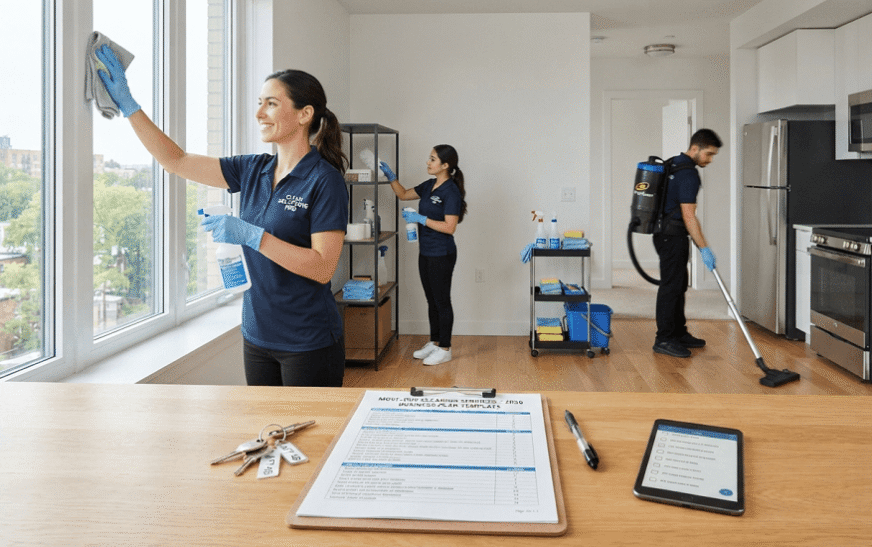


Starting a move out cleaning business is one of the most affordable ways to become your own boss, but many new business owners overlook one of the most important investments they’ll ever make: business insurance.
It’s easy to focus on purchasing cleaning supplies, creating a website, or finding your first clients, and skipping insurance is one of the most costly move-out cleaning business mistakes you can make. However, one accident, such as damaging an expensive appliance, breaking a customer’s window, or a client slipping on a wet floor, could cost thousands of dollars if your business isn’t properly protected.
Insurance isn’t just about complying with legal requirements. It demonstrates professionalism, builds trust with landlords and property managers, protects your finances, and gives you confidence to take on larger and more profitable jobs.
The good news is that cleaning business insurance is often much more affordable than many people expect. For many solo operators, the annual cost is small compared to the financial protection it provides.
In this guide, you’ll learn whether insurance is required for a move out cleaning business, the different types of coverage available, average costs, common mistakes to avoid, and how to choose the right insurance for your business.
Why Insurance Matters for a Move Out Cleaning Business
Many new business owners assume that because they’re working alone or cleaning residential properties, insurance isn’t necessary.
In reality, even small cleaning businesses face risks every day.
Imagine accidentally
- Scratching hardwood flooring while moving furniture.
- Breaking a glass shower door.
- Damaging an expensive stainless-steel refrigerator.
- Spilling chemicals on a customer’s carpet.
- Cracking a stone countertop.
- Knocking over a valuable decoration.
- Leaving a wet floor that causes someone to slip.
Even if the damage is accidental, your business could still be held financially responsible.
Without insurance, these expenses would likely come directly from your own pocket.
Business insurance acts as a financial safety net, helping protect both your company and your personal finances.
Is Insurance Required by Law?
One of the most common questions new business owners ask is
“Can I legally start a move-out cleaning business without insurance?”
The answer depends on where your business operates.
In many areas, general liability insurance isn’t legally required for a solo cleaning business. However, other types of insurance—such as workers’ compensation—may become mandatory once you hire employees.
Even when insurance isn’t legally required, many clients expect it.
For example, property managers, commercial clients, apartment complexes, and real estate companies often require proof of insurance before awarding contracts.
Without coverage, you may lose opportunities to work with some of your most valuable long-term clients.
Why Many Customers Prefer Insured Cleaning Companies
Insurance doesn’t just protect your business—it also reassures customers.
When comparing two similar cleaning companies, many customers naturally choose the one that is fully insured because it reduces their perceived risk.
Being insured shows that you:
- Take your business seriously.
- Are prepared for unexpected situations.
- Value professionalism.
- Understand industry standards.
- Are committed to protecting your customers’ property.
Mentioning that your business is insured on your website, Google Business Profile, and marketing materials can strengthen trust and improve conversion rates, and pairing insurance with a professional move-out cleaning contract template further demonstrates that you operate as a legitimate, trustworthy business.
What Can Happen Without Insurance?
Many cleaning businesses operate for years without ever filing an insurance claim.
However, the purpose of insurance isn’t to cover routine work—it’s to protect your business when unexpected events occur.
Some examples include:
Property Damage
Accidentally scratching hardwood floors, damaging furniture, breaking windows, or staining carpets could result in expensive repair or replacement costs.
Customer Injuries
Imagine a customer entering a room while the floor is still wet and slipping.
If you’re found responsible, medical bills and legal expenses could become significant.
Equipment Theft
Commercial vacuums, carpet cleaners, steam cleaners, and pressure washers represent a considerable investment.
If your equipment is stolen from your vehicle or storage location, replacing everything out of pocket could disrupt your business.
Vehicle Accidents
If you use a vehicle to transport cleaning supplies between jobs, accidents may create additional financial exposure depending on how your vehicle is insured.
Legal Costs
Even when you believe you’ve done nothing wrong, defending yourself against a lawsuit can be expensive.
Insurance may help cover legal defense costs depending on your policy and the circumstances.
Types of Insurance Every Cleaning Business Should Consider
Not every policy is necessary for every business.
The right combination depends on factors such as the following:
- Business size
- Number of employees
- Services offered
- Annual revenue
- Whether you use company vehicles
- Commercial versus residential clients
Let’s look at the most common types of insurance available for cleaning businesses.
General Liability Insurance
General liability insurance is usually considered the foundation of business protection for cleaning companies.
It helps cover claims involving accidental property damage, customer injuries, and certain legal expenses.
Examples include:
- Breaking an expensive light fixture.
- Damaging hardwood flooring.
- Cracking a marble countertop.
- Accidentally staining furniture.
- A customer slipping on a recently cleaned floor.
Because cleaning professionals regularly work inside customers’ homes and rental properties, this is often the first policy business owners purchase.
What General Liability Insurance May Cover
Coverage often includes:
- Property damage
- Bodily injury claims
- Legal defense costs
- Medical payments
- Advertising injury (depending on the policy)
Always review the specific terms of your insurance policy, as coverage limits, exclusions, and deductibles vary by insurer.
Workers’ Compensation Insurance
If you plan to hire employees, workers’ compensation insurance may become legally required depending on your location.
This coverage generally helps if an employee is injured while performing work-related duties.
Examples include:
- Slipping while mopping floors.
- Falling from a ladder.
- Chemical exposure.
- Lifting-related back injuries.
- Cuts from broken glass.
Besides helping with medical expenses and lost wages where applicable, having workers’ compensation coverage demonstrates that you’re operating as a responsible employer.
Commercial Auto Insurance
Many cleaning businesses travel between multiple properties every day while transporting equipment and supplies.
If you use a vehicle primarily for business purposes, personal auto insurance may not provide sufficient coverage in every situation.
Commercial auto insurance is designed to help protect vehicles used for business operations and may cover damages resulting from certain accidents, depending on the policy.
This becomes especially important as your business grows and your team spends more time traveling between customer locations.
Professional Liability Insurance
Unlike general liability insurance, which focuses on physical damage and injuries, professional liability insurance addresses claims related to the services you provide.
Although it’s more commonly associated with consultants and licensed professionals, some cleaning businesses choose this coverage when working under contracts that include service guarantees or performance expectations.
Whether this policy is necessary depends on the type of work you perform and the requirements of your clients.
Business Owner’s Policy (BOP)
As your company grows, you may qualify for a Business Owner’s Policy (BOP).
A BOP typically combines several common coverages into one policy, which can simplify insurance management and sometimes reduce overall costs.
Depending on the provider, a BOP may include the following:
- General liability coverage
- Commercial property insurance
- Business interruption coverage
For growing cleaning businesses with office space or valuable equipment, this can be a practical option to explore.
Inland Marine Insurance (Equipment Coverage)
Despite its name, Inland Marine Insurance has nothing to do with boats or ships. For cleaning businesses, it’s designed to help protect the tools and equipment you transport between job sites.
Since move-out cleaning businesses frequently carry expensive equipment from one property to another, this type of coverage can be especially valuable.
It may help cover portable business equipment such as the following:
- Commercial vacuums
- Carpet cleaning machines
- Steam cleaners
- Pressure washers
- Floor polishers
- Extension poles
- Toolkits
- Specialized cleaning equipment
Without this protection, replacing stolen or damaged equipment could cost thousands of dollars and temporarily prevent you from accepting new jobs.
For businesses investing heavily in professional equipment, Inland Marine Insurance is worth considering as part of an overall risk management strategy.
Umbrella Insurance
As your business grows, your exposure to risk increases.
You may begin.
- Managing multiple crews.
- Working on larger homes.
- Serving commercial properties.
- Signing contracts with property management companies.
- Cleaning luxury homes.
An umbrella insurance policy provides additional liability protection beyond the limits of your standard policies.
For example, if a claim exceeds your general liability coverage limit, umbrella insurance may provide additional financial protection depending on the policy terms.
Many growing service businesses purchase umbrella coverage once they begin handling higher-value projects.
What Is a Janitorial Bond?
Many new cleaning business owners confuse bonding with insurance, but they serve different purposes.
Insurance primarily protects your business from financial losses caused by covered events.
A janitorial bond primarily protects your customer against certain dishonest acts, such as employee theft, subject to the bond’s terms and conditions.
Being a bonded cleaning company can strengthen your credibility, particularly when working inside customers’ homes or offices.
Some commercial clients and property management companies specifically request bonded cleaning contractors before signing service agreements.
Insurance vs Bonding
Understanding the difference helps you choose the right protection for your business.
| Feature | Insurance | Bond |
| Primary purpose | Protects your business from covered losses | Protects the customer from certain dishonest acts |
| Covers accidental property damage | ✔ | ✘ |
| Covers customer injuries | ✔ | ✘ |
| May cover legal defense | ✔ | ✘ |
| Helps build customer trust | ✔ | ✔ |
| Often requested by commercial clients | ✔ | ✔ |
Many established cleaning companies carry both insurance and bonding because they serve different purposes.
How Much Does a Move-Out Cleaning Business Insurance Cost?
Insurance costs vary depending on several factors, including your location, annual revenue, number of employees, services offered, and coverage limits.
For many small owner-operated cleaning businesses, insurance remains one of the more affordable business expenses.
Typical annual costs may include the following:
| Policy Type | Typical Annual Cost (USD) |
| General Liability Insurance | $350–$1,200 |
| Business Owner’s Policy (BOP) | $500–$1,500 |
| Commercial Auto Insurance | $800–$2,500 |
| Workers’ Compensation | Varies by payroll and state |
| Inland Marine Insurance | $150–$600 |
| Umbrella Insurance | $300–$1,000 |
These figures are general estimates. Actual premiums depend on your insurer, business profile, and local regulations.
Although insurance represents an ongoing operating expense, many business owners consider it a worthwhile investment compared to the financial consequences of a major claim.
What Affects Your Insurance Premium?
Insurance companies evaluate several factors when calculating premiums.
Common considerations include:
Business Location
Some areas have higher claim rates, labor costs, or litigation risks, which may influence pricing.
Annual Revenue
Businesses generating higher revenue often perform more jobs, increasing overall exposure to potential claims.
Number of Employees
Hiring staff generally increases insurance costs because additional workers create greater exposure to workplace injuries and liability risks.
Services You Offer
Offering specialty services such as:
- Carpet cleaning
- Pressure washing
- Exterior cleaning
- High-reach cleaning
- Heavy equipment use
may increase premiums because they involve different levels of risk.
Claims History
Businesses with previous insurance claims may pay higher premiums than companies with a clean claims history.
Maintaining strong safety procedures and quality control can help reduce both accidents and future insurance costs.
Coverage Limits
Policies with higher coverage limits usually have higher premiums but provide greater financial protection if a covered claim occurs.
Choose limits that reflect the size of your business and the types of properties you service.
How to Choose the Right Insurance Provider
Not every insurance company specializes in cleaning businesses.
Look for providers experienced in serving contractors or cleaning companies, as they’ll better understand the risks associated with your work.
When comparing providers, evaluate more than just the monthly premium.
Consider:
- Financial stability.
- Customer reviews.
- Claims handling reputation.
- Coverage flexibility.
- Policy exclusions.
- Deductibles.
- Customer support.
- Availability of bundled policies.
Selecting the right insurer can save significant time and frustration if you ever need to file a claim.
Questions to Ask Before Buying Insurance
Before purchasing a policy, ask the provider questions such as:
- What exactly does this policy cover?
- What exclusions should I know about?
- What is the deductible?
- Are my tools and equipment covered while traveling?
- Are subcontractors covered?
- Does this policy cover accidental damage inside customer homes?
- Are legal defense costs included?
- Can I easily obtain a Certificate of Insurance (COI) for commercial clients?
- How quickly are claims typically processed?
Understanding these details before buying coverage helps avoid surprises later.
Common Insurance Mistakes New Cleaning Businesses Make
Many new business owners purchase insurance without fully understanding what they’re buying.
Avoid these common mistakes.
Choosing the Cheapest Policy
The lowest premium isn’t always the best value.
A policy with major exclusions or very low coverage limits may leave your business exposed when you need protection most.
Instead, compare the overall value of each policy.
Waiting Too Long to Buy Insurance
Some business owners delay purchasing insurance until they secure larger contracts.
However, accidents can happen during your very first job.
Buying coverage before serving customers reduces unnecessary financial risk.
Assuming Personal Insurance Covers Business Activities
Personal auto or homeowners insurance may not cover business-related incidents.
If you regularly transport equipment or use your vehicle for work, confirm what your existing policies do and don’t cover.
Not Reviewing Policies Annually
As your business grows, your insurance needs may change.
Review your coverage at least once a year, especially after:
- Hiring employees.
- Purchasing expensive equipment.
- Expanding service areas.
- Adding new cleaning services.
- Increasing annual revenue.
Regular reviews help ensure your coverage keeps pace with your business.
Failing to Keep Documentation
Maintain organized records of:
- Insurance policies.
- Certificates of Insurance (COIs).
- Renewal dates.
- Claims history.
- Equipment purchases.
- Receipts for high-value tools.
Good recordkeeping simplifies renewals and claims if problems arise.
Do Solo Cleaning Business Owners Need Insurance?
A common misconception is that insurance is only necessary once you hire employees or start working with commercial clients.
In reality, solo cleaning business owners often face many of the same risks as larger companies.
For example, imagine you accidentally
- Crack a customer’s glass cooktop while cleaning.
- Damage an expensive hardwood floor.
- Spill a cleaning chemical on a designer rug.
- Knock over an antique vase.
- Scratch stainless steel appliances while moving them.
Even though you’re the only person working, you could still be responsible for repairing or replacing damaged property.
Insurance provides financial protection that helps you recover from unexpected incidents without jeopardizing your business or personal savings.
For many solo operators, carrying general liability insurance is one of the simplest ways to demonstrate professionalism while reducing financial risk.
Insurance Can Help You Win More Clients
Insurance isn’t just about protecting your business—it can also become a competitive advantage.
Many customers compare several cleaning companies before making a decision.
When one business is fully insured and another isn’t, customers often feel more comfortable choosing the insured provider.
Insurance communicates that your business is
- Professional
- Reliable
- Prepared
- Responsible
- Committed to protecting customer property
Mentioning that you’re licensed and insured on your website, Google Business Profile, social media profiles, proposals, and business cards can increase customer confidence.
Why Property Managers Often Require Proof of Insurance
Property managers, apartment communities, and real estate agencies generally work with multiple service providers.
To reduce their own risk, many require contractors to provide a Certificate of Insurance (COI) before work begins.
A COI is a document issued by your insurance company that confirms the following:
- Your policy is active.
- The coverage types you carry.
- Your policy limits.
- The policy’s effective dates.
Having a COI readily available can help you secure larger contracts and recurring work with professional clients.
If your long-term goal is to work with property management companies, landlords, or commercial customers, obtaining appropriate insurance early can strengthen your credibility.
Insurance as Part of Your Business Growth Strategy
As your business expands, your insurance needs will likely change.
For example:
Stage 1 – Solo Business
Typical priorities:
- General liability insurance
- Equipment protection (if needed)
Stage 2 – Hiring Employees
You may also need:
- Workers’ compensation insurance
- Higher liability limits
Stage 3 – Multiple Cleaning Crews
Growing businesses often review:
- Business Owner’s Policy (BOP)
- Commercial auto insurance
- Umbrella insurance
- Higher equipment coverage
Rather than viewing insurance as an expense, think of it as an investment that supports sustainable growth.
Review your policies regularly so they continue to match your business size and services.
Frequently Asked Questions
Is insurance legally required for a move-out cleaning business?
Requirements vary by location. In many areas, a solo cleaning business may not be legally required to carry general liability insurance. However, other policies—such as workers’ compensation—may become mandatory when you hire employees. Always check the regulations that apply where your business operates.
What Is the Most Important Insurance for a Cleaning Business?
For many move-out cleaning businesses, general liability insurance is considered the foundation because it helps protect against accidental property damage, customer injuries, and related legal claims covered by the policy.
How Much Does Cleaning Business Insurance Cost?
Costs depend on factors such as the following:
- Business location
- Annual revenue
- Number of employees
- Services offered
- Coverage limits
- Claims history
Many solo operators pay a few hundred to around a thousand dollars per year for general liability coverage, while businesses with employees or additional policies typically pay more.
Can I Get Cleaning Contracts Without Insurance?
Some residential customers may not ask for proof of insurance.
However, many property managers, commercial clients, apartment complexes, and real estate agencies require insured contractors before awarding contracts.
Being insured can improve your credibility and increase access to higher-value opportunities.
What’s the Difference Between Being Licensed, Bonded, and Insured?
These terms are often confused, but they serve different purposes.
- Licensed: Meets applicable government or local registration requirements.
- Bonded: Provides financial protection to customers in certain situations defined by the bond.
- Insured: Protects your business against covered risks such as property damage or liability claims.
Many established cleaning companies are licensed (where required), bonded, and insured because each serves a different purpose.
Should I Increase My Insurance Coverage as My Business Grows?
Yes. As you hire employees, purchase expensive equipment, expand into new markets, or begin serving commercial clients, it’s a good idea to review your coverage with your insurance provider to make sure it still reflects your business needs.
Conclusion
Insurance is one of the smartest investments you can make when starting or growing a move-out cleaning business. While it may not always be legally required, it provides financial protection, strengthens your professional reputation, and helps you pursue larger opportunities with confidence.
Whether you’re operating as a solo cleaner or managing multiple crews, having the right insurance coverage can protect your business from unexpected setbacks that might otherwise threaten your finances.
The best approach is to evaluate your risks, compare several providers, understand exactly what each policy covers, and review your coverage regularly as your business evolves. Insurance should be viewed as part of your long-term business strategy—not simply another expense.
By combining proper insurance with strong pricing, quality service, effective marketing, and clear operational systems, you’ll be in a much stronger position to build a sustainable and trusted move-out cleaning business.