
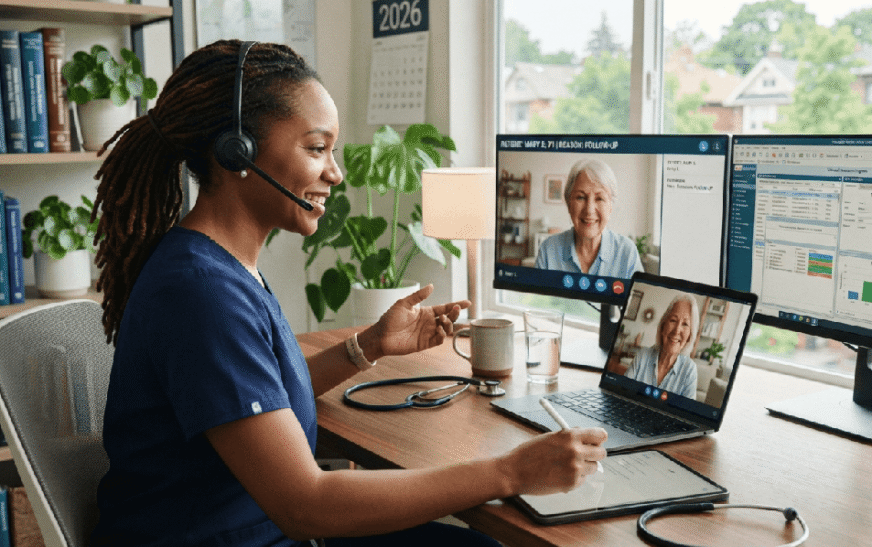
Healthcare is no longer limited to hospitals, clinics, and physician offices. Advances in digital technology, secure telemedicine platforms, electronic health records, and virtual patient monitoring have created thousands of remote healthcare opportunities across the United States. Today, licensed clinicians, healthcare administrators, medical coders, health IT specialists, and patient support professionals can build successful careers while working from home.
The rapid expansion of telehealth has transformed how healthcare services are delivered. Patients now receive consultations, chronic disease management, mental health counseling, follow-up appointments, and preventive care through secure virtual platforms. At the same time, healthcare organizations increasingly rely on remote teams to manage medical documentation, insurance authorizations, clinical coordination, and digital health operations.
Whether you’re interested in becoming a telehealth nurse, virtual care coordinator, remote medical coder, health informatics specialist, or telemedicine provider, this guide explores career paths, salaries, required skills, certifications, and long-term opportunities in the growing remote healthcare industry.
Why Remote Healthcare Jobs Are Growing
Healthcare organizations are expanding remote work opportunities to improve patient access, reduce operational costs, and address workforce shortages.
Key factors driving growth include the following:
- Expansion of telemedicine services
- Increased adoption of virtual care
- Growth of electronic health records
- Advances in digital health technology
- Rising demand for chronic disease management
- Healthcare workforce shortages
- Rural healthcare access initiatives
- AI-assisted healthcare workflows
- Flexible workforce strategies
- Increased patient preference for virtual care
These trends continue to create new career opportunities across clinical and non-clinical healthcare roles. For a complete overview of related opportunities across the broader healthcare career landscape, explore our detailed guide to healthcare jobs in the USA.
Remote Healthcare Jobs
Remote healthcare positions support patient care, healthcare administration, technology, and clinical operations without requiring employees to work on-site every day.
Common remote healthcare careers include:
- Telehealth Nurse
- Medical Coder
- Medical Biller
- Health Information Specialist
- Remote Case Manager
- Virtual Care Coordinator
- Clinical Documentation Specialist
- Health Informatics Analyst
- Medical Transcriptionist
- Patient Access Representative
- Remote Prior Authorization Specialist
- Telemedicine Physician Assistant
Many employers offer fully remote, hybrid, or flexible work arrangements depending on the role.
Telehealth Careers
Telehealth careers involve delivering healthcare services through secure digital communication platforms.
Professionals working in telehealth may provide:
- Virtual consultations
- Patient education
- Chronic disease monitoring
- Mental health counseling
- Medication management
- Follow-up appointments
- Remote patient assessments
- Care coordination
Telehealth professionals combine clinical expertise with digital communication skills to deliver high-quality patient care remotely.
Work-From-Home Medical Jobs
Many healthcare positions now support remote work while maintaining patient confidentiality and regulatory compliance.
Popular work-from-home medical jobs include:
- Medical Coder
- Medical Biller
- Clinical Documentation Specialist
- Medical Scribe
- Telehealth Nurse
- Case Manager
- Utilization Review Nurse
- Health Coach
- Medical Transcriptionist
- Patient Scheduler
These careers typically require secure internet access, healthcare software proficiency, and knowledge of privacy regulations.
Virtual Care Jobs
Virtual care extends beyond video appointments. Healthcare professionals support patients through various digital health services.
Examples include:
- Remote patient monitoring
- Care coordination
- Medication adherence programs
- Chronic disease management
- Behavioral health support
- Nutrition coaching
- Health education
- Preventive care follow-up
Virtual care careers continue expanding as healthcare systems invest in digital health infrastructure.
Telemedicine Career Opportunities
Telemedicine professionals provide healthcare services remotely using secure communication technologies.
Career options include:
- Telemedicine Physician
- Telemedicine Nurse Practitioner
- Telemedicine Physician Assistant
- Telehealth Registered Nurse
- Behavioral Health Therapist
- Virtual Primary Care Provider
- Telepharmacist
- Remote Clinical Consultant
Telemedicine improves access to healthcare while creating flexible employment opportunities for licensed professionals.
Remote Clinical Jobs
Some clinical responsibilities can now be performed remotely without compromising patient care.
Examples include:
- Telephone triage
- Care coordination
- Chronic disease management
- Case management
- Utilization review
- Clinical documentation
- Patient education
- Virtual follow-up care
Remote clinical professionals continue collaborating with hospitals, physician groups, insurers, and healthcare systems.
Health IT Remote Work
Health Information Technology (Health IT) professionals support healthcare organizations by managing digital systems, data security, analytics, and electronic medical records.
Popular remote health IT careers include the following:
- Health Informatics Analyst
- Clinical Systems Analyst
- EHR Implementation Specialist
- Healthcare Data Analyst
- Clinical Documentation Improvement Specialist
- Healthcare Cybersecurity Analyst
- Medical Records Specialist
- Health Information Manager
As healthcare technology continues evolving, health IT remains one of the fastest-growing remote healthcare sectors.
Telehealth Nurse Jobs
Telehealth nurses provide patient care remotely using secure communication platforms such as video conferencing, phone consultations, and patient portals. They assess symptoms, educate patients, coordinate follow-up care, and support physicians without requiring in-person visits.
Typical responsibilities include:
- Conducting virtual patient assessments
- Providing health education
- Monitoring chronic conditions
- Reviewing medications
- Coordinating referrals
- Documenting patient interactions
- Supporting post-discharge care
- Triaging non-emergency cases
Common Employers
- Hospital systems
- Telemedicine companies
- Insurance providers
- Primary care networks
- Home healthcare organizations
- Digital health startups
Typical Salary
$75,000–$115,000 annually
Telehealth nursing continues to expand as healthcare providers increase virtual care services, and for a deeper look at nursing careers and specializations, explore our comprehensive guide to nursing roles and career pathways.
Remote Medical Coder
Medical coders review clinical documentation and assign standardized diagnosis and procedure codes for billing and insurance purposes.
Primary duties include:
- Reviewing medical records
- Assigning ICD-10-CM, CPT, and HCPCS codes
- Ensuring coding accuracy
- Supporting reimbursement processes
- Maintaining compliance with healthcare regulations
- Communicating with providers regarding documentation
Recommended Certifications
- Certified Professional Coder (CPC)
- Certified Coding Specialist (CCS)
- Certified Inpatient Coder (CIC)
Typical Salary
$55,000–$85,000 annually
Medical coding is one of the most established remote careers in healthcare.
Virtual Triage Nurse
Virtual triage nurses evaluate patient symptoms remotely and determine the appropriate level of medical care.
Common responsibilities include:
- Assessing symptoms by phone or video
- Prioritizing patient needs
- Providing home-care guidance
- Referring patients to emergency services when necessary
- Scheduling follow-up appointments
- Documenting assessments
Skills Required
- Strong clinical judgment
- Communication skills
- Critical thinking
- Patient education
- Emergency assessment knowledge
Typical Salary
$80,000–$120,000 annually
These professionals help reduce unnecessary emergency department visits while improving patient access to care.
Remote Health Coach
Health coaches work with individuals to improve long-term health through lifestyle guidance and behavioral support.
Areas of focus include:
- Weight management
- Diabetes prevention
- Nutrition
- Physical activity
- Stress management
- Smoking cessation
- Chronic disease management
- Wellness planning
Common Employers
- Insurance companies
- Corporate wellness providers
- Digital health platforms
- Hospitals
- Telehealth organizations
Typical Salary
$50,000–$85,000 annually
Demand for remote health coaching continues to grow alongside preventive healthcare initiatives.
Remote Prior Authorization Specialist
Prior authorization specialists coordinate insurance approvals for medications, procedures, and medical services.
Responsibilities include:
- Reviewing insurance requirements
- Preparing authorization requests
- Communicating with providers and insurers
- Monitoring approvals
- Resolving documentation issues
- Maintaining compliance records
Typical Salary
$50,000–$75,000 annually
Healthcare organizations increasingly support remote work for experienced authorization specialists.
Telemedicine Physician Assistant
Physician assistants (PAs) can provide many healthcare services remotely under state laws and supervising physician agreements.
Common duties include:
- Conducting virtual consultations
- Diagnosing common illnesses
- Prescribing medications (where permitted)
- Managing chronic conditions
- Ordering diagnostic tests
- Providing follow-up care
Typical Salary
$110,000–$155,000 annually
Telemedicine expands career flexibility for experienced physician assistants while improving access to healthcare in underserved areas.
Remote Health Informatics Careers
Health informatics professionals combine healthcare knowledge with information technology to improve patient care and healthcare operations.
Typical job titles include the following:
- Health Informatics Analyst
- Clinical Informatics Specialist
- EHR Implementation Consultant
- Healthcare Data Analyst
- Health Information Manager
- Clinical Systems Analyst
Responsibilities
- Managing healthcare data
- Improving EHR workflows
- Supporting clinical decision-making
- Analyzing healthcare performance metrics
- Ensuring regulatory compliance
- Optimizing digital health systems
Typical Salary
$80,000–$130,000 annually
As healthcare becomes more data-driven, health informatics remains one of the fastest-growing remote specialties.
Remote Medical Transcriptionist
Medical transcriptionists convert physician dictation and clinical recordings into accurate medical documentation.
Primary responsibilities include:
- Listening to recorded medical reports
- Preparing clinical documentation
- Editing physician notes
- Reviewing terminology for accuracy
- Maintaining patient confidentiality
- Updating electronic medical records
Typical Salary
$40,000–$65,000 annually
Although AI-assisted transcription tools are increasingly common, experienced transcriptionists remain valuable for quality assurance and documentation accuracy.
Remote Healthcare Salary Comparison
Below is a general overview of salary ranges for common remote healthcare careers in the United States.
| Career | Typical Annual Salary |
| Medical Transcriptionist | $40,000–$65,000 |
| Prior Authorization Specialist | $50,000–$75,000 |
| Health Coach | $50,000–$85,000 |
| Remote Medical Coder | $55,000–$85,000 |
| Telehealth Nurse | $75,000–$115,000 |
| Health Informatics Analyst | $80,000–$130,000 |
| Virtual Triage Nurse | $80,000–$120,000 |
| Telemedicine Physician Assistant | $110,000–$155,000 |
Compensation varies by experience, employer, credentials, specialty, and geographic location.
Education Pathways
Educational requirements depend on the career you choose.
Certificate Programs
Suitable for roles such as:
- Medical Coding
- Medical Transcription
- Prior Authorization
- Health Information Support
Associate Degrees
Often required for:
- Health Information Technology
- Nursing
- Medical Assisting
Bachelor’s Degrees
Common for:
- Health Informatics
- Healthcare Administration
- Public Health
- Information Systems
Graduate Degrees
Advanced roles may require:
- Master of Science in Nursing (MSN)
- Physician Assistant Studies
- Health Informatics
- Public Health (MPH)
- Healthcare Administration (MHA)
Professional Certifications
Employers often value certifications that demonstrate specialized knowledge.
Examples include:
- Certified Professional Coder (CPC)
- Certified Coding Specialist (CCS)
- Registered Health Information Administrator (RHIA)
- Registered Health Information Technician (RHIT)
- Certified Case Manager (CCM)
- Certified Professional in Healthcare Information and Management Systems (CPHIMS)
- Certified Clinical Documentation Specialist (CCDS)
These credentials can strengthen job applications and support career advancement. For a comprehensive look at healthcare certifications that can boost your earning potential across various specialties, explore our detailed guide to high-ROI credentials.
Career Progression
Remote healthcare careers provide multiple opportunities for specialization and leadership.
A common progression might look like this:
- Entry-Level Remote Healthcare Role
- Certified Specialist
- Senior Clinical or Administrative Professional
- Remote Team Lead
- Healthcare Program Manager
- Director of Telehealth or Digital Health
- Executive Healthcare Leadership
Many professionals move between clinical, administrative, technology, and leadership roles as they gain experience and additional certifications.
Future Outlook for Remote Healthcare Careers
Remote healthcare is expected to remain a major component of healthcare delivery.
Growth is being driven by:
- Expansion of telemedicine
- Aging population
- Chronic disease management
- Increased demand for behavioral health services
- Wider adoption of remote patient monitoring
- Continued investment in digital health technologies
- AI-assisted clinical workflows
- Growth in healthcare data analytics
- Improved broadband access
- Flexible workforce strategies
These trends create long-term opportunities across both clinical and non-clinical remote healthcare professions.
Skills Employers Look for in Remote Healthcare Professionals
Working remotely in healthcare requires a combination of clinical expertise, technical proficiency, and strong communication skills. Because professionals collaborate virtually with patients, providers, and care teams, employers prioritize candidates who can work independently while maintaining high standards of patient care and data security.
Key skills include:
- Verbal and written communication
- Patient education
- Clinical decision-making
- Time management
- Critical thinking
- Organization
- Empathy and active listening
- Problem-solving
- Digital literacy
- Team collaboration in virtual environments
Healthcare professionals who combine clinical knowledge with technology skills are well-positioned for long-term success in remote roles.
AI and Digital Health Are Transforming Remote Healthcare
Artificial intelligence, cloud computing, and digital health platforms are reshaping how healthcare is delivered outside traditional clinical settings.
Healthcare organizations increasingly use AI to support the following:
- Virtual patient triage
- Clinical documentation assistance
- Medical coding suggestions
- Appointment scheduling
- Remote patient monitoring
- Predictive analytics for patient risk
- Population health management
- Workflow automation
- Clinical decision support
- Healthcare workforce planning
While AI improves efficiency and administrative processes, healthcare professionals remain essential for clinical judgment, patient communication, ethical decision-making, and personalized care.
How to Start a Remote Healthcare Career
Breaking into remote healthcare becomes easier when you build experience and relevant technical skills.
Step 1: Choose Your Career Path
Identify a role that matches your background and interests.
Popular options include:
- Telehealth Nurse
- Remote Medical Coder
- Health Informatics Analyst
- Medical Transcriptionist
- Prior Authorization Specialist
- Remote Health Coach
- Virtual Case Manager
- Telemedicine Physician Assistant
Each career has different education, licensing, and certification requirements. For those just starting out, explore our guide to entry-level healthcare careers that can serve as a foundation for remote and telehealth roles.
Step 2: Gain Relevant Experience
Many remote employers prefer candidates with prior healthcare experience.
Helpful backgrounds include:
- Hospital nursing
- Medical assisting
- Health information management
- Medical coding
- Patient care coordination
- Clinical administration
- Physician office experience
Hands-on clinical or administrative experience helps professionals adapt to remote workflows.
Step 3: Earn Industry Certifications
Professional certifications strengthen your qualifications and demonstrate expertise.
Depending on your career, consider certifications such as the following:
- Certified Professional Coder (CPC)
- Certified Coding Specialist (CCS)
- Registered Health Information Administrator (RHIA)
- Certified Case Manager (CCM)
- Basic Life Support (BLS)
- Advanced Cardiovascular Life Support (ACLS)
- Certified Professional in Healthcare Information and Management Systems (CPHIMS)
Choose certifications that align with your specialty and long-term career goals.
Step 4: Build Digital Skills
Remote healthcare professionals should become comfortable using:
- Electronic Health Record (EHR) systems
- Telemedicine platforms
- HIPAA-compliant communication tools
- Video conferencing software
- Clinical documentation systems
- Digital scheduling platforms
- Secure file-sharing tools
- Healthcare analytics dashboards
Technology proficiency is increasingly important across all remote healthcare roles.
Step 5: Apply for Remote Healthcare Positions
Look for opportunities with:
- Hospital systems
- Insurance companies
- Telehealth providers
- Digital health startups
- Home healthcare organizations
- Government healthcare agencies
- Healthcare consulting firms
- Health technology companies
Tailor your resume to emphasize remote collaboration, technology experience, certifications, and measurable achievements.
Benefits of Remote Healthcare Careers
Remote healthcare offers flexibility while allowing professionals to make a meaningful impact on patient care.
Advantages include:
- Flexible work schedules
- Reduced commuting time
- Better work-life balance
- Access to nationwide job opportunities
- Improved productivity
- Competitive salaries
- Career growth in digital health
- Opportunities to specialize
- Greater geographic flexibility
- Growing long-term demand
These benefits continue to attract both experienced clinicians and healthcare professionals transitioning into remote roles.
Key Takeaways
- Remote healthcare careers continue to expand as telemedicine, digital health, and virtual care become integral parts of modern healthcare delivery.
- Opportunities are available across clinical and non-clinical roles, including telehealth nursing, medical coding, health informatics, prior authorization, virtual care coordination, and medical transcription.
- Strong communication skills, digital literacy, healthcare experience, and professional certifications improve competitiveness in remote healthcare hiring.
- AI enhances remote healthcare through workflow automation, clinical documentation support, predictive analytics, and patient monitoring, but human expertise remains essential for quality care.
- Building experience with healthcare technology and secure digital platforms prepares professionals for long-term success in remote and hybrid healthcare environments.
- Continued investment in telehealth and health IT is expected to drive strong demand for remote healthcare professionals throughout the coming years.
Frequently Asked Questions
What are remote healthcare jobs?
Remote healthcare jobs allow professionals to perform clinical, administrative, technical, or support responsibilities from home or another remote location using secure healthcare technology and communication platforms.
Do remote healthcare jobs require clinical experience?
It depends on the position. Clinical roles such as telehealth nursing usually require previous patient care experience, while positions like medical coding or medical transcription may be accessible through specialized training and certification.
What are the highest-paying remote healthcare careers?
Among the highest-paying remote roles are the following:
- Telemedicine Physician Assistant
- Health Informatics Analyst
- Telehealth Nurse
- Virtual Triage Nurse
- Clinical Documentation Specialist
- Healthcare Data Analyst
Compensation varies based on education, certifications, specialty, and employer.
Can nurses work from home?
Yes. Registered Nurses can work remotely in telehealth, case management, utilization review, patient education, care coordination, and virtual triage roles.
Is medical coding a good remote career?
Yes. Medical coding remains one of the most established work-from-home healthcare careers due to the continued demand for accurate clinical documentation and insurance reimbursement.
Are remote healthcare jobs expected to grow?
Yes. Expansion of telemedicine, remote patient monitoring, digital health technologies, and healthcare workforce modernization continues to increase demand for remote healthcare professionals across the United States.
What certifications help with remote healthcare careers?
Useful certifications include:
- Certified Professional Coder (CPC)
- Certified Coding Specialist (CCS)
- Registered Health Information Administrator (RHIA)
- Certified Case Manager (CCM)
- Certified Clinical Documentation Specialist (CCDS)
- Basic Life Support (BLS), where applicable
The best certification depends on your chosen career path.
Can I start a remote healthcare career without a medical degree?
Yes. Many remote healthcare roles—including medical coding, health information management support, prior authorization, medical transcription, and administrative positions—do not require a medical degree, although they may require specialized training or certification.
Conclusion
Remote healthcare and telehealth careers have transformed how medical services are delivered, creating flexible opportunities for both clinical and non-clinical professionals. From telehealth nursing and virtual care coordination to medical coding, health informatics, and digital health operations, remote roles continue to expand as healthcare organizations invest in technology-driven care. By combining healthcare expertise, digital skills, and relevant certifications, professionals can build rewarding careers that offer flexibility, competitive compensation, and strong long-term growth in the evolving healthcare industry.