

Breaking into software sales can be one of the fastest ways to build a high-income B2B career without spending years in graduate school. The field includes entry-level Sales Development Representatives (SDRs), Account Executives (AEs), enterprise sellers, sales engineers, account managers, and sales leaders, and for a broader look at the broader sales career landscape across all industries, explore our comprehensive sales careers guide.
What makes SaaS sales different from many traditional sales careers is its structured progression, measurable performance targets, recurring-revenue business model, and widespread use of commission-based compensation.
This guide explains the SaaS sales career path, tech sales jobs, software sales salaries, OTE, commission structures, quotas, sales cycles, promotion from SDR to AE, and practical ways to break into tech sales.
What Is SaaS Sales?
SaaS stands for Software as a Service. SaaS sales professionals sell subscription-based software to businesses or consumers.
In B2B software sales, customers might purchase platforms for:
- Customer relationship management
- Cybersecurity
- Accounting
- Human resources
- Marketing
- Data analytics
- Cloud infrastructure
- Project management
- Artificial intelligence
- Sales automation
Unlike one-time software purchases, SaaS companies generally generate recurring revenue through subscriptions. This creates a sales environment where new customer acquisition, renewals, expansions, and account growth are closely connected.
SaaS Sales Career Path
The traditional SaaS sales career path often begins with an SDR or BDR position.
- SDR / BDR
- Account Executive
- Senior Account Executive
- Enterprise / Strategic AE
- Sales Manager OR Senior Individual Contributor
- Sales Director
- VP of Sales
- Chief Revenue Officer
Not every professional follows this exact route.
Other paths include:
- SDR → Account Executive
- SDR → Sales Operations
- SDR → Revenue Operations
- AE → Customer Success
- AE → Sales Management
- AE → Strategic Accounts
- AE → Sales Engineering, for a deeper look at sales engineering careers, including salaries, skills, and day-to-day responsibilities, explore our comprehensive guide.
The best route depends on whether you prefer prospecting, closing, technical problem-solving, relationship management, analytics, or leadership.
SDR vs. AE: What Is the Difference?
The SDR-to-AE career path is one of the most common routes into technology sales.
Sales Development Representative
An SDR generally focuses on creating qualified sales opportunities.
Typical responsibilities include:
- Prospecting
- Cold calling
- Email outreach
- Social selling
- Lead qualification
- Appointment setting
- Account research
- CRM management
SDRs generally do not own the entire sales cycle.
Account Executive
An AE typically takes qualified opportunities and manages them through the buying process.
Responsibilities can include:
- Discovery
- Demonstrations
- Needs analysis
- Proposal development
- Negotiation
- Closing
- Forecasting
- Contract management
The transition from SDR to AE represents an important career milestone because AEs generally have greater responsibility and greater variable compensation potential.
SDR Salary USA
SDR salary in the USA varies based on location, company, industry, experience, and compensation structure.
An SDR compensation package commonly includes:
- Base salary
- Variable compensation
- OTE
- Performance bonuses
- Benefits
When comparing SDR opportunities, candidates should look beyond the advertised OTE.
Ask:
- How many SDRs hit target last year?
- What percentage of variable pay is guaranteed during ramp?
- How long is the ramp period?
- What activity metrics are required?
- How are meetings or opportunities credited?
- How frequently are SDRs promoted to AE roles?
A lower advertised OTE with realistic targets can be more attractive than a higher OTE that very few employees achieve.
SaaS Sales OTE Explained
OTE means On-Target Earnings.
In SaaS sales, OTE usually represents the total compensation a salesperson is expected to earn when achieving 100% of their assigned target, a concept central to commission-based compensation across many performance-driven roles.
For example:
| Compensation | Example |
| Base Salary | $70,000 |
| Target Variable | $30,000 |
| OTE | $100,000 |
OTE is not the same as guaranteed salary.
A salesperson could earn:
- Less than OTE if they miss quota
- Approximately OTE if they hit quota
- More than OTE if accelerators apply and they exceed quota
This distinction is essential when evaluating tech sales jobs.
SaaS Commission Structure
A typical SaaS commission structure contains several components.
Base Salary
This is the fixed portion of compensation.
Variable Compensation
Variable pay is tied to performance and may be based on:
- Revenue
- Annual contract value
- Annual recurring revenue
- New customers
- Expansion revenue
- Gross margin
- Qualified opportunities
Quota
Quota represents the sales target assigned to the representative.
Commission Rate
The commission rate determines how much variable compensation is earned from eligible sales.
Accelerators
Accelerators increase the commission rate after a salesperson exceeds a certain percentage of quota.
For example:
0–100% of quota → Standard commission
100–125% → Higher commission rate
125%+ → Accelerated earnings
The exact structure varies considerably between SaaS companies.
What Is AE Quota in SaaS?
An AE quota is the sales target an account executive is expected to achieve within a specified period.
Quota can be measured using:
- Annual recurring revenue
- Annual contract value
- Bookings
- New customer revenue
- Contract value
- Other company-specific revenue metrics
Quota should always be evaluated alongside the sales cycle and average deal size.
For example, an AE with a large annual quota may need only a relatively small number of enterprise deals if average contract values are high.
How to Evaluate an AE Quota
When interviewing for a SaaS AE position, ask:
- What percentage of AEs achieved quota?
- What was the median attainment?
- What is the average contract value?
- What is the average sales cycle?
- How much pipeline coverage is expected?
- How long is the ramp?
- How many opportunities are required to achieve quota?
- What percentage of new hires reach full productivity?
- Are commissions capped?
- Are accelerators included?
These questions provide a better picture of earning potential than OTE alone.
SDR to AE Conversion Rate
The SDR to AE conversion rate describes how often SDRs progress into Account Executive positions.
There is no universal industry-wide conversion rate because companies differ dramatically in:
- Hiring practices
- Promotion policies
- Team growth
- AE headcount
- Product complexity
- Sales cycle
- Performance expectations
Rather than relying on a generic benchmark, ask prospective employers about their own promotion history.
A strong interview question is the following:
“How many of your current AEs started as SDRs?”
You can also ask:
“How many SDRs were promoted internally to AE during the past year?”
These questions reveal whether the advertised career path actually exists.
How Long Is the SaaS Sales Cycle?
SaaS sales cycle length depends heavily on the target customer.
SMB SaaS
Smaller companies can sometimes make purchasing decisions relatively quickly.
Mid-Market SaaS
Mid-market purchases may involve several stakeholders, demonstrations, security reviews, procurement, and budget approval.
Enterprise SaaS
Enterprise sales can take substantially longer because deals may require:
- Multiple executive approvals
- Security reviews
- Legal review
- Procurement
- Technical validation
- Implementation planning
- Budget approval
This is why enterprise AEs can manage fewer opportunities but potentially much larger contracts.
Enterprise vs. SMB Sales Career
Choosing between enterprise and SMB sales can significantly affect your career experience.
| Factor | SMB Sales | Enterprise Sales |
| Deal Size | Smaller | Larger |
| Sales Cycle | Usually shorter | Usually longer |
| Customers | Smaller businesses | Large organizations |
| Stakeholders | Fewer | More |
| Deal Complexity | Lower | Higher |
| Pipeline Volume | Higher | Lower |
| Negotiation | Moderate | High |
| Strategic Selling | Moderate | High |
SMB sales can be an excellent environment for developing sales fundamentals quickly.
Enterprise sales is generally more complex and can be attractive to professionals who enjoy strategic selling and large accounts.
Software Sales Salary Factors
A software sales salary is influenced by much more than job title.
Important factors include:
- Experience
- Geography
- Company stage
- Product category
- Customer segment
- Deal size
- Territory
- Quota
- Commission structure
- Technical complexity
- Market demand
An enterprise account executive selling cybersecurity software can have a very different compensation structure from an SMB AE selling a relatively inexpensive productivity platform.
How to Break Into Tech Sales
One of the biggest attractions of tech sales is that some entry-level positions do not require a technical degree.
A common entry route is the following:
- Research SaaS Industry
- Learn Basic Sales Fundamentals
- Build Relevant Resume
- Apply for SDR/BDR Roles
- Complete Interviews
- Start SDR Role
- Develop Sales Skills
- Earn Promotion to AE
Candidates can strengthen their applications by learning the following:
- CRM fundamentals
- Prospecting
- Cold calling
- Discovery
- Business communication
- SaaS business models
- Basic sales metrics
- Pipeline management
Tech Sales No Degree Path
A four-year degree is not always required for entry-level tech sales.
Candidates without a degree can compete by demonstrating:
- Communication skills
- Sales ability
- Customer service experience
- Business development experience
- Persistence
- Commercial awareness
- CRM familiarity
- Strong interview performance
Relevant backgrounds can include:
- Retail sales
- Customer service
- Recruiting
- Hospitality
- Real estate
- Insurance
- Entrepreneurship
- Call-center work
The key is translating previous experience into sales-relevant achievements.
SaaS Sales Interview Questions
SaaS sales interviews often test communication, resilience, curiosity, business understanding, and sales ability.
Common questions include:
“Why do you want to work in SaaS sales?”
Explain why technology, business, customer interaction, and performance-based compensation appeal to you.
“Why sales?”
Show that you understand the actual work rather than simply saying you want to make money.
“How would you handle rejection?”
Give a specific example demonstrating persistence and learning.
“How would you prospect a new account?”
Explain how you would research the account, identify relevant stakeholders, form a hypothesis about their problems, and create a personalized outreach strategy.
“Sell me this product.”
Focus on discovery before pitching.
A strong response might begin with:
“Before recommending the product, I’d like to understand how you’re currently solving this problem.”
“What makes a good SDR?”
Discuss:
- Consistency
- Research
- Communication
- Resilience
- Coachability
- Organization
- Activity management
Salesforce and HubSpot Sales Tools
Modern SaaS sales teams rely heavily on CRM and sales technology.
Two widely recognized platforms are Salesforce and HubSpot.
Salesforce provides CRM and sales technology used to manage customer relationships, opportunities, accounts, forecasting, and sales workflows.
HubSpot provides CRM, marketing, sales, service, and automation tools.
Understanding core CRM concepts is more important for beginners than mastering every feature.
You should understand:
- Contacts
- Accounts
- Leads
- Opportunities
- Pipeline stages
- Activities
- Forecasting
- Reports
- Sales dashboards
SaaS Sales Metrics You Should Know
Learning sales terminology can make interviews and onboarding easier.
Pipeline
The collection of potential deals being worked by the sales organization.
Win Rate
The percentage of qualified opportunities that ultimately become customers.
Average Contract Value
The average value of a customer contract.
Sales Cycle
The time between the beginning of an opportunity and its close.
Quota Attainment
The percentage of the assigned sales target achieved.
Conversion Rate
The percentage of prospects or opportunities that move to the next stage.
Churn
The rate at which customers cancel or stop subscribing.
ARR
Annual Recurring Revenue.
MRR
Monthly Recurring Revenue.
SaaS Sales Career Skills
The most transferable SaaS sales skills include:
Prospecting
Finding relevant potential customers and creating conversations.
Discovery
Understanding customer needs before proposing a solution.
Business Acumen
Connecting the software to financial or operational outcomes.
Negotiation
Handling pricing, terms, procurement, and objections.
CRM Discipline
Maintaining accurate pipeline and customer information.
Data Literacy
Understanding conversion rates, pipeline coverage, quota attainment, and forecasting.
Executive Communication
Enterprise sales increasingly requires communication with senior decision-makers.
SaaS Sales Career: Individual Contributor vs. Management
Experienced SaaS sellers eventually have another major career decision.
Individual Contributor
Senior AEs can continue advancing through the following:
- Larger accounts
- Strategic territories
- Enterprise customers
- Higher-value deals
- Specialized industries
This path can provide substantial earning potential without managing employees.
Sales Management
Managers focus on:
- Coaching
- Hiring
- Forecasting
- Pipeline management
- Performance management
- Territory strategy
- Team development
The management route can eventually lead to the following:
Manager → Director → VP Sales → CRO
Choose management because you want to lead people—not simply because it appears to be the next promotion.
How to Choose a SaaS Sales Company
Not every SaaS company provides the same career opportunity.
Before joining, investigate:
Product-Market Fit
Does the product solve a meaningful problem?
Customer Retention
Are customers staying with the product?
Quota Attainment
How many representatives actually hit quota?
Sales Enablement
Does the company provide training, coaching, and sales resources?
Promotion History
Are SDRs genuinely promoted to AE positions?
Compensation
Is the commission plan clear and achievable?
Territory
Does the representative receive enough quality accounts to build a pipeline?
Management
Does the sales manager have a strong coaching reputation?
Red Flags in a SaaS Sales Job
Be cautious if a company refuses to explain:
- Quota attainment
- SDR promotion history
- Sales-cycle length
- Ramp period
- Commission rules
- Territory assignment
- Average deal size
- Employee turnover
Other warning signs include:
- Unrealistically high OTE claims
- Extremely high SDR turnover
- Constantly changing compensation plans
- Weak product-market fit
- Limited training
- No clear promotion criteria
A high OTE does not automatically make a sales job attractive.
SaaS Sales Career Roadmap
A practical long-term roadmap looks like:
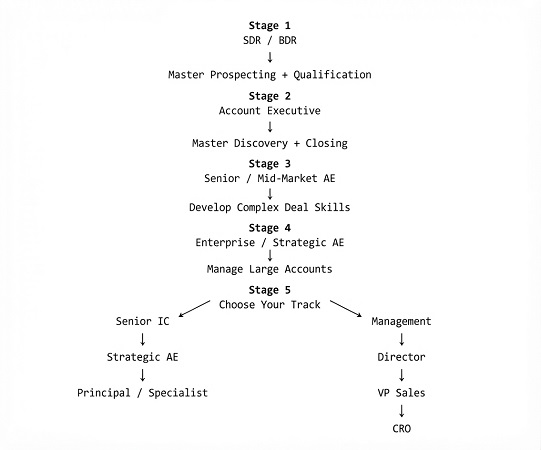
The strongest career move is not always the next title. Sometimes moving to a better company, territory, product, or market segment can create greater earning potential than accepting a promotion with weaker economics.
Key Takeaways
- SaaS sales provides a structured career path from SDR/BDR roles into account executive, enterprise sales, management, and executive positions.
- OTE represents target total compensation, not guaranteed income.
- SaaS commission structures commonly combine base salary, variable compensation, quota, and potentially accelerators.
- SDRs should evaluate promotion history rather than relying on promises about moving into AE positions.
- Enterprise sales generally involves larger contracts, more stakeholders, and longer sales cycles than SMB sales.
- A four-year degree is not always necessary for entry-level tech sales.
- CRM knowledge, prospecting, discovery, negotiation, business acumen, and data literacy are valuable skills for SaaS sales professionals.
- When comparing offers, evaluate quota attainment, territory quality, sales cycle, product-market fit, management, and promotion opportunities—not just OTE.
- SaaS sales can offer both a high-earning individual-contributor route and a management path toward sales leadership.
Frequently Asked Questions
Is SaaS sales a good career?
SaaS sales can be a strong career for people who enjoy communication, competition, business, technology, and performance-based compensation. It offers multiple advancement routes and does not always require a technical degree.
Can I get into tech sales without a degree?
Yes. Some entry-level SDR and BDR positions do not require a bachelor’s degree. Relevant experience, communication skills, persistence, and demonstrated sales ability can help candidates compete.
What is SaaS OTE?
SaaS OTE, or On-Target Earnings, is the expected total compensation a salesperson can earn when they achieve their assigned performance target. It generally includes base salary plus target variable compensation.
How do I become an account executive?
Many professionals begin as SDRs or BDRs, develop prospecting and qualification skills, demonstrate strong performance, and then move into an AE role. Some companies also hire experienced AEs directly from other sales organizations.
What is the difference between SDR and AE?
An SDR generally creates and qualifies sales opportunities, while an AE manages qualified opportunities through discovery, negotiation, and closing.
Is enterprise SaaS sales better than SMB sales?
Neither is universally better. SMB sales generally offers shorter sales cycles and higher opportunity volume, while enterprise sales involves larger deals and more complex buying processes. Your preferred work style and career goals should determine the choice.
How much can SaaS salespeople earn?
Earnings vary substantially by role, company, geography, product, territory, quota, and performance. Candidates should evaluate base salary, OTE, quota attainment, commission rules, and accelerators together rather than relying on a single salary figure.
What CRM should someone entering tech sales learn?
Learning the fundamentals of a major CRM such as Salesforce or HubSpot can be useful. Focus first on understanding leads, accounts, contacts, opportunities, pipeline stages, activities, forecasting, and reporting.
Conclusion
A SaaS sales career can provide a relatively accessible route into technology, strong performance-based earning potential, and several long-term career directions. The typical path starts with SDR or BDR work and can progress into account executive, enterprise sales, strategic accounts, sales management, or revenue leadership.
However, the best SaaS sales opportunity is not necessarily the one with the largest advertised OTE. Quota difficulty, territory quality, product-market fit, sales-cycle length, management, promotion history, and actual quota attainment can have a much greater impact on your experience and earnings.
For someone looking to break into tech sales, the most practical starting point is to build strong communication and prospecting skills, understand SaaS metrics and CRM fundamentals, target companies with genuine SDR-to-AE promotion paths, and evaluate compensation plans based on realistic earning potential rather than headline OTE alone.