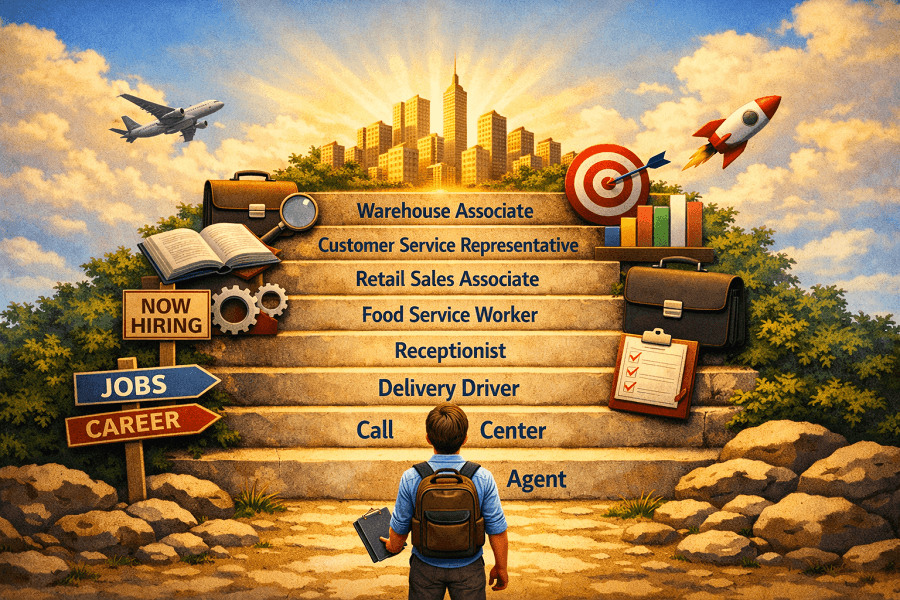


Choosing between startup vs. corporate jobs is one of the biggest career decisions professionals face. For those just entering the workforce, understanding the broader entry-level job market can help identify which type of organization offers the best starting point for your career goals A startup can offer broader responsibilities, faster learning, and potentially meaningful equity. A large corporation may provide stronger benefits, structured career development, greater resources, and more predictable employment.
Neither path is automatically better.
The right choice depends on your career stage, financial priorities, tolerance for uncertainty, desired work environment, and how much autonomy you want.
Startup vs Corporate Jobs at a Glance
| Factor | Startup | Large Corporation |
| Work environment | Fast-changing | More structured |
| Responsibilities | Often broad | Usually specialized |
| Career progression | Potentially fast | More defined |
| Job security | Can be less predictable | Often more predictable |
| Benefits | Varies widely | Usually comprehensive |
| Equity | More common | Less common or different structure |
| Management | Less hierarchical | More hierarchical |
| Training | Often informal | Often formal |
| Resources | Limited to moderate | Extensive |
| Decision-making | Faster | Can be slower |
| Workload | Often variable/high | More predictable in many roles |
| Brand recognition | Varies | Often strong |
| Innovation | Often high | Depends on company |
| Bureaucracy | Usually lower | Usually higher |
The differences can be significant, but company size alone doesn’t determine the employee experience, and for those considering work location flexibility, hybrid work arrangements are more common in larger corporations, while startups often offer fully remote or highly flexible policies.
A well-run startup may provide more stability than a poorly performing corporation, while a high-growth corporation may feel more entrepreneurial than an established startup.
What Is a Startup Job?
A startup is generally a young company attempting to develop and scale a product, service, or business model.
Startup employees may work across multiple functions because teams are smaller.
A marketing employee, for example, might handle:
- Content
- Paid advertising
- Analytics
- Partnerships
- Customer research
- Product feedback
This broader responsibility can accelerate learning.
However, it can also mean unclear responsibilities and frequent changes in priorities.
What Is a Corporate Career?
A corporate career typically involves working for an established company with larger teams, defined departments, formal processes, and established management structures.
Corporate employees may have specialized responsibilities within areas such as:
- Finance
- Marketing
- Human resources
- Technology
- Operations
- Sales
- Legal
- Procurement
Large companies often provide structured career paths and internal mobility.
The tradeoff can be less individual autonomy and more organizational bureaucracy.
Startup Career Pros
1. Broader Responsibilities
Startups often have smaller teams.
That means employees can gain exposure to multiple areas of the business.
A junior employee might interact directly with:
- Founders
- Executives
- Customers
- Investors
- Product teams
- Engineers
This can accelerate professional development.
2. Faster Learning
Startup employees frequently encounter new problems without established processes.
You may need to:
- Build a process
- Research a solution
- Test an idea
- Measure results
- Change direction quickly
This environment can be valuable for people who learn best through practical experience.
3. Greater Visibility
In a small company, individual contributions can be easier for leadership to see.
An employee who solves an important problem may work directly with the founder or executive team.
That visibility can potentially accelerate advancement.
4. More Autonomy
Startups often have fewer layers of management.
Employees may have more freedom to decide:
- How to approach projects
- Which tools to use
- How to prioritize work
- Which experiments to run
For those seeking part-time flexibility, many startups offer opportunities that fit within the broader part-time employment landscape, especially in early-stage companies.
For self-directed workers, this can be a major advantage.
5. Potential Equity Upside
Startup equity compensation can provide an opportunity to participate in the company’s financial upside.
Common forms include:
- Stock options
- Restricted stock
- Restricted stock units
- Other equity arrangements
However, equity isn’t the same as cash compensation.
Its eventual value depends on factors such as the following:
- Company performance
- Funding
- Valuation
- Liquidity
- Dilution
- Vesting
- Exit or public-market events
Never value startup equity as if it were guaranteed salary.
Startup Career Cons
1. Greater Employment Uncertainty
Startups can face:
- Funding challenges
- Revenue shortfalls
- Product failures
- Layoffs
- Acquisitions
- Strategic changes
- Shutdowns
Employees may therefore experience more uncertainty than they would at a mature employer.
2. Less Predictable Workloads
Priorities can change rapidly.
One week you may be focused on one product initiative, and the next week your team may be redirected toward another.
Some employees enjoy this pace.
Others find it stressful.
3. Benefits May Be Less Comprehensive
A startup may offer competitive benefits, but smaller companies don’t always match the resources available at large employers.
Compare:
- Health insurance
- Retirement plans
- Paid leave
- Parental benefits
- Disability coverage
- Life insurance
- Professional development
- Wellness programs
Don’t assume a higher startup salary automatically represents a better total package.
4. Fewer Formal Career Paths
A startup may not have clearly defined levels such as
Analyst → Senior Analyst → Manager → Director → VP
Instead, career progression may depend on company growth and the availability of leadership roles.
This can create opportunities—but also uncertainty.
Corporate Career Pros
1. Structured Career Development
Large organizations often have defined job levels and promotion criteria.
A typical corporate career ladder might look like:
Entry-Level → Associate → Senior → Manager → Director → Executive
Not every corporation uses this exact structure, but larger organizations generally have more formalized progression.
2. Stronger Benefits
One major advantage of corporate employment is the potential breadth of benefits.
A corporate benefits comparison may include:
- Health insurance
- Dental and vision coverage
- Retirement contributions
- Paid vacation
- Sick leave
- Parental leave
- Life insurance
- Disability insurance
- Employee assistance programs
- Education assistance
Benefits vary by employer, so compare the actual package rather than assuming every large company offers the same benefits.
3. Greater Resources
Large corporations can provide access to:
- Larger budgets
- Specialized teams
- Advanced technology
- Formal training
- Established vendors
- Dedicated legal support
- Analytics teams
- Internal recruiters
This allows employees to specialize rather than handling everything themselves.
4. Brand Recognition
Working for a recognized corporation can strengthen a résumé.
A well-known employer may help establish credibility when applying for future roles.
This can be particularly valuable early in a career.
5. Potentially Greater Job Stability
Established corporations generally have more diversified revenue, larger customer bases, and greater financial resources than early-stage startups.
That can provide greater employment stability.
However, large companies can still conduct layoffs, reorganizations, acquisitions, and workforce reductions.
Corporate employment is not guaranteed employment security.
Corporate Career Cons
1. Bureaucracy
Large organizations often require more:
- Approvals
- Meetings
- Documentation
- Reviews
- Processes
- Stakeholder coordination
This can slow decision-making.
2. More Specialized Roles
Corporate employees often have narrower responsibilities.
A finance analyst may focus primarily on:
- Forecasting
- Reporting
- Budgeting
- Financial models
That provides specialization but may reduce exposure to other functions.
3. Slower Decision-Making
A decision that takes one meeting at a startup might require several departments and approval levels at a large corporation.
This can frustrate employees who prefer rapid experimentation.
4. More Competition for Promotions
A large company may have hundreds or thousands of employees competing for management positions.
A structured career ladder doesn’t guarantee fast advancement.
Startup Culture vs Corporate Culture
Culture is one of the biggest differences people consider when choosing between these environments.
Startup Culture
Often emphasizes:
- Speed
- Experimentation
- Flexibility
- Informal communication
- Ownership
- Rapid change
Corporate Culture
Often emphasizes:
- Processes
- Consistency
- Risk management
- Formal communication
- Compliance
- Organizational structure
Neither culture is universally better.
The question is which environment matches your working style.
Startup vs Corporate Work-Life Balance
Work-life balance depends heavily on the specific employer.
A startup may require longer hours during the following:
- Product launches
- Fundraising
- Major customer implementations
- Critical deadlines
But some startups intentionally prioritize flexible schedules.
Large companies may provide more predictable schedules and formal leave policies, but some departments can still have intense periods.
Don’t judge work-life balance solely by company size.
Ask employees about the actual team’s expectations.
Startup vs Corporate Salary
Salary comparisons can be misleading.
A startup might offer:
$100,000 salary + equity
while a corporation offers the following:
$95,000 salary + bonus + stronger benefits
The startup’s equity could eventually become valuable—but it could also become worthless.
When comparing offers, calculate:
Base salary + expected bonus + benefits + realistic equity value
Avoid treating speculative equity as guaranteed compensation.
FAANG vs Startup Salary
Comparisons between large technology companies and startups often focus heavily on compensation.
A major technology employer may offer:
- Strong base salary
- Annual bonus
- Equity
- Comprehensive benefits
- Retirement contributions
A startup may offer:
- Competitive base salary
- Startup equity
- Performance bonuses
- Faster responsibility growth
The better financial choice depends on your priorities.
A lower startup salary may be justified by meaningful equity, but only if you understand the risk.
Startup Equity Compensation Explained
Startup equity can be complicated.
Before accepting an offer, ask:
- What type of equity is it?
- How many shares or options?
- What percentage of the company does that represent?
- What is the vesting schedule?
- Is there a cliff?
- What is the current valuation?
- What is the exercise price for options?
- How could future funding dilute ownership?
- What happens if you leave?
For stock options, tax implications can also be important.
Consider consulting a qualified tax or financial professional before making decisions based on substantial equity.
Startup Failure Rate and Employee Impact
A startup’s potential upside comes with business risk.
If the company fails, employees could face the following:
- Job loss
- Lost expected equity value
- Unvested equity cancellation
- Difficulty finding a comparable position
- Relocation or financial disruption
This is why evaluating the company’s financial condition is important.
Consider:
- Revenue growth
- Cash runway
- Funding history
- Customer concentration
- Business model
- Competitive position
- Leadership
- Hiring pace
A startup’s headline valuation doesn’t necessarily tell you how secure the job is.
Job Security Comparison
| Factor | Startup | Corporation |
| Revenue diversification | Often limited | Often broader |
| Funding dependence | May be high | Usually lower |
| Layoff risk | Can be significant | Still possible |
| Role stability | Often lower | Generally higher |
| Business processes | Developing | Established |
| Financial visibility | Can be limited | Often greater |
A large corporation may offer greater stability, but no private-sector employer can guarantee permanent employment.
Startup Growth Career Trajectory
Startups can provide rapid career progression when the company grows quickly.
An employee might move from the following:
Individual Contributor → Team Lead → Manager → Department Head
in a relatively short period.
This can happen because the company needs new leaders as it expands.
But rapid growth isn’t guaranteed.
If the company stops growing, promotion opportunities may disappear.
Corporate Career Ladder
Large companies often provide a clearer progression system.
For example:
Analyst → Senior Analyst → Manager → Senior Manager → Director
Advantages include:
- Defined expectations
- Formal performance reviews
- Training programs
- Internal job postings
- Leadership development
The disadvantage is that promotions may depend on openings, organizational restructuring, and competition.
Choosing a Startup or Big Company
Ask yourself these questions:
Do You Prefer Stability?
If yes, a mature corporation may be more attractive.
Do You Want Broad Responsibility?
If yes, consider a startup.
Is Equity Important?
A startup may provide greater exposure to equity.
Do You Need Strong Benefits?
Large corporations may have an advantage.
Do You Want a Structured Career Path?
A corporation may provide more predictable progression.
Do You Enjoy Ambiguity?
Startups tend to require greater comfort with uncertainty.
Do You Want Specialization?
Corporate roles often provide deeper specialization.
Startup or Corporation for New Graduates?
Both can work well for early-career professionals.
Startup Advantages
- Broader responsibilities
- Direct access to leadership
- Fast learning
- Potentially rapid growth
- Entrepreneurial exposure
Corporate Advantages
- Structured training
- Recognized employer
- Formal mentorship
- Benefits
- Defined career paths
- Greater resources
A graduate who wants to explore many functions may prefer a startup.
Someone who wants structured training and specialization may prefer a corporation.
Startup or Corporation for Experienced Professionals?
Experienced professionals should evaluate the opportunity differently.
At a startup, your expertise may give you significant influence.
At a corporation, you may gain access to:
- Larger budgets
- Bigger teams
- Global projects
- Specialized resources
- Senior leadership programs
The decision should depend on whether you want breadth and ownership or scale and specialization.
Silicon Valley vs Corporate USA
The traditional image of startup work is closely associated with Silicon Valley, but startup opportunities now exist throughout the United States.
Startup ecosystems can be found in many cities and regions.
Meanwhile, corporate careers exist across the following:
- Technology
- Finance
- Healthcare
- Manufacturing
- Retail
- Logistics
- Energy
- Professional services
You don’t need to move to Silicon Valley to build a startup career.
How to Evaluate a Startup Before Joining
Before accepting an offer, investigate:
Funding
How much capital has the company raised?
Runway
How long can the company operate at its current spending rate?
Revenue
Is the company generating meaningful revenue?
Customers
Does it have recurring customers?
Leadership
Does the leadership team have relevant experience?
Product
Does the company solve a genuine customer problem?
Hiring
Is the company expanding responsibly?
Turnover
Are employees leaving quickly?
These factors can provide clues about employment risk.
How to Evaluate a Corporation Before Joining
Large companies also require due diligence.
Research:
- Recent layoffs
- Financial performance
- Department stability
- Management quality
- Promotion rates
- Employee turnover
- Benefits
- Workplace policies
- Reputation in your specific business unit
A large company can be financially strong while a particular department is undergoing restructuring.
Your immediate manager and team can matter as much as the overall corporation.
Startup vs Corporate Decision Matrix
| Your Priority | Potentially Better Fit |
| Maximum stability | Corporation |
| Broad responsibilities | Startup |
| Structured training | Corporation |
| Rapid experimentation | Startup |
| Strong benefits | Corporation |
| Equity upside | Startup |
| Clear career ladder | Corporation |
| Direct founder access | Startup |
| Large-scale projects | Corporation |
| Entrepreneurial experience | Startup |
| Specialization | Corporation |
| High autonomy | Startup |
Use this as a starting point, not a universal rule.
Startup vs Corporate Jobs for Entry-Level Workers
Your first job can shape your skills, network, and future opportunities, so the startup-versus-corporate decision deserves careful consideration.
Starting at a Startup
A startup may give you exposure to multiple areas of the business.
You might:
- Work directly with senior leaders
- Take ownership of projects
- Learn several business functions
- Build processes from scratch
- Receive responsibilities beyond your formal job title
This can accelerate learning, especially for people who enjoy ambiguity.
The downside is that training may be less structured, and you may have to figure things out independently.
Starting at a Corporation
Large companies may offer:
- Formal onboarding
- Training programs
- Mentorship
- Established processes
- Defined job levels
- Internal mobility
This can provide a stronger foundation for someone who wants structured professional development.
Best fit: Choose based on whether you learn better through structured training or hands-on ownership.
Startup vs Corporate Jobs for Mid-Career Professionals
Mid-career professionals often have more leverage because they bring specialized experience.
A startup may allow you to become a
- Team lead
- Functional owner
- Department head
- Early executive
- Strategic decision-maker
A corporation may offer:
- Larger teams
- Larger budgets
- Global responsibilities
- More specialized leadership roles
- Formal management development
At this stage, consider whether your priority is breadth and influence or scale and resources.
Startup vs Corporate Jobs for Senior Professionals
Senior professionals should examine the quality of the opportunity rather than simply comparing company sizes.
At a startup, senior employees may have significant influence over:
- Strategy
- Hiring
- Product direction
- Fundraising
- Operations
- Company culture
At a corporation, senior employees may oversee:
- Large teams
- Major budgets
- Global operations
- Enterprise customers
- Complex business units
For executives, startup equity can be particularly important—but so can the company’s financial position and leadership team.
Startup vs Corporate Compensation
Compensation is one of the hardest areas to compare because the structures can be completely different.
A corporate package might include the following:
- Base salary
- Annual bonus
- Stock or RSUs
- Health insurance
- Retirement contributions
- Paid leave
A startup might offer:
- Base salary
- Stock options
- Performance bonus
- Health insurance
- Smaller or different benefit package
Instead of comparing salary alone, calculate the approximate total compensation.
Example
Startup
- $115,000 base
- $15,000 target bonus
- Equity with uncertain future value
Corporation
- $110,000 base
- $15,000 bonus
- $20,000 equity
- Stronger benefits
The corporate package may have greater predictable value even though the startup has greater theoretical upside.
How to Evaluate Startup Equity
Startup equity deserves separate analysis.
Suppose a startup offers you options representing 0.1% of the company.
That percentage alone doesn’t tell you what the equity is worth.
You also need to know:
- Total shares outstanding
- Option exercise price
- Current company valuation
- Vesting schedule
- Future dilution
- Preferred versus common shares
- Potential exit scenarios
- Tax treatment
A percentage of a company isn’t the same as cash in your bank account.
Treat startup equity as potential upside, not guaranteed compensation.
Vesting and Startup Equity
Many startup equity packages use a multi-year vesting schedule.
A common structure may include:
- Four-year vesting
- One-year cliff
- Monthly or quarterly vesting afterward
The actual terms vary.
If you leave before the equity vests, you may lose some or all of the unvested portion.
For stock options, leaving the company can also create important decisions around exercising vested options.
Read the actual equity documents before assigning a financial value to the offer.
Corporate Equity Compensation
Large corporations may also provide equity compensation, particularly for:
- Technology employees
- Managers
- Executives
- High-demand specialists
Public-company equity can be easier to value because shares may trade in public markets.
However, stock prices fluctuate, and equity compensation remains subject to market risk.
When comparing startup and corporate equity, consider liquidity as well as theoretical value.
Job Security: Startup vs Corporation
Job security is often one of the biggest reasons workers choose established corporations.
A mature company may have:
- Multiple revenue streams
- Established customers
- Large cash reserves
- Diverse business units
- Access to capital
A startup may depend heavily on:
- Investor funding
- Product-market fit
- A small customer base
- Continued growth
- Future fundraising
However, corporations can also experience major layoffs.
The better question is
“How financially and operationally stable is this specific employer and team?”
Startup Failure and Your Career
If a startup fails, the immediate consequence may be losing your job.
But the career impact isn’t necessarily negative.
Startup employees often gain:
- Broad experience
- Ownership experience
- Problem-solving skills
- Cross-functional knowledge
- Entrepreneurial exposure
Those skills can become valuable when applying to another startup, a corporation, or launching a business.
The financial impact can still be significant, particularly if you accepted lower cash compensation in exchange for equity.
Corporate Layoffs and Career Risk
Large companies can also experience layoffs caused by:
- Reorganizations
- Economic downturns
- Mergers
- Acquisitions
- Cost reductions
- Changes in strategy
- Automation
- Business-unit closures
Therefore, corporate job security should be viewed as relative stability rather than a guarantee.
Employees should maintain transferable skills and professional networks regardless of company size.
Startup Growth Career Trajectory
One potential advantage of startup employment is the possibility of growing with the company.
Imagine joining as an early marketing specialist.
As the company grows, you might become:
Marketing Specialist → Marketing Manager → Head of Marketing → VP Marketing
This trajectory can happen quickly if the company expands significantly.
But there is an important condition:
The company must actually grow.
If growth stalls, the same opportunity may disappear.
Corporate Career Ladder
Large companies generally provide a more established progression path.
For example:
Analyst → Senior Analyst → Manager → Senior Manager → Director → Vice President
Benefits can include:
- Clear expectations
- Formal performance reviews
- Leadership training
- Internal job postings
- Mentorship programs
- Defined compensation bands
The tradeoff is that progression can sometimes be slower because promotions depend on organizational openings.
Startup Culture vs Corporate Culture
Culture isn’t simply about whether a company is small or large.
Look at how the company actually operates.
Startup Culture May Emphasize
- Speed
- Experimentation
- Ownership
- Informality
- Risk-taking
- Rapid iteration
Corporate Culture May Emphasize
- Predictability
- Compliance
- Process
- Risk management
- Specialization
- Organizational consistency
But startups can become bureaucratic as they grow, and corporations can have entrepreneurial teams.
Evaluate the specific team rather than relying on stereotypes.
Work-Life Balance Comparison
| Factor | Startup | Corporation |
| Working hours | Can vary significantly | Often more predictable |
| Schedule flexibility | Varies | Varies |
| PTO policy | Varies | Often formalized |
| Busy periods | Potentially frequent | Usually team-dependent |
| Work boundaries | May be less defined | Often clearer |
| Remote work | Company-dependent | Company-dependent |
The actual manager and team often matter more than company size.
Startup vs Corporate Benefits
A proper corporate benefits comparison should include more than health insurance.
Compare:
Health
- Medical
- Dental
- Vision
Financial
- 401(k)
- Employer match
- Bonus
- Equity
Leave
- Vacation
- Sick leave
- Parental leave
- Bereavement
Other
- Disability insurance
- Life insurance
- Tuition assistance
- Wellness programs
- Commuter benefits
A startup can have excellent benefits, while some large companies offer surprisingly limited packages.
Always compare the actual plan documents.
Which Is Better for Career Growth?
There are two different forms of career growth.
Startup Growth
Often means
More responsibility → broader role → leadership
Corporate Growth
Often means
Higher level → greater specialization → larger team or business scope
If you want to become a generalist or entrepreneur, a startup may provide stronger exposure.
If you want deep expertise or experience managing large organizations, a corporation may offer more opportunities.
Which Is Better for Networking?
Both environments can build strong networks.
Startup Network
You may develop close relationships with:
- Founders
- Investors
- Early employees
- Entrepreneurs
- Customers
Corporate Network
You may connect with:
- Senior executives
- Industry specialists
- Recruiters
- Global teams
- Corporate clients
- Alumni networks
The value of either network depends heavily on how actively you maintain those relationships.
Startups vs. Corporations for Career Switching
Startups can make it easier to demonstrate broad responsibilities because one role may involve multiple functions.
For example, a startup operations employee might gain experience in:
- Finance
- HR
- Vendor management
- Analytics
- Customer operations
Corporate roles may provide deeper specialization.
For career changers, the best choice depends on whether you need breadth or recognized specialized experience.
Startup vs Corporate for Building an Executive Career
A startup can expose you to company-building decisions earlier.
You may learn about:
- Hiring
- Fundraising
- Product strategy
- Pricing
- Operations
- Business development
A corporation can provide experience managing complexity at scale.
You may learn about:
- Global operations
- Large budgets
- Enterprise strategy
- Compliance
- Organizational design
- Large-scale leadership
For future executives, both paths can be valuable.
How to Choose Between Two Job Offers
When comparing an actual startup and corporate offer, score each from 1 to 5 on:
- Compensation
- Benefits
- Job stability
- Career growth
- Learning
- Manager quality
- Culture
- Work-life balance
- Location
- Equity potential
- Brand value
- Role responsibility
Then weight the categories according to your priorities.
For example, someone supporting a family may assign greater weight to stability and benefits.
An early-career entrepreneur may assign greater weight to learning, responsibility, and equity.
The Five Questions to Ask Before Choosing
1. What Do I Want to Learn?
If the answer is “how to build a company,” a startup may be more attractive.
If it’s “how to become an expert in my field,” a corporation may be better.
2. How Much Financial Risk Can I take?
Greater financial obligations generally make predictable compensation more valuable.
3. What Does My Next Career Step Require?
Choose the role that builds the experience you need for your next target position.
4. Who Will I Work For?
Your direct manager can have a larger effect on your daily experience than the company logo.
5. What Happens if the Company Changes?
Ask yourself whether you’d still be comfortable if:
- The startup loses funding.
- The corporation restructures.
- Your manager leaves.
- Your role changes.
- Your remote arrangement ends.
Thinking through these scenarios can expose hidden risks.
Final Decision Framework
Choose a startup when you prioritize:
- Broad responsibility
- Autonomy
- Rapid learning
- Entrepreneurial exposure
- Potential equity upside
- Fast-changing environments
Choose a corporation when you prioritize:
- Predictability
- Benefits
- Structured advancement
- Formal training
- Specialization
- Large-scale resources
Choose based on the specific company and role, not simply the company category.
A great startup can be better than a mediocre corporation, and a strong corporate team can be better than a poorly managed startup.
The most important question isn’t
“Startup or corporation?”
It’s:
“Which opportunity gives me the best combination of compensation, learning, stability, career growth, and personal fit for the next stage of my career?”
Frequently Asked Questions
Is it better to work at a startup or a corporation?
Neither is universally better. Startups can offer broader responsibilities, faster learning, autonomy, and potential equity upside. Corporations often provide stronger benefits, structured career paths, training, and greater organizational resources.
Do startups pay more than corporations?
Not necessarily. Some startups offer competitive or higher base salaries, while others use equity to supplement lower cash compensation. Compare total compensation, including salary, bonus, benefits, and the realistic value of equity.
Are startup jobs less secure?
They can be less predictable because startups may depend on funding, rapid growth, or a limited customer base. However, large corporations can also experience layoffs and restructuring.
Is startup equity worth it?
Startup equity can become valuable, but it is speculative. Its potential value depends on the company’s performance, valuation, dilution, vesting terms, liquidity, and eventual exit or public offering.
Which is better for career growth: a startup or corporation?
A startup can provide faster responsibility growth and broader experience. A corporation may offer a clearer promotion structure, formal development programs, and opportunities to manage larger teams or business units.
Are corporate jobs better for work-life balance?
Not automatically. Some corporations provide predictable schedules and strong leave benefits, while some startups offer considerable flexibility. Evaluate the specific team, manager, workload, and company policies.
Which is better for recent graduates?
Both can be good choices. Startups may provide hands-on experience and direct access to leadership, while corporations may offer structured training, mentorship, and clearer career development.
Should I take a lower salary for startup equity?
Only after carefully evaluating the equity and your ability to absorb the financial risk. Equity should not be treated as guaranteed compensation.
What should I ask a startup before accepting a job?
Ask about funding, revenue, runway, equity terms, vesting, turnover, hiring plans, company strategy, and the expectations of your specific team.
What should I ask a corporation before accepting a job?
Ask about the team’s stability, promotion process, manager expectations, benefits, recent organizational changes, workload, office requirements, and opportunities for internal mobility.