

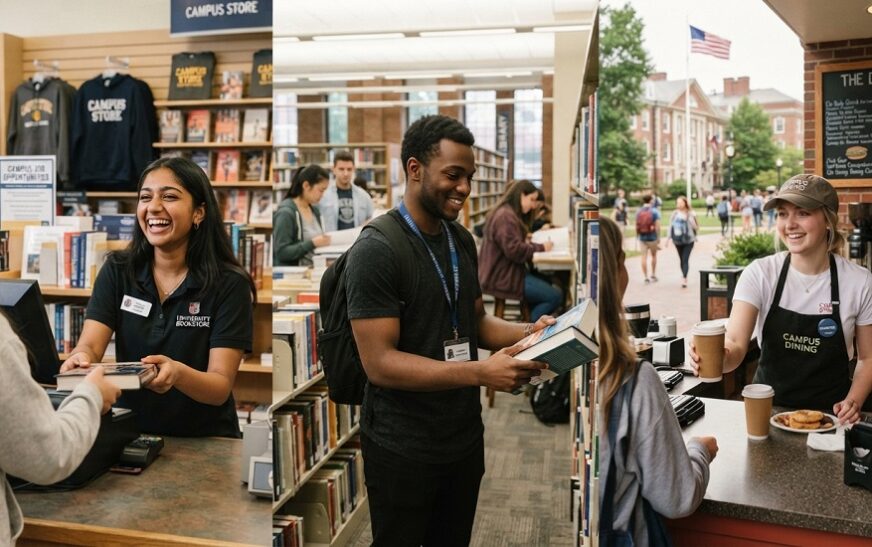
Finding the right student job can help you cover everyday expenses, build professional experience, and develop skills without letting work interfere with your education. The best student jobs in the USA balance pay, schedule flexibility, commute time, academic demands, and career value.
College students can choose from campus jobs, federal work-study positions, research roles, resident advisor positions, university dining jobs, internships, and off-campus employment.
Best Student Jobs in the USA
The right job depends on your schedule and career goals, and for students looking beyond part-time work, understanding the broader entry-level job market can help identify career paths with long-term growth potential.
| Student Job | Flexibility | Career Value | Best For |
| Campus assistant | High | Moderate | Flexible schedules |
| Federal work-study | High | Moderate–High | Eligible students |
| Research assistant | Moderate | High | Academic careers |
| Resident advisor | Moderate | High | Housing savings + leadership |
| Library assistant | High | Moderate | Quiet campus work |
| Dining staff | Moderate | Low–Moderate | Quick entry |
| Tutor | High | High | Strong subject knowledge |
| Internship | Moderate | Very High | Career preparation |
| Off-campus retail | Moderate | Moderate | Income-focused students |
| Freelance work | High | Variable | Skilled students |
Part-Time Jobs for Students
A good part-time job for students should fit around classes rather than compete with them.
Popular choices include:
- Campus office assistant
- Library assistant
- Dining hall worker
- Research assistant
- Tutor
- Resident advisor
- Recreation center employee
- IT help-desk assistant
- Admissions assistant
- Bookstore employee
- Student ambassador
- Off-campus retail worker
Before accepting a position, determine the actual weekly schedule. A job offering 15 hours per week may still become difficult if those hours are concentrated during your busiest class days, and for a broader look at the part-time employment landscape across all schedules and industries, explore our comprehensive part-time jobs guide.
On-Campus Jobs
On-campus employment is often one of the easiest places for students to start.
Universities may hire students in:
- Libraries
- Dining facilities
- Administrative offices
- Recreation centers
- Computer labs
- Admissions
- Student services
- Research departments
- Academic departments
Why Students Choose Campus Jobs
The biggest advantage is convenience.
You may be able to:
- Walk to work from class
- Work around your academic schedule
- Reduce commuting expenses
- Meet other students
- Develop relationships with faculty and staff
Some campus positions can also provide experience directly related to your degree.
Federal Work-Study Program
The Federal Work-Study Program provides part-time employment opportunities for eligible students with financial need through participating schools.
Work-study jobs can be located on campus and, in some cases, with approved off-campus organizations.
Importantly, receiving work-study as part of financial aid does not necessarily mean you automatically receive the money. Students generally need to obtain an eligible work-study position and earn wages through employment.
The availability of positions, pay, and hours varies by school.
Students interested in work-study should check their financial-aid award and university employment resources.
Campus Research Assistant Jobs
A campus research assistant position can be particularly valuable for students considering graduate school or research-oriented careers.
Depending on the department, students may help with the following:
- Data collection
- Literature reviews
- Laboratory work
- Surveys
- Data analysis
- Research documentation
- Administrative research tasks
Research experience can strengthen a resume because it demonstrates skills beyond simply holding a part-time job, and for students interested in healthcare, many entry-level healthcare roles offer part-time schedules that can accommodate class schedules while providing valuable clinical experience.
For students considering graduate school, research experience may also help them understand what academic research actually involves.
Resident Advisor Jobs
A resident advisor, commonly called an RA, helps manage a university residence hall or student housing community.
Responsibilities may include:
- Supporting residents
- Organizing activities
- Enforcing housing policies
- Responding to issues
- Participating in training
- Handling emergencies according to university procedures
RA compensation varies substantially between universities.
Instead of looking only at RA resident advisor pay, compare the complete package.
Compensation may include:
- Housing
- Meal plans
- Stipends
- Hourly wages
- Other university benefits
In some cases, the value of reduced housing costs can be more important than the cash component.
Graduate Teaching Assistant Jobs
Graduate students may have access to graduate teaching assistant positions.
Typical responsibilities include:
- Leading discussion sections
- Grading
- Holding office hours
- Supporting faculty
- Assisting with laboratories
- Teaching assigned courses under university policies
Graduate teaching assistant salary and benefits vary by institution, department, degree program, workload, and funding.
Students considering graduate school should evaluate the entire funding package rather than comparing the stipend alone.
Student Library Jobs
Library jobs are popular because they can provide a relatively structured campus environment.
Potential duties include the following:
- Checking materials in and out
- Shelving books
- Helping patrons
- Maintaining study areas
- Basic administrative work
- Supporting library programs
Library jobs may appeal to students who prefer a quieter working environment.
They can also provide transferable customer service, organizational, and information management skills.
University Dining Jobs
University dining facilities frequently employ students.
Possible roles include:
- Cashier
- Food-service worker
- Kitchen assistant
- Barista
- Server
- Food preparation worker
- Dining hall attendant
These positions can be accessible to students without previous professional experience.
The main advantage is convenience when the dining facility is located on campus.
Campus IT & Computer Lab Jobs
Students with technical skills can look beyond traditional campus employment.
Potential positions include the following:
- Help-desk assistant
- Computer lab assistant
- Technology support assistant
- Web assistant
- Media lab assistant
- Student systems assistant
These jobs can be especially valuable for students studying:
- Computer science
- Information technology
- Engineering
- Data science
- Digital media
Technical campus experience can provide a stronger connection between employment and your academic program.
Tutoring Jobs for College Students
Tutoring is one of the most flexible options for students who perform well academically.
You can potentially tutor:
- Mathematics
- Writing
- Science
- Languages
- Computer programming
- Business
- Test preparation
Tutoring can take place through:
- University tutoring centers
- Private clients
- Online platforms
- Student organizations
Students can often schedule tutoring around their own classes.
Internships During College
An internship is different from a typical student job because its primary value may be career preparation rather than immediate income.
Internships can provide experience in:
- Finance
- Accounting
- Marketing
- Technology
- Engineering
- Healthcare
- Government
- Research
- Media
- Consulting
A paid internship can combine income with professional experience.
For students choosing between a generic part-time job and a relevant internship, the internship may offer greater long-term career value even if the immediate pay is similar or lower.
On-Campus vs. Off-Campus Jobs
| Factor | On-Campus | Off-Campus |
| Commute | Usually shorter | Maybe longer |
| Schedule flexibility | Often student-friendly | It depends on the employer. |
| Career relevance | Depends on role | Potentially high |
| Work-study | May be available | Sometimes available through approved programs |
| Transportation cost | Often lower | Maybe higher |
| Networking | University-focused | Broader professional network |
| Convenience | Usually high | Varies |
Neither option is automatically better.
Choose based on your academic schedule, transportation, pay, and career objectives.
Best Jobs for Students With No Experience
If you’re applying for your first job, focus on positions where employers can train you.
Good options include:
- Dining hall staff
- Library assistant
- Campus office assistant
- Recreation center staff
- Retail associate
- Customer service
- Student ambassador
- Basic administrative work
Your application should emphasize:
- Reliability
- Communication
- Academic achievements
- Teamwork
- Technology skills
- Volunteer experience
- Extracurricular activities
You don’t need a long professional history to demonstrate that you’re dependable and capable.
Best Student Jobs for Different Majors
Your major can help determine which jobs provide the greatest career value.
Finance & Accounting Students
Consider:
- Accounting assistant
- Finance intern
- Research assistant
- Bank teller
- Bookkeeping
- Business office assistant
Computer Science Students
Consider:
- IT help desk
- Computer lab assistant
- Software internship
- Research assistant
- Web development
Biology & Science Students
Consider:
- Laboratory assistant
- Research assistant
- Tutor
- Teaching assistant
Communications & Marketing Students
Consider:
- Social media assistant
- Student communications
- Marketing intern
- Campus newspaper
- Event assistant
Education Students
Consider:
- Tutor
- Teaching assistant
- Camp counselor
- Classroom aide
Engineering Students
Consider:
- Engineering internship
- Laboratory assistant
- CAD assistant
- Research assistant
- Technical support
Best Student Jobs for Career Experience
If your primary goal is building your resume, prioritize roles connected to your desired career.
For example:
Finance major → finance internship
Computer science major → software internship
Biology major → laboratory research
Marketing major → social media or marketing internship
Education major → tutoring or classroom experience
A job doesn’t have to perfectly match your major to be valuable, but relevant experience can make future applications stronger.
How Many Hours Should a College Student Work?
There isn’t one ideal number for every student.
Your workload depends on:
- Course load
- Difficulty of classes
- Commute
- Financial needs
- Extracurricular activities
- Health and personal responsibilities
- Whether you’re working during an academic term or break
A student taking a demanding full-time course load may need fewer work hours than someone taking a lighter schedule.
Start conservatively if you’re unsure.
It’s easier to add hours later than to recover academically after taking on too much work.
How to Find Student Employment
Start with your university.
Check:
- Student employment portals
- Financial aid office
- Career center
- Department websites
- Faculty announcements
- Residence life
- Library
- Campus dining
- Recreation center
Also search externally through:
- Employer career pages
- Job boards
- Internship platforms
- Professional networks
- Local businesses
For student employment, don’t rely exclusively on general job boards. Universities often advertise student-specific opportunities through their own systems.
How to Get a Campus Job
A simple process is:
1. Check Eligibility
Determine whether you qualify for work-study or other student employment programs.
2. Search Campus Openings
Look across departments rather than applying to only one type of job.
3. Prepare Your Resume
Keep it concise and highlight school, volunteer, extracurricular, and relevant work experience.
4. Apply Early
Popular campus jobs can receive many applications.
5. Explain Your Availability
Clearly list when you’re available to work.
6. Prepare for the Interview
Expect questions about reliability, customer service, teamwork, and balancing employment with academics.
How to Balance College and Work
Working while studying requires planning.
Use a weekly schedule that includes:
- Classes
- Work
- Study time
- Meals
- Transportation
- Sleep
- Personal commitments
Avoid scheduling work immediately before every major exam or assignment deadline.
Also tell your employer your academic availability honestly.
A good student employer understands that your education remains a primary responsibility.
Student Jobs During Summer
Summer can provide an opportunity to increase work hours without the same class schedule.
Potential summer options include:
- Internships
- Research positions
- Camp jobs
- Seasonal employment
- Retail
- Hospitality
- National park work
- Tutoring
- Temporary office positions
Students should apply early because popular summer positions can be filled months before the season begins.
Student Jobs During Winter Break
Short winter breaks can still provide opportunities for temporary work.
Consider:
- Holiday retail
- Warehouse work
- Customer service
- Food service
- Temporary administrative work
- Tutoring
- Seasonal hospitality
If you return home during winter break, search for jobs near your home rather than limiting yourself to your college town.
Paid Internship vs. Part-Time Job
| Factor | Paid Internship | General Part-Time Job |
| Career relevance | Usually high | Varies |
| Immediate income | Yes | Yes |
| Skill development | Industry-focused | General or role-specific |
| Networking | Strong potential | Moderate |
| Resume value | Often high | Depends on role |
| Flexibility | Varies | Often higher |
| Long-term career value | Usually high | Varies |
If finances allow, a relevant internship may provide more long-term value.
If immediate income and schedule flexibility are the priority, a conventional student job may be better.
How to Put Student Employment on Your Resume
Don’t minimize campus employment.
A campus job can demonstrate valuable skills.
Instead of:
Library worker
Write:
Assisted students with library services, maintained organized materials, processed transactions, and provided front-desk support.
For a research role:
Assisted faculty research projects by collecting and organizing data, conducting literature searches, and maintaining research documentation.
Focus on responsibilities, skills, and measurable outcomes.
Best College Student Jobs by Career Goal
Not every student needs the same type of employment. If your primary goal is income, prioritize predictable hours and reasonable pay. If your goal is career development, look for positions that build experience in your intended field.
For Extra Income
Consider:
- Campus dining
- Retail
- Customer service
- Library jobs
- Recreation center jobs
- Delivery or gig work
- Administrative support
For Resume Building
Consider:
- Internships
- Research assistant positions
- Department assistant roles
- Student marketing jobs
- IT support
- Teaching assistant positions
For Maximum Flexibility
Consider:
- Tutoring
- Freelance work
- Campus jobs
- Research positions
- Virtual assistant work
For Graduate School Preparation
Consider:
- Research assistantships
- Teaching assistantships
- Laboratory positions
- Faculty projects
- Academic tutoring
The best job is the one that matches your immediate financial needs without undermining your academic performance.
Best Student Jobs by Major
Business & Finance Students
Students studying business, finance, accounting, or economics can look for:
- Accounting assistant
- Bookkeeping assistant
- Bank teller
- Financial services intern
- Business office assistant
- Research assistant
- Tax preparation assistant
- Finance internship
These positions can provide experience with spreadsheets, financial records, customer service, analysis, and business operations.
Computer Science & IT Students
Technology students should consider jobs that let them build practical technical experience.
Examples include:
- IT help desk
- Computer lab assistant
- Web development
- Software testing
- Research assistant
- Systems support
- Technical internship
A relevant student job can help bridge the gap between classroom knowledge and professional experience.
Healthcare Students
Students pursuing healthcare careers may find opportunities such as the following:
- Medical office assistant
- Research assistant
- Patient-services support
- Laboratory assistant
- Healthcare internship
- Administrative healthcare roles
Students should verify whether a position requires specific credentials or training.
Education Students
Education majors can build relevant experience through:
- Tutoring
- Classroom assistance
- Teaching assistant roles
- Camp counseling
- Academic support
- After-school programs
Tutoring is particularly useful because it develops communication, lesson planning, and instructional skills.
Communications & Marketing Students
Potential roles include:
- Social media assistant
- Campus communications
- Student newspaper
- Marketing assistant
- Event coordinator
- Content creation
- Public relations internship
Building a portfolio alongside employment can make these positions even more valuable.
Engineering Students
Engineering students can look for:
- Research assistantships
- Laboratory positions
- Engineering internships
- CAD-related work
- Technical support
- Manufacturing internships
Career-related engineering experience can be particularly valuable when applying for full-time positions after graduation.
Federal Work-Study vs. Regular Student Employment
These are related but aren’t the same thing.
Federal Work-Study
Federal Work-Study is a financial-aid program that provides eligible students with opportunities to earn money through approved employment.
Regular Campus Employment
Universities may also hire students for positions that aren’t part of Federal Work-Study.
Examples include:
- Dining staff
- Library workers
- Recreation assistants
- Administrative assistants
- IT support
A student who isn’t eligible for work-study can still potentially find other campus employment.
How Does Work-Study Pay Work?
Work-study generally functions as employment rather than an automatic tuition discount.
You typically:
- Receive work-study eligibility through financial aid.
- Find an eligible position.
- Get hired.
- Work the assigned hours.
- Receive wages based on hours worked.
The amount you can earn is generally limited by the terms of your financial-aid award and available employment.
Your school determines many details, including available positions and how work-study is administered.
Resident Advisor Jobs: Is the Compensation Worth It?
RA positions deserve special consideration because compensation isn’t always presented as a simple hourly wage.
A university may offer some combination of:
- Room and board
- Housing discount
- Meal plan
- Stipend
- Hourly pay
To evaluate an RA position, calculate the total value.
For example:
Cash compensation + estimated housing savings + meal benefits = approximate total value
Also consider the responsibilities.
RAs may have evening or weekend duties, training requirements, community programming responsibilities, and emergency-response expectations.
Graduate Teaching Assistantships
For graduate students, teaching assistantships can combine academic experience with financial support.
Potential responsibilities include:
- Grading
- Discussion sections
- Office hours
- Laboratory assistance
- Student support
- Course preparation
The compensation package can include a stipend and, depending on the institution and program, tuition-related benefits.
Because packages vary significantly, compare:
- Stipend
- Tuition coverage
- Required hours
- Health benefits
- Duration
- Summer funding
- Teaching responsibilities
Don’t compare graduate teaching assistant salary figures without considering the full funding package.
Student Research Assistantships
Research assistantships can be particularly valuable for students considering the following:
- Graduate school
- Medicine
- Science
- Engineering
- Economics
- Psychology
- Data science
- Academic careers
You may gain experience in:
- Research methods
- Data analysis
- Laboratory procedures
- Academic writing
- Literature reviews
- Presentations
Ask faculty members directly about research opportunities if positions aren’t publicly advertised.
Student Library Jobs
Library employment can be a good choice for students seeking a campus-based role.
Typical responsibilities include:
- Circulation desk support
- Shelving
- Patron assistance
- Basic administrative work
- Inventory
- Maintaining study areas
Benefits can include convenient campus location and potentially predictable scheduling.
University Dining Jobs
Dining positions can be among the easiest campus jobs to enter.
Possible roles include:
- Cashier
- Barista
- Food preparation worker
- Server
- Kitchen assistant
- Dining hall attendant
They can be particularly useful for students who need a job quickly and don’t yet have specialized experience.
The downside is that schedules may overlap with busy meal periods, so students should check shift requirements carefully.
On-Campus vs. Off-Campus Student Jobs
Choosing between the two depends largely on your circumstances.
Choose On-Campus If You Want:
- Short commute
- Easier scheduling around classes
- Campus environment
- Access to university employment
- Potential work-study opportunities
Choose Off-Campus If You Want:
- Broader professional experience
- Higher earning potential in some fields
- Experience outside academia
- A larger employer network
- Industry-specific opportunities
A student studying accounting, for example, may benefit more from an off-campus accounting internship than from an unrelated campus position if both fit the schedule.
Student Jobs During the Academic Year
During semesters, prioritize manageable schedules.
A practical approach is to look for jobs with:
- Predictable weekly hours
- Short commute
- Shift flexibility
- Limited late-night requirements
- Scheduling around classes
Campus employment often works well because employers are accustomed to student schedules.
Student Jobs During Summer Break
Summer offers more room to work full-time or increase weekly hours.
Consider:
- Paid internships
- Research
- Seasonal jobs
- Hospitality
- Summer camps
- National parks
- Retail
- Tutoring
- Temporary office jobs
If career development is your goal, prioritize internships or research opportunities whenever possible.
If income is the priority, compare seasonal and temporary jobs based on guaranteed hours and total compensation.
Student Jobs During Winter Break
Winter break employment is usually shorter-term.
Popular options include:
- Holiday retail
- Warehouse work
- Package handling
- Restaurant work
- Temporary administrative work
- Tutoring
- Seasonal customer service
Students returning home can search for temporary positions in their hometown rather than trying to maintain employment near campus.
How to Balance Jobs While in College
The biggest challenge isn’t finding a job. It’s maintaining academic performance while working.
Use a weekly calendar to map:
Classes → Work → Study → Sleep → Personal commitments
Then look for conflicts before accepting shifts.
Practical Rules
- Keep travel time realistic.
- Don’t schedule every available hour.
- Leave study time before major exams.
- Tell your employer your class schedule.
- Reassess your workload if grades decline.
- Consider reducing hours during particularly demanding semesters.
Your degree remains the primary long-term investment.
How to Find Student Jobs
Start with your university’s own resources.
Check:
- Student employment portal
- Career center
- Financial aid office
- Department websites
- Faculty offices
- Residence life
- Library
- Dining services
- Recreation center
- IT department
Then expand your search to:
- Company career pages
- Internship platforms
- Job boards
- Local employers
- Professional networks
Don’t wait until the semester begins if you know you will need a job. Popular positions may fill early.
How to Get a Student Job With No Experience
Your resume can still be strong even if you have never held a formal job.
Highlight:
- Coursework
- Projects
- Volunteer work
- Clubs
- Sports
- Leadership
- Academic achievements
- Technical skills
- Certifications
For example, a student applying for an administrative job could highlight experience organizing a student organization rather than leaving the experience section empty.
How to Choose Between Two Student Jobs
When comparing offers, score each position on:
- Hourly pay
- Guaranteed hours
- Schedule flexibility
- Commute
- Career relevance
- Workload
- Benefits
- Future opportunities
A job paying slightly less may be the better choice if it is five minutes from your classroom, works around your schedule, and provides useful career experience.
Best Student Job Strategy
For most students, a three-stage approach works well:
First Year
Prioritize:
- Campus employment
- Basic work experience
- Academic adjustment
- Transferable skills
Second Year
Begin targeting:
- Research
- Department jobs
- Career-related employment
- Early internships
Third Year
Prioritize:
- Relevant internships
- Research
- Professional networking
- Industry experience
Final Year
Focus on:
- Advanced internships
- Career-related part-time work
- Professional connections
- Full-time job preparation
This progression helps transform basic student employment into a longer-term career advantage.
Final Takeaway
The best college student jobs aren’t simply the ones that pay the most per hour.
A strong student employment decision balances the following:
Income + flexibility + academic workload + career value.
Campus jobs, work-study, research assistantships, RAs, tutoring, internships, and off-campus employment can all be useful depending on your situation.
For students focused primarily on income, prioritize reliable hours and convenience.
For students focused on career development, prioritize internships, research, and positions connected to their degree.
And for students trying to do both, the ideal position is one that provides reasonable pay, manageable hours, and experience that strengthens your resume after graduation.
Frequently Asked Questions About Student Jobs in the USA
What are the best student jobs in the USA?
Popular options include campus jobs, Federal Work-Study positions, research assistant roles, tutoring, resident advisor positions, internships, library jobs, dining jobs, and off-campus part-time employment.
The best choice depends on your academic schedule, financial needs, and career goals.
How many hours should a college student work?
There is no universal number. Students should consider their course load, academic difficulty, commute, extracurricular activities, and financial needs.
A manageable schedule is generally more valuable than maximizing work hours at the expense of academic performance.
What is the Federal Work-Study Program?
Federal Work-Study is a need-based federal financial-aid program that provides eligible students with opportunities to earn money through approved part-time employment.
Receiving work-study eligibility does not automatically provide cash. Students generally need to obtain an eligible position and earn wages by working.
Can graduate students get teaching assistant jobs?
Yes. Many colleges and universities offer graduate teaching assistantships, although availability depends on the program and institution.
Responsibilities can include grading, office hours, discussion sections, laboratory assistance, and teaching-related duties.
How much do resident advisors get paid?
RA compensation varies by university. Some positions offer housing, meal plans, stipends, hourly pay, or a combination of benefits.
Compare the complete compensation package rather than looking only at the cash payment.
Are campus jobs better than off-campus jobs?
Not necessarily.
Campus jobs usually offer convenience and may be easier to schedule around classes. Off-campus positions can provide broader professional experience and potentially higher pay.
Choose based on pay, schedule, commute, and career relevance.
Are internships considered student jobs?
An internship is a form of student employment when it is paid, but its primary purpose is usually professional learning and career preparation.
Paid internships can be especially valuable because they combine income with industry experience.
Can students work from home?
Yes. Students can find remote opportunities such as the following:
- Online tutoring
- Virtual assistance
- Customer service
- Freelance writing
- Social media work
- Data entry
- Transcription
Remote work can be convenient, but students should still check whether the position requires fixed shifts.
What are the best student jobs with no experience?
Good starting points include:
- Library assistant
- Dining staff
- Campus office assistant
- Recreation center employee
- Retail associate
- Student ambassador
- Basic administrative positions
Volunteer experience, extracurricular activities, coursework, and leadership can all strengthen an application.
Can a student work full-time while attending college?
Some students do, but the workload can be difficult to sustain alongside a full-time academic program.
Before committing to full-time employment, consider the effect on class attendance, study time, sleep, and academic performance.
Where can college students find jobs?
Start with:
- University student employment portals
- Career centers
- Financial aid offices
- Academic departments
- Faculty
- Campus libraries
- Dining services
- Recreation centers
- Company career pages
- Job boards
- Internship platforms
Student Job Application Checklist
Before applying, prepare:
- One-page resume
- Class schedule
- Weekly availability
- Relevant coursework
- Volunteer experience
- Extracurricular activities
- Certifications
- References when requested
For campus positions, emphasize your connection to the university and your ability to work around your academic schedule.
For internships, emphasize skills and coursework related to the industry.
How to Put Campus Jobs on Your Resume
Don’t treat a campus position as less valuable than a traditional job.
Instead of:
Library Assistant
use:
Provided front-desk assistance to students, processed library transactions, maintained organized materials, and resolved routine customer questions.
For a research assistant:
Supported faculty research by organizing datasets, conducting literature searches, and maintaining research documentation.
The objective is to show what you did and what skills you developed.