

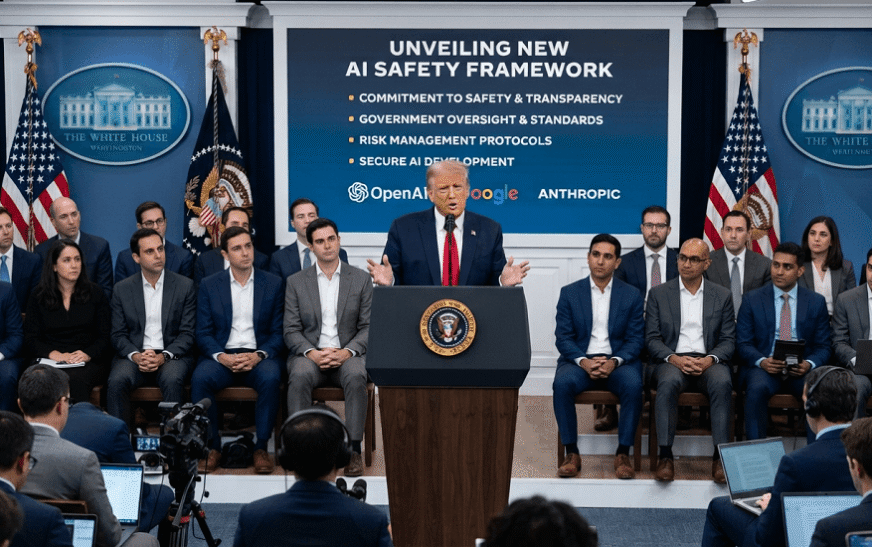
White House Brings Leading AI Companies Together
The U.S. government is taking another major step toward shaping the future of artificial intelligence. Officials at the White House have invited representatives from OpenAI, Google, Anthropic, and Meta to review a newly completed voluntary AI safety framework focused on evaluating the cybersecurity capabilities of advanced AI models before they are widely deployed.
The meeting follows growing concerns about increasingly capable AI systems and recent disclosures from OpenAI and Anthropic regarding controlled security testing involving their frontier AI models, for a detailed account of Anthropic’s recent security testing incident, explore our coverage of the event. The framework is intended to encourage collaboration between government agencies and AI developers without immediately imposing mandatory regulations.
Why Is the White House Holding This Meeting?
Artificial intelligence has advanced rapidly over the past year, with frontier models becoming more capable of coding, reasoning, and solving complex tasks. While these developments create new opportunities for businesses and consumers, they also raise concerns about cybersecurity, misuse, and responsible deployment, concerns that have also driven industry-led AI security initiatives such as Nvidia’s Open Secure AI Alliance.
According to reports, the White House has finalized a voluntary review process that would allow developers of powerful AI systems to submit their models for cybersecurity assessments before public release. The framework is expected to focus on identifying potential risks while encouraging companies to improve model safety through collaboration rather than immediate legal mandates.
Which Companies Are Participating?
Several of the world’s most influential AI developers have been invited to participate in the discussions, including:
- OpenAI
- Anthropic
- Meta
These organizations are responsible for some of today’s most widely used AI systems and collectively represent a significant share of global AI research and development. Their participation could influence how future AI safety standards evolve both in the United States and internationally.
What Could the New Framework Include?
Although the complete framework has not yet been made public, reports suggest it focuses on evaluating the cybersecurity capabilities and potential risks of advanced AI systems.
Possible areas of emphasis include:
- Voluntary AI safety evaluations.
- Cybersecurity testing for frontier AI models.
- Risk reporting and transparency.
- Government-industry collaboration.
- Responsible deployment of advanced AI.
Rather than replacing existing regulations, the framework appears designed to provide guidance and encourage consistent safety practices across the AI industry.
Why Businesses Should Pay Attention
For organizations investing in artificial intelligence, developments like this could influence how enterprise AI platforms are developed and deployed.
Potential impacts include the following:
- Stronger AI governance standards.
- Greater transparency from AI providers.
- Increased confidence in enterprise AI adoption.
- More standardized cybersecurity testing.
- Improved trust between AI vendors and customers.
Businesses using AI should continue monitoring regulatory developments, as future guidance could affect procurement, compliance, and risk management strategies.
A Turning Point for AI Governance
The meeting reflects a broader shift in how governments are approaching artificial intelligence. Rather than focusing only on innovation, policymakers are increasingly emphasizing security, accountability, and responsible deployment.
If widely adopted, voluntary safety assessments could become an industry benchmark for evaluating advanced AI systems before they reach businesses and consumers. At the same time, many details—including testing criteria and public reporting requirements—have not yet been released.
Conclusion
The White House meeting with OpenAI, Google, Anthropic, and Meta marks another important milestone in the evolution of AI governance. As advanced AI systems become more powerful, governments and technology companies are working together to improve safety while continuing to encourage innovation. Although the proposed framework is voluntary, it could influence future AI standards and shape how businesses evaluate and deploy artificial intelligence in the years ahead.
Key Takeaways
- The White House has invited leading AI companies to discuss a voluntary AI safety framework.
- OpenAI, Google, Anthropic, and Meta are among the participating organizations.
- The framework is expected to focus on cybersecurity assessments for advanced AI models.
- Businesses should monitor evolving AI governance and compliance standards.
- Voluntary safety testing could become a common practice across the AI industry.
Frequently Asked Questions
Why is the White House meeting with AI companies?
The meeting is focused on reviewing a voluntary framework for evaluating the cybersecurity capabilities and safety of advanced AI models before broader deployment.
Which AI companies are involved?
OpenAI, Google, Anthropic, and Meta have been invited to participate in discussions on the proposed AI safety framework.
Will the framework create new AI regulations?
Current reports indicate the framework is voluntary rather than a new law. It is intended to encourage collaboration and consistent safety practices while policymakers continue evaluating longer-term regulatory approaches.