

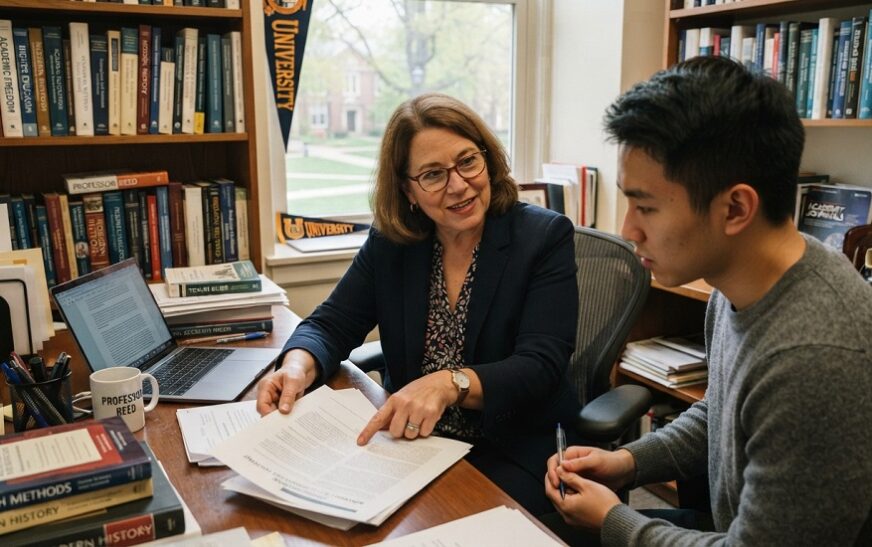
A college professor’s career can be intellectually rewarding and offer opportunities to teach, conduct research, publish scholarship, mentor students, and contribute to academic communities. But becoming a professor is a long and competitive process, and the traditional path from graduate school to tenure-track employment is very different from careers in other parts of higher education.
The higher education workforce also extends far beyond tenure-track faculty, and for a broader look at the broader education career landscape across all settings and levels, explore our comprehensive education careers guide. Universities and colleges employ adjunct instructors, lecturers, postdoctoral researchers, academic advisors, research staff, administrators, instructional designers, student-services professionals, and other specialists.
For someone considering university professor jobs, the most important decision is not simply whether to earn a PhD. Candidates should understand the type of institution they want to work for, whether they prefer teaching or research, how tenure-track hiring differs from adjunct work, what compensation looks like, and what alternatives exist if a faculty position does not materialize.
The U.S. Bureau of Labor Statistics reports a $83,980 median annual wage for postsecondary teachers in May 2024, with the highest 10% earning more than $199,520. BLS projects employment of postsecondary teachers to grow 7% from 2024 to 2034, with approximately 114,000 openings per year on average.
At the same time, faculty compensation varies substantially by institution, rank, discipline, employment status, and benefits. The American Association of University Professors’ 2025–26 Faculty Compensation Survey collected data from nearly 780 institutions covering approximately 360,000 full-time and more than 125,000 part-time faculty members.
What Does a College Professor Do?
College professors teach students at community colleges, four-year colleges, universities, graduate institutions, and other postsecondary organizations.
Depending on the position, responsibilities can include the following:
- Teaching undergraduate courses
- Teaching graduate courses
- Developing curriculum
- Advising students
- Conducting research
- Publishing academic work
- Applying for research funding
- Mentoring graduate students
- Serving on academic committees
- Participating in departmental governance
- Performing community or professional service
The balance between teaching, research, and service depends heavily on the institution and appointment.
A research-intensive university may emphasize publications and external research funding, while a teaching-focused college may place greater weight on classroom instruction and student engagement, and for those considering teaching at the K-12 level, K-12 teaching career paths offer a different balance focused primarily on classroom instruction and student development.
Types of University Professor Jobs
The title “professor” covers several distinct academic positions.
Assistant Professor
At many institutions, assistant professor is the entry-level tenure-track faculty rank.
Responsibilities may include:
- Teaching
- Research
- Publishing
- Student advising
- Departmental service
An assistant professor who successfully meets institutional tenure and promotion standards may advance to associate professor.
Associate Professor
Associate professors generally have more experience and may have earned tenure, although institutional structures vary.
Responsibilities often expand into:
- Advanced teaching
- Research leadership
- Graduate supervision
- Committee work
- Mentoring junior faculty
- Program development
Professor
Professor, sometimes called “full professor,” is a senior academic rank.
Full professors often have established research records, extensive teaching experience, significant service responsibilities, and leadership roles within departments or institutions.
Lecturer
Lecturers usually focus primarily on teaching. Some positions are full-time and continuing, while others may have fixed-term appointments.
Adjunct Professor
Adjunct faculty generally teach on a part-time or course-by-course basis.
Adjunct appointments can provide a pathway into higher education teaching, but compensation and benefits can be substantially different from full-time faculty employment.
Academic Career Path
The traditional academic career path can look like this:
- Bachelor’s Degree
- Master’s Degree
- PhD / Doctoral Training
- Graduate Research / Teaching
- Postdoctoral Position
- Assistant Professor
- Tenure Review
- Associate Professor
- Professor
- Academic Leadership
This pathway is not universal.
Some disciplines require a PhD for most tenure-track positions, while others may employ faculty with professional experience, master’s degrees, or specialized credentials. BLS states that postsecondary education requirements vary by subject and institution, with a PhD typically required for many positions, while a master’s degree may be sufficient for some community-college teaching roles and some professional disciplines.
How to Become a College Professor
The pathway depends heavily on the academic discipline.
A traditional research university route generally involves the following:
Earn a Bachelor’s Degree
Choose a field that aligns with your intended academic specialization.
Complete Graduate Study
A master’s degree may precede doctoral study or form part of the doctoral pathway depending on the field and program.
Earn a PhD
Doctoral programs typically involve advanced coursework, comprehensive examinations, original research, dissertation work, and professional development.
Build Research Experience
Graduate students often develop their academic profile through:
- Research projects
- Conference presentations
- Publications
- Teaching
- Grants
- Academic collaborations
Complete Postdoctoral Training When Required
Some disciplines, particularly laboratory sciences, commonly use postdoctoral appointments as part of the transition toward independent research.
Apply for Faculty Positions
Candidates compete for available faculty openings through academic job postings, institutional networks, professional conferences, and discipline-specific recruitment.
PhD to Professor Pipeline
The transition from Ph.D. student to professor is not automatic.
A simplified pipeline is
- PhD Student
- Dissertation Completion
- Postdoc / Visiting Faculty / Research Position
- Faculty Job Search
- Assistant Professor
- Tenure & Promotion
At each stage, candidates need to build evidence of academic value.
Depending on the discipline, this can include the following:
- Peer-reviewed publications
- Research grants
- Conference presentations
- Teaching evaluations
- Curriculum development
- Professional service
- Student mentoring
- Collaboration
The competitiveness of the pipeline varies greatly by discipline and institution.
Tenure-Track Professor
A tenure-track professor is typically hired into a position that can lead to permanent academic appointment if the faculty member satisfies the institution’s tenure requirements.
The tenure process commonly evaluates a combination of:
- Research
- Publications
- Teaching
- Student outcomes or evaluations
- Service
- Professional recognition
- Grant activity where relevant
The weighting of these factors varies significantly.
For example:
Research-intensive university:
A research and publication record may carry substantial weight.
Teaching-focused college:
Teaching effectiveness may receive greater emphasis.
Candidates should therefore understand an institution’s expectations before accepting a position.
Tenure Track vs Adjunct
The distinction between tenure-track and adjunct employment is one of the most important concepts in an academic career.
| Tenure-Track | Adjunct |
| Usually full-time | Usually part-time |
| Long-term advancement path | Often course-by-course |
| Tenure may be available | Generally no tenure path |
| Broader institutional responsibilities | Often focused on assigned courses |
| Benefits commonly available for eligible full-time faculty | Benefits vary and may be limited |
| Research may be expected | Usually less research responsibility |
| Greater job security after tenure | Appointment can depend on course demand |
Compensation differences can also be significant.
Tenure-Track vs Adjunct Pay Gap
There is no single national pay gap because adjunct compensation is frequently calculated per course while full-time faculty salaries are annualized.
The AAUP’s 2025–26 Faculty Compensation Survey substantially expanded its part-time faculty data collection. Its preliminary 2025–26 results include compensation information from more than 125,000 part-time faculty members, illustrating the scale and variability of this employment category.
The previous AAUP survey found part-time faculty pay per course section varied widely across institution types, demonstrating why an annual “adjunct salary” can be misleading without knowing course load and institutional compensation structure.
Candidates should compare:
Per-course pay × number of courses × actual preparation/workload
rather than treating an adjunct appointment as equivalent to a salaried full-time position.
Adjunct Professor Salary
Adjunct professor compensation is typically structured differently from full-time faculty salaries.
An adjunct may be paid:
- Per course
- Per credit hour
- Per semester
- Per student in some specialized arrangements
Compensation may also vary according to:
- Institution type
- Discipline
- Course level
- Geographic location
- Instructor qualifications
- Union agreements
- Course format
- Number of enrolled students
Because benefits and paid preparation time can vary significantly, the nominal per-course rate does not tell the entire story.
Adjunct Professor Average Pay USA
There is no single authoritative national average that fully captures adjunct compensation because institutions use different payment structures and reporting periods.
AAUP is one of the most useful sources for understanding adjunct economics because its Faculty Compensation Survey specifically collects part-time faculty compensation data. Its 2025–26 survey expanded part-time faculty participation to more than 125,000 faculty members across hundreds of institutions.
Prospective adjuncts should ask for:
- Per-course compensation
- Expected enrollment
- Preparation expectations
- Office-hour requirements
- Grading workload
- Contract length
- Benefits eligibility
- Renewal conditions
Community College Professor Salary
Community colleges can provide an alternative to research-university careers.
Some community colleges employ faculty with master’s degrees, particularly in disciplines where a master’s degree is the accepted faculty qualification. BLS explicitly notes that a master’s degree may be sufficient for some postsecondary teaching positions at community colleges.
Community college faculty often focus heavily on:
- Teaching
- Student support
- Curriculum
- Advising
- Applied learning
The compensation level varies widely by state, institution, discipline, rank, and collective bargaining structure.
Research Professor vs Teaching Professor
Academic career goals should be aligned with institutional mission.
Research-Focused Career
Research faculty may spend significant time on:
- Research
- Publications
- Grant applications
- Laboratory or field work
- Graduate supervision
- Academic collaboration
Teaching-Focused Career
Teaching-focused faculty may spend more time on:
- Course development
- Classroom instruction
- Student advising
- Assessment
- Mentoring
- Educational innovation
Neither path is inherently superior. The important consideration is matching your career preferences to an institution whose evaluation system rewards the type of work you want to perform.
Publish or Perish Academic Career
The phrase “publish or perish” describes the pressure some academics experience to maintain a strong publication record to remain competitive for tenure, promotion, funding, or future employment.
Publication expectations can vary based on:
- Discipline
- Institution
- Faculty rank
- Research intensity
- Department
- Tenure criteria
In research-intensive fields, candidates may be evaluated on:
- Number and quality of publications
- Journal reputation
- Citation impact
- Research funding
- Collaboration
- Scholarly influence
But publications are not equally important everywhere. A teaching-focused institution may place substantially greater weight on teaching quality and service.
Postdoc to Professor Timeline
There is no standard postdoc-to-professor timeline.
A simplified route can look like:
- PhD Completion
- Postdoctoral Appointment
- Additional Postdoc / Research Role
- Assistant Professor Application
- Faculty Appointment
Some candidates enter faculty positions after one postdoc, while others complete multiple postdoctoral appointments or work in research positions for several years.
The timeline is particularly influenced by:
- Academic discipline
- Research record
- Publication strength
- Grant experience
- Available faculty openings
- Geographic flexibility
- Teaching experience
Academic Job Market 2026
The academic job market in 2026 should be viewed as a collection of discipline-specific markets rather than one national market.
Employment prospects differ across the following:
- STEM
- Healthcare
- Business
- Engineering
- Social sciences
- Humanities
- Professional disciplines
- Community colleges
- Research universities
- Teaching-focused institutions
BLS projects 7% employment growth for postsecondary teachers from 2024 to 2034 and about 114,000 openings annually on average. Those openings include replacement demand, not simply brand-new faculty positions.
The strongest strategy is therefore to research your specific academic field, institution type, geographic region, and specialization rather than relying on broad statements about whether “academia” is hiring.
Higher Education Jobs Beyond Professor Roles
A PhD does not require you to become a professor.
Higher education also offers careers such as the following:
- Academic Advisor
- Research Administrator
- Institutional Research Analyst
- Student Affairs Professional
- Program Director
- Curriculum Specialist
- Instructional Designer
- Grant Administrator
- Higher Education Consultant
- Enrollment Management Professional
- Assessment Specialist
These roles can provide alternatives for PhD holders who want to remain connected to higher education without pursuing a tenure-track appointment.
PhD Careers Outside Academia
A PhD can also lead into industries beyond universities.
Potential paths include the following:
- Research and development
- Government research
- Scientific consulting
- Data analysis
- Technical writing
- Policy analysis
- Healthcare research
- Corporate strategy
- Education technology
- Industry research
- Nonprofit research
The right transition depends on discipline and transferable skills.
For example:
PhD in Computer Science → AI / Data / Engineering
PhD in Biology → Biotechnology / Research
PhD in Economics → Consulting / Policy / Finance
PhD in Education → Research / Administration / Learning Design
How to Decide Whether Academia Is Right for You
Before committing to a PhD or faculty career, consider:
Research Preference
Do you genuinely enjoy sustained research and publication?
Teaching Preference
Do you enjoy teaching enough to make it a central part of your career?
Geographic Flexibility
Academic hiring can require relocation or broad job searches.
Compensation
Compare faculty compensation with realistic alternative careers available to someone with the same degree.
Career Risk
A PhD does not guarantee a tenure-track position.
Institution Type
A teaching-focused college can provide a very different career from a research-intensive university.
This analysis should happen before entering a doctoral program, not only after graduation.
Academic Career Skills
Successful academics develop a combination of scholarly, teaching, and professional skills.
Important capabilities include:
- Research design
- Academic writing
- Statistical analysis
- Teaching
- Grant writing
- Public speaking
- Curriculum development
- Student mentoring
- Collaboration
- Academic networking
- Project management
- Data analysis
For professionals considering careers outside academia, transferable skills should be deliberately documented throughout graduate school.
Faculty Compensation in 2026
Understanding academic compensation requires more than looking at a national professor salary.
Pay can vary according to the following:
- Academic rank
- Discipline
- Institution type
- Geographic location
- Tenure status
- Contract length
- Research expectations
- Administrative responsibilities
- Benefits
- Additional summer or research compensation
The AAUP’s 2025–26 Faculty Compensation Survey provides one of the most detailed current pictures of faculty pay. Its final report covers approximately 359,234 full-time faculty members at 768 institutions and 125,149 part-time faculty members at 664 institutions.
AAUP found that average full-time faculty salaries increased 2.3% nominally from fall 2024 to fall 2025 but declined about 0.4% after inflation. This demonstrates why salary growth should be evaluated using both nominal compensation and purchasing power.
Full-Time Faculty vs. Adjunct Compensation
Full-time and part-time academic employment should not be compared simply by annual salary.
Full-time faculty may receive:
- Annual salary
- Health insurance
- Retirement contributions
- Paid leave
- Professional development
- Tuition benefits
- Research support
Adjunct faculty may instead be paid per course section.
AAUP’s 2025–26 report found that the average pay for a standard three-credit course section was $4,093 among 428 reporting institutions for the 2024–25 academic year. The median minimum starting pay reported by 556 institutions was $3,130 per course section.
Benefits also differed substantially. Only 32.7% of institutions reported contributing toward retirement for some or all part-time faculty paid per course section, while 30.6% reported contributing toward medical insurance premiums for such faculty.
This is why prospective adjuncts should calculate the total value of an appointment rather than looking only at the advertised course payment.
Community College Professor Career
Community colleges can provide a different academic career model from research universities.
Faculty often place greater emphasis on:
- Classroom teaching
- Student advising
- Curriculum development
- Applied education
- Student retention
- Community engagement
A PhD is not necessarily required for every community-college teaching position. BLS notes that a master’s degree may be sufficient for some postsecondary teaching positions at community colleges, although requirements vary by discipline and institution. (bls.gov)
Community colleges may therefore be particularly attractive to professionals who enjoy teaching but are less interested in a research-intensive academic career.
Tenure-Track vs. Teaching-Focused Careers
Prospective professors should understand the difference between institutional models.
Research University
Faculty may be expected to:
- Publish extensively
- Secure research funding
- Supervise graduate students
- Build research programs
- Teach
- Participate in institutional service
Teaching-Focused College
Faculty may place greater emphasis on:
- Classroom instruction
- Student mentoring
- Curriculum
- Advising
- Teaching innovation
- Service
Community College
Faculty may focus heavily on:
- Instruction
- Student success
- Applied education
- Advising
- Curriculum development
A candidate should choose graduate training and job searches based on the type of academic work they actually want to perform.
Academic Publishing and the “Publish or Perish” Culture
Publication expectations can be one of the most important differences between academic institutions.
A research-oriented department may evaluate faculty on:
- Peer-reviewed publications
- Research impact
- Citations
- Grants
- Conference activity
- Research collaboration
- Graduate supervision
Teaching-focused institutions may use a substantially different evaluation framework.
Before accepting a tenure-track position, candidates should ask for the written promotion and tenure standards. Understanding those criteria is more useful than assuming that all universities use the same definition of academic success.
Postdoc to Professor Timeline
There is no guaranteed timeline from postdoctoral research to a faculty appointment.
A candidate may spend several years building the following:
- Publications
- Research independence
- Grant experience
- Teaching experience
- Professional networks
- Conference participation
A strong candidate may transition directly from a postdoc into a faculty position, while another may complete additional postdocs or research appointments.
The process is particularly competitive in disciplines with limited tenure-track openings.
The 2026 Academic Job Market
The academic job market in 2026 should be evaluated by discipline rather than treated as one national market.
Employment conditions differ across the following:
- Engineering
- Computer science
- Healthcare
- Business
- Education
- Life sciences
- Social sciences
- Humanities
- Professional programs
BLS projects employment of postsecondary teachers to increase 7% from 2024 to 2034, faster than the 3% projected growth for all occupations. Approximately 114,000 postsecondary-teacher openings per year are projected, largely because of both expansion and replacement needs. (bls.gov)
However, BLS also notes that there is expected to be a limited number of full-time tenure and non-tenure positions in all disciplines, making the academic hiring market competitive. Public-college hiring can also be affected by state and local government budgets. (bls.gov)
How to Search for Academic Jobs
Academic job searches should begin well before graduation.
Candidates can monitor:
- University career pages
- Department websites
- Professional associations
- Discipline-specific job boards
- Higher education employment sites
- Academic conferences
- Faculty networking groups
The Chronicle of Higher Education Jobs is one recognized source for higher education employment opportunities and academic career information.
Search terms can include:
- Assistant Professor
- Lecturer
- Teaching Professor
- Adjunct Faculty
- Postdoctoral Fellow
- Research Scientist
- Academic Advisor
- Instructional Designer
- Department Chair
- Higher Education Administrator
Academic Application Materials
Faculty applications often require substantially more than a standard resume.
Depending on the position, candidates may submit the following:
- Curriculum vitae (CV)
- Cover letter
- Research statement
- Teaching statement
- Diversity or inclusion statement
- Writing sample
- Publication list
- References
- Teaching evaluations
- Sample syllabi
- Research portfolio
The exact package varies by institution and discipline.
Academic CV vs. Resume
An academic CV generally provides a comprehensive record of scholarly activity.
It may include:
- Education
- Academic appointments
- Publications
- Research
- Grants
- Conferences
- Teaching
- Courses taught
- Advising
- Awards
- Professional memberships
- Service
- Certifications
A private-sector resume is usually shorter and more targeted. A faculty search committee may need much more detailed evidence of research, teaching, and service.
How to Improve Academic Job Prospects
Candidates can strengthen their profile by building evidence in the areas relevant to their target institutions.
For research-oriented positions:
- Publish quality research
- Develop research independence
- Pursue funding
- Build collaborations
- Present at conferences
For teaching-focused positions:
- Gain substantial teaching experience
- Develop strong courses
- Build teaching evaluations
- Demonstrate student-centered pedagogy
- Develop curriculum
For community colleges:
- Demonstrate effective teaching
- Build applied expertise
- Show commitment to student success
- Develop inclusive instructional practices
The key is alignment between your profile and the type of institution hiring you.
PhD Careers Outside Academia
A doctoral degree can provide valuable skills outside the professoriate.
Potential alternatives include:
Industry Research
Work in research and development, laboratories, product research, or scientific organizations.
Consulting
Use research, analytical, and communication skills to solve business problems.
Government
Work in policy, scientific research, statistics, program evaluation, or public administration.
Education Technology
Transition into instructional design, learning science, product development, or education research.
Data and Analytics
Quantitative PhD graduates may transition into data science, analytics, econometrics, or related roles.
Science Communication
Researchers with strong writing and communication skills can work in technical communication, publishing, public education, or scientific outreach.
Higher Education Careers Outside Faculty
Higher education institutions employ thousands of professionals who are not professors.
Career areas include:
- Academic Advising
- Student Affairs
- Admissions
- Financial Aid
- Institutional Research
- Research Administration
- Grant Management
- Instructional Design
- Enrollment Management
- Career Services
- Academic Technology
- Library Services
- University Communications
These positions can be especially attractive to people who enjoy higher education but do not want the uncertainty associated with tenure-track faculty hiring.
Academic Career Salary and Benefits
When comparing academic jobs, evaluate the complete compensation package.
Consider:
- Base salary
- Contract length
- Summer salary
- Research support
- Retirement contributions
- Medical insurance
- Tuition benefits
- Paid leave
- Conference funding
- Relocation assistance
- Workload
- Course releases
- Administrative responsibilities
AAUP’s 2025–26 report found that 98.4% of full-time faculty were eligible to participate in retirement plans, and average employer retirement expenditures for covered faculty were approximately $13,281.
Benefits can therefore materially change the value of an academic appointment.
Academic Career Progression Beyond Professor
Academic advancement does not stop at full professor.
Possible leadership paths include:
- Assistant Professor
- Associate Professor
- Professor
- Program Director
- Department Chair
- Associate Dean
- Dean
- Provost
- University President
Not every professor wants administrative leadership. Many academics remain focused on research and teaching while progressing through faculty ranks.
Is a College Professor Career Worth It?
A college professor career can be highly rewarding for professionals who genuinely enjoy research, teaching, mentorship, and academic work.
However, the career requires realistic expectations.
Potential Advantages
- Intellectual freedom
- Research opportunities
- Teaching
- Student mentorship
- Academic community
- Long-term tenure opportunity at eligible institutions
- Retirement benefits at many institutions
Potential Challenges
- Long training period
- Competitive faculty hiring
- Geographic relocation
- Research and publication pressure
- Grant pressure in some fields
- Adjunct compensation limitations
- Administrative responsibilities
- Uncertain post-PhD pathway
The best candidates approach academia as a specific professional choice rather than assuming a doctorate automatically leads to a professorship.
How to Build a Successful Academic Career
A successful college professor career usually depends on aligning your research, teaching, and professional development with the type of institution where you want to work.
A common mistake is preparing for a research-intensive university when your real preference is teaching or pursuing a teaching-focused position while building a profile designed primarily around research publications.
Your career strategy should begin with the institution you want to work for and work backward from its expectations.
1. Choose Your Academic Career Model
Before entering graduate school or beginning a faculty search, decide which environment fits you best.
Research-Intensive University
Best for professionals who enjoy:
- Research
- Publishing
- Grant development
- Graduate supervision
- Academic collaboration
Teaching-Focused College
Best for professionals who prioritize:
- Classroom teaching
- Student mentorship
- Curriculum
- Teaching innovation
- Academic service
Community College
A strong option for educators who prefer the following:
- Teaching
- Student support
- Applied education
- Community engagement
Adjunct Career
May provide flexibility for professionals who want to teach part-time but should be evaluated carefully because course-by-course compensation and benefits can vary significantly.
2. Build a Strong Academic Profile
For a tenure-track position, candidates generally need evidence that they can contribute to the institution’s academic mission.
Depending on the discipline, this can include the following:
- Peer-reviewed publications
- Conference presentations
- Research projects
- Grant activity
- Teaching experience
- Course development
- Student mentoring
- Professional service
- Academic collaborations
The weighting of these factors differs by institution.
A candidate for a research-intensive position may need a stronger publication and research record, while a teaching-focused institution may give greater weight to classroom experience.
3. Develop Teaching Experience Early
Graduate students should seek opportunities to develop teaching experience before entering the faculty market.
Useful experience includes:
- Teaching assistantships
- Instructor-of-record assignments
- Guest lectures
- Online teaching
- Curriculum development
- Student mentoring
- Course redesign
- Teaching workshops
Keep records of courses taught, student feedback, learning outcomes, and instructional innovations. This information can later strengthen your teaching statement and faculty applications.
4. Build a Research Record Strategically
For research-oriented academic careers, quality generally matters more than simply accumulating publications.
Focus on:
- Strong research questions
- Methodological rigor
- High-quality journals
- Meaningful collaboration
- Conference participation
- Research visibility
- Grant development
Candidates should also understand what their target departments actually value.
A publication strategy that works in one discipline may not translate directly to another.
5. Understand the Tenure Process Before Accepting a Job
A tenure-track job is not automatically equivalent to guaranteed tenure.
Before accepting a position, review:
- Tenure criteria
- Promotion standards
- Required publication expectations
- Teaching evaluation standards
- Service expectations
- Grant expectations
- Review timeline
- Departmental standards
- College or university policies
Ask current faculty how the formal policy is applied in practice.
The difference between written requirements and departmental expectations can matter substantially.
6. Evaluate Academic Offers by Total Compensation
A faculty offer should be evaluated using more than base salary.
Consider:
Salary + Benefits + Retirement + Research Support + Workload + Job Security + Career Development
Important questions include:
- Is the position nine-month or twelve-month?
- Is summer funding available?
- Is there a retirement contribution?
- What healthcare coverage is included?
- Is conference travel supported?
- Are there course releases for research?
- How many courses are taught per term?
- What committee responsibilities are expected?
- Is relocation assistance available?
AAUP’s latest compensation reporting demonstrates why benefits matter. Its 2025–26 survey found that nearly all full-time faculty were eligible for retirement plans, and average employer retirement expenditures for covered faculty were substantial.
7. Build Professional Networks
Academic hiring is highly connected to disciplinary communities.
Build relationships through:
- Conferences
- Research collaborations
- Professional associations
- Workshops
- Seminar presentations
- Academic publications
- Department visits
- Research networks
Networking should not replace qualifications, but it can help you identify opportunities, understand departments, find collaborators, and learn about the academic job market.
8. Use Academic Job Boards Strategically
The Chronicle of Higher Education Jobs is a useful resource for higher education opportunities, but it should not be the only source.
Monitor:
- University career pages
- Department websites
- Professional associations
- Discipline-specific job boards
- Higher education employment platforms
- Academic conferences
Search by the specific role rather than only “professor.”
Useful searches include:
- Assistant Professor
- Associate Professor
- Lecturer
- Teaching Professor
- Adjunct Faculty
- Postdoctoral Fellow
- Research Scientist
- Academic Advisor
- Instructional Designer
- Program Director
9. Build a Non-Academic Backup Plan
A PhD or academic career plan should include options outside the tenure track.
Transferable skills can lead to:
- Research
- Data analysis
- Writing
- Policy
- Consulting
- Government
- Technology
- Healthcare research
- Education technology
- Corporate learning
- Program management
Creating an alternative career strategy does not mean abandoning academia. It reduces dependence on one highly competitive employment pathway.
10. Prepare an Academic Job Application Package
A strong faculty application should be customized to the institution and department.
Depending on the job, prepare:
- Academic CV
- Cover letter
- Research statement
- Teaching statement
- Publication list
- Writing sample
- Diversity statement where requested
- Course syllabi
- Teaching evaluations
- References
The strongest applications demonstrate a direct match between the candidate’s background and the department’s needs.
Academic Career Decision Framework
Before pursuing a professorship, evaluate these questions:
| Question | Why It Matters |
| Do I enjoy research? | Determines fit for research institutions |
| Do I enjoy teaching? | Important for teaching-focused careers |
| Can I relocate? | Faculty opportunities may be geographically limited |
| Do I accept publication pressure? | Important in tenure-track research careers |
| What is my alternative career? | Reduces dependence on a single pathway |
| What institution type fits me? | Shapes job expectations and career satisfaction |
| What compensation do I need? | Faculty salaries vary significantly |
| How competitive is my field? | Determines realistic job-search strategy |
This framework can help candidates decide whether to pursue a tenure-track career, a teaching-focused position, adjunct work, or a PhD career outside academia.
Final Key Takeaways
- A college professor career is one of several academic career paths, not the only higher education option.
- Tenure-track positions generally require strong evidence of research, teaching, and service aligned with institutional expectations.
- Adjunct teaching can provide experience and flexibility but should be evaluated carefully based on per-course pay, workload, benefits, and renewal conditions.
- Community colleges can offer teaching-oriented academic careers, with some positions requiring a master’s degree rather than a PhD.
- The 2026 academic job market varies considerably by discipline and institution type; national postsecondary employment projections do not tell the whole story.
- Academic compensation should be evaluated as total compensation, including retirement, healthcare, workload, research support, and job stability.
- A PhD can create valuable opportunities beyond academia in research, industry, government, consulting, technology, healthcare, education, and policy.
- The strongest academic career strategy is to choose an institution type that matches your preferred balance of teaching, research, and service.
Frequently Asked Questions
How long does it take to become a college professor?
There is no fixed timeline. A typical research-oriented path may include a bachelor’s degree, doctoral study, possible postdoctoral research, and then a faculty search. Some disciplines require several years of postdoctoral training before a faculty appointment.
Do I need a PhD to become a professor?
Not always. Many university research positions require a doctorate, but some colleges, professional programs, and community colleges may hire faculty with master’s degrees or other advanced professional qualifications. Requirements vary by discipline and institution.
Are adjunct professor jobs worth it?
They can be useful for gaining teaching experience or supplementing another career, but compensation and benefits vary considerably. Compare per-course pay with preparation, grading, student support, and administrative workload.
How much do college professors make?
BLS reported an $83,980 median annual wage for postsecondary teachers in May 2024, but compensation differs substantially by discipline, rank, institution, and employment status.
Is academia a stable career?
It can be stable after achieving tenure at institutions that grant it, but the path to a permanent faculty appointment can be highly competitive. Candidates should evaluate their specific discipline and institution type.
Is a postdoc required to become a professor?
Not universally. Postdoctoral experience is common in several research-heavy disciplines, but some fields and institutions hire faculty directly after doctoral training or other relevant professional experience.
What is the difference between a lecturer and an adjunct?
Both can be teaching-focused, but a lecturer may hold a full-time or continuing appointment depending on the institution, whereas adjunct positions are commonly part-time or course-based. Titles and employment conditions vary by institution.
Can a PhD lead to a high-paying career outside academia?
Yes. Depending on the field, PhD holders can transition into research, technology, consulting, healthcare, government, analytics, policy, industry, and education technology.
Conclusion
A career in higher education can provide intellectual independence, teaching opportunities, research, mentorship, and long-term professional development. But the path to a tenure-track professor position is competitive and requires deliberate planning.
The strongest candidates understand the difference between research-focused and teaching-focused institutions, build relevant teaching and research experience, develop a strong academic network, and evaluate compensation and tenure expectations carefully.
Just as importantly, earning a PhD does not require committing to academia forever. Research, analytical thinking, writing, teaching, project management, and subject-matter expertise can create valuable opportunities outside universities.
For anyone considering a college professor career, the smartest approach is to treat academia as one career path within the larger higher education jobs ecosystem and choose the route that best matches your strengths, financial priorities, and long-term professional goals.