

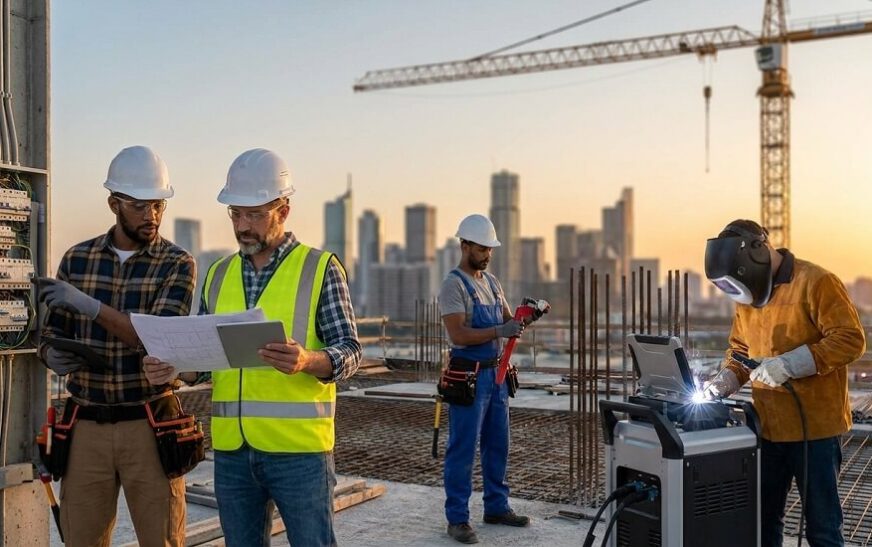
Blue-collar careers are no longer synonymous with low wages. Many skilled manual occupations require substantial technical knowledge, specialized training, licensing, apprenticeships, or years of experience, and some can provide six-figure compensation.
The strongest earning opportunities are often found in trades and technical occupations where workers operate complex equipment, work in hazardous environments, manage critical infrastructure, or possess skills that are difficult to replace.
A high-paying blue-collar job can include elevator installation, electrical linework, industrial maintenance, power generation, specialized welding, boilermaking, millwright work, heavy construction, and other technical fields.
This guide covers high-paying blue-collar jobs, best-paid trade careers, six-figure trade jobs, well-paid manual careers, trade worker income, specialized occupations, union compensation, overtime, career progression, and routes from hands-on work into supervision or business ownership. For a broader look at the skilled trade career ecosystem across all occupations, explore our comprehensive guide.
What Makes a Blue-Collar Career High-Paying?
High compensation in manual and technical careers usually comes from a combination of factors.
Specialized Skills
The more difficult a skill is to develop and replace, the more valuable it can become.
Risk
Some jobs involve high-voltage electricity, heights, extreme environments, heavy machinery, confined spaces, or other hazards.
Overtime
Some industries operate around the clock or depend on emergency response, creating additional earning opportunities.
Licensing
Specialized licenses or credentials can restrict the supply of qualified workers.
Industry
Utilities, energy, specialized manufacturing, construction, transportation, and infrastructure can offer different compensation levels from general labor.
Union Contracts
Union trades may provide structured wages, benefits, pensions, and overtime provisions.
Geographic Mobility
Workers willing to travel can access specialized projects and markets with higher compensation.
Highest-Paying Blue-Collar Careers
Some of the strongest earning opportunities can be found in:
- Elevator and escalator installation
- Electrical power-line work
- Nuclear power operations
- Power distribution
- Specialized construction
- Boilermaking
- Pile driving
- Industrial maintenance
- Millwright work
- Specialized welding
- Commercial diving
- Heavy industrial operations
For a deeper look at electrician earnings and career progression, including journeyman, master, and contractor income, explore our comprehensive guide.
Not every worker in these occupations earns six figures. Compensation varies by location, experience, industry, shift, overtime, union status, and job responsibility.
Six-Figure Trade Jobs
Six-figure income can be achievable in certain blue-collar occupations, but it is rarely guaranteed by a job title alone.
Potential paths include:
- Elevator mechanic
- Power-line worker
- Nuclear power reactor operator
- Power distributor or dispatcher
- Senior industrial mechanic
- Specialized millwright
- Experienced construction supervisor
- Specialized commercial diver
- High-level contractor or business owner
Some workers reach six figures through base compensation.
Others reach it through a combination of the following:
Base pay + overtime + premiums + travel + bonuses
When evaluating a career, distinguish between guaranteed compensation and variable earnings.
Blue-Collar Career Income
Long-term income depends on more than the first-year wage.
Important factors include:
- Apprenticeship pay
- Wage progression
- Overtime
- Shift premiums
- Benefits
- Pension
- Specialization
- Supervisory opportunities
- Geographic mobility
- Self-employment
A career that starts at a moderate wage but has strong progression can ultimately outperform a job with a higher initial wage but limited advancement.
Elevator Mechanic Career
Elevator and escalator installers and repairers are among the highest-paid occupations in the construction and extraction category.
The work involves:
- Elevators
- Escalators
- Moving walkways
- Motors
- Controls
- Safety systems
- Mechanical components
The occupation combines mechanical and electrical knowledge with highly specialized equipment.
BLS reported a $106,580 median annual wage for elevator and escalator installers and repairers in May 2024, while the May 2025 BLS occupational data showed an annual mean wage of $109,820.
This occupation generally requires apprenticeship-based training, making it a notable example of a high-paying career that does not necessarily begin with a traditional four-year degree.
Elevator Mechanic Career Path
A typical progression can include:
Apprentice → Elevator Mechanic → Experienced Mechanic → Lead → Supervisor
Professionals may eventually move into:
- Inspection
- Project supervision
- Field management
- Elevator contracting
- Specialized modernization
The work requires strong safety discipline because elevators contain high-risk mechanical and electrical systems.
Why Elevator Mechanics Can Earn More
Several factors can contribute to the occupation’s compensation:
- Specialized training
- Limited labor supply
- Complex equipment
- Safety responsibility
- Technical troubleshooting
- Construction and modernization demand
- Maintenance requirements
The trade also requires workers to stay current as elevator technology changes.
Power Lineworker Career
Electrical power-line installers and repairers install and maintain systems used to distribute electrical power.
Work can involve:
- Utility lines
- Distribution systems
- Transmission
- Storm restoration
- Transformers
- High-voltage equipment
The work can be physically demanding and hazardous.
BLS reported a $92,560 median annual wage for electrical power-line installers and repairers in May 2024, with 7% projected employment growth from 2024 to 2034.
Power Lineman Career Path
A common route is:
Ground Worker or Helper → Apprentice Lineman → Journeyman Lineman → Lead → Foreman → Line Supervisor
Apprentices learn:
- Climbing
- Electrical systems
- Rigging
- Equipment
- Safety
- Rescue procedures
- Storm restoration
The career can provide strong income potential, particularly when overtime and emergency restoration work are available.
Power Lineman Overtime Income
Lineworkers may respond to the following:
- Storms
- Grid failures
- Emergency repairs
- Infrastructure projects
This can create substantial overtime during major events.
However, emergency income is irregular.
A career comparison should therefore separate the following:
- Normal annual earnings
- Typical overtime
- Exceptional storm-response income
Nuclear Power Reactor Operator Career
Nuclear power reactor operators monitor and control nuclear power-generation systems.
The occupation is highly specialized and involves:
- Plant systems
- Controls
- Safety procedures
- Monitoring
- Emergency procedures
- Technical documentation
BLS reported a $122,610 median annual wage for nuclear power reactor operators in May 2024.
This is one of the strongest examples of a high-income technical occupation that can be pursued without a traditional four-year degree in every case.
The role does require extensive training, plant-specific qualification, testing, and strict regulatory compliance.
Nuclear Plant Operator Career Path
A potential path is:
Plant Trainee → Auxiliary Operator → Licensed Operator → Senior Operator → Shift Supervisor
Advancement requires substantial technical competency and experience.
The work environment is highly controlled and procedure-driven.
Nuclear Plant Operator Salary
Nuclear power reactor operators had a median annual wage above $120,000 in May 2024.
Compensation can vary based on:
- Plant
- Experience
- Location
- Shift
- Seniority
- Overtime
- Union representation
Because the workforce is relatively small, individual job openings can be competitive.
Boilermaker Career
Boilermakers install, maintain, and repair boilers, tanks, pressure vessels, and related industrial equipment.
Work can occur in:
- Power plants
- Refineries
- Manufacturing
- Industrial facilities
- Shipyards
- Construction
The work can involve:
- Welding
- Rigging
- Metal fabrication
- Inspection
- Industrial maintenance
BLS reported an annual mean wage of $80,090 for boilermakers in May 2025.
Boilermaker Union Wage
Union boilermaking can provide structured wage and benefit packages.
Potential compensation components include:
- Hourly wage
- Overtime
- Pension
- Health benefits
- Travel pay
- Per diem
Actual union wages vary by local agreement and geographic jurisdiction.
Candidates should compare the complete package rather than the hourly wage alone.
Boilermaker Career Path
A potential progression is the following:
Apprentice → Journeyman Boilermaker → Lead → Foreman → Superintendent
Experienced workers can also specialize in:
- Welding
- Inspection
- Shutdown work
- Industrial maintenance
- Pressure vessels
Shutdown and turnaround projects can create periods of intense work and additional overtime.
Millwright Career
Millwrights install, maintain, align, and repair industrial machinery.
They may work with:
- Conveyors
- Motors
- Pumps
- Turbines
- Production equipment
- Bearings
- Hydraulic systems
- Automated machinery
BLS reported a $63,510 median annual wage for industrial machinery mechanics, machinery maintenance workers, and millwrights in May 2024.
Millwrights with advanced mechanical, electrical, or automation skills can move into higher-responsibility positions.
Millwright Career Salary
Millwright compensation depends on the following:
- Industrial sector
- Location
- Union status
- Shift
- Overtime
- Experience
- Technical specialization
High-value environments can include:
- Power generation
- Manufacturing
- Energy
- Heavy industry
- Large automated facilities
Millwright to Maintenance Manager
A millwright can advance through the following:
Apprentice → Journeyman → Senior Millwright → Lead → Maintenance Supervisor → Maintenance Manager
Adding electrical, controls, and automation knowledge can expand advancement opportunities.
Pile Driver Operator Career
Pile driver operators work with equipment that drives piles into the ground for foundations and infrastructure.
Projects can include:
- Bridges
- Ports
- Buildings
- Docks
- Roads
- Marine structures
BLS reported an annual mean wage of $80,710 for pile driver operators in May 2025.
The occupation is highly specialized and often requires substantial job-site experience.
Pile Driver Operator Pay
Earnings can vary with the following:
- Project size
- Location
- Union membership
- Overtime
- Equipment specialization
- Travel
- Infrastructure activity
Large infrastructure projects can create periods of strong demand.
Commercial Diver Career
Commercial divers perform underwater construction, inspection, repair, maintenance, and related work.
They can work on:
- Bridges
- Ports
- Ships
- Offshore infrastructure
- Pipelines
- Dams
- Marine structures
The career requires professional diving training and specialized safety procedures.
Commercial diving is different from recreational scuba diving and involves significant occupational hazards.
Commercial Diver Salary
There is no single reliable compensation figure that applies to all commercial divers.
Income varies according to:
- Diving specialty
- Offshore versus inland work
- Project conditions
- Experience
- Certification
- Travel
- Depth
- Working environment
Offshore and specialized diving projects can produce much higher earnings than entry-level inland work, but those opportunities are not representative of every commercial-diving job.
Underwater Welder Income Comparison
Underwater welding is a specialty that combines commercial diving and welding.
It is often portrayed as one of the highest-paying blue-collar careers.
In reality, income varies enormously.
Factors include:
- Diving qualification
- Welding certification
- Offshore work
- Project type
- Experience
- Travel
- Contract length
Candidates should compare underwater welding with conventional pipe welding, industrial welding, and commercial diving rather than assuming it automatically provides exceptional income.
Underwater Welding Career Path
A potential progression is the following:
Welder → Commercial Diver → Underwater Welding Specialist → Senior Diver/Welder → Dive Supervisor
The career requires more than welding skill.
Workers need:
- Diving training
- Safety
- Underwater procedures
- Emergency response
- Welding competency
Highest-Wage Trade Workers
Among trade and technical occupations, the strongest compensation often occurs in specialized niches.
Examples include:
| Career | Recent BLS Benchmark |
| Nuclear power reactor operator | $122,610 median, May 2024 |
| Elevator and escalator installer/repairer | $106,580 median, May 2024 |
| Power-line installer/repairer | $92,560 median, May 2024 |
| Pile driver operator | $80,710 means May 2025 |
| Boilermaker | $80,090 mean, May 2025 |
| Millwright-related occupation | $63,510 median, May 2024 |
| Electrician | $62,350 median, May 2024 |
| Plumber/pipefitter/steamfitter | $62,970 median, May 2024 |
These figures are not directly interchangeable because some are medians and others are means, and the occupational definitions differ.
Why Some Trades Pay More
High-paying blue-collar occupations often share several characteristics.
Specialized Training
Workers require substantial preparation before working independently.
Difficult Working Conditions
Jobs may involve:
- Heights
- High voltage
- Extreme temperatures
- Confined spaces
- Offshore environments
High Cost of Errors
Mistakes can create safety, production, or infrastructure problems.
Scarce Talent
Employers may have difficulty finding sufficiently experienced workers.
Critical Infrastructure
Utility, energy, transportation, and industrial systems require reliable technical workers.
Overtime
Some industries operate around the clock or depend on emergency response.
Union vs Non-Union Blue-Collar Pay
Union employment can provide:
- Wage scales
- Health benefits
- Retirement plans
- Apprenticeships
- Overtime rules
- Collective bargaining
Non-union employment can provide the following:
- Individual negotiation
- Employer flexibility
- Different career structures
- Small-business opportunities
Neither model guarantees higher total income.
Compare:
Base wage + overtime + benefits + retirement + training + job stability
Apprenticeship and High-Paying Trades
Several high-paying blue-collar occupations can be entered through structured training.
Apprenticeships are particularly common in the following:
- Elevator work
- Electrical linework
- Boilermaking
- Millwright work
- Construction
- Skilled mechanical trades
An apprenticeship can therefore be a strong alternative to a traditional university pathway.
The tradeoff is that early-career wages are lower than experienced-worker wages.
How to Reach Six-Figure Trade Income
Six-figure income usually becomes more realistic when workers increase one or more of these variables:
Skill
Develop a hard-to-find specialization.
Responsibility
Move into lead, foreman, superintendent, or supervisor roles.
Industry
Target high-value industries such as the following:
- Utilities
- Energy
- Aerospace
- Specialized manufacturing
- Infrastructure
- Nuclear power
Location
Move toward markets with strong demand and higher wages.
Overtime
Take advantage of legitimate overtime opportunities when they fit your lifestyle.
Business Ownership
Use technical expertise to build a contracting or service company.
Best Paid Trade Careers by Interest
Prefer Mechanical Systems?
Consider millwright and industrial maintenance careers.
Prefer Electricity?
Consider linework, electrical, and specialized utility careers.
Prefer Industrial Work?
Consider boilermaking or industrial maintenance.
Prefer Precision?
Consider elevator systems and specialized manufacturing.
Prefer infrastructure?
Consider pile driving, linework, and specialized construction.
Prefer Extreme Environments?
Consider commercial diving, offshore work, or specialized industrial projects.
High-Paying Trades Without a Degree
A four-year degree is not universally required for many high-paying blue-collar occupations.
Potential entry routes include the following:
- Apprenticeship
- Employer training
- Technical school
- On-the-job training
- Licensing programs
However, “no degree” does not mean “no education.”
High-paying trades often require the following:
- Long training periods
- Exams
- Certifications
- Safety training
- Supervised work
- Continuing education
Trade School and High-Paying Careers
Technical school can be useful for workers who want to enter the following:
- Electrical
- HVAC
- Welding
- CNC
- Industrial maintenance
But the highest-paying trades do not necessarily require expensive private trade school.
A paid apprenticeship may provide stronger financial ROI when available.
High-Paying Blue-Collar Career Advancement
Long-term income often increases as workers move from physical execution into higher-responsibility positions.
A possible progression is the following:
Apprentice → Qualified Worker → Lead → Foreman → Supervisor → Manager
Another route is:
Technician → Inspector → Specialist → Senior Technical Role
Or:
Tradesperson → Contractor → Business Owner
Leadership is not the only way to earn more. Technical specialization can also create significant value.
Trade Specialization vs Management
Technical Specialist
Advantages:
- Continued hands-on work
- Deep expertise
- Potential premium pay
- Less administrative responsibility
Manager
Advantages:
- Broader responsibility
- Larger teams
- Career mobility
- Potential executive progression
Professionals should not assume management is automatically the best next step.
A highly specialized technician can be extremely valuable.
Blue-Collar Career Income and Overtime
Overtime can materially change annual compensation.
Industries with frequent overtime include:
- Utilities
- Construction
- Industrial maintenance
- Power generation
- Manufacturing
- Emergency restoration
But overtime has a cost.
Workers should consider:
- Fatigue
- Family time
- Physical wear
- Travel
- Recovery
A sustainable base wage can be more valuable than a job that requires excessive overtime to reach a target income.
Benefits in High-Paying Trade Careers
Compensation should include:
- Health insurance
- Retirement
- Pension
- Vacation
- Paid training
- Tool allowances
- Per diem
- Travel reimbursement
Union trades can sometimes offer particularly comprehensive benefits packages.
A job with a lower hourly wage can potentially have greater total compensation after benefits are considered.
Geographic Mobility
Some blue-collar workers increase earnings by moving between regions.
Potential high-demand markets can develop around:
- Infrastructure
- Energy
- Manufacturing
- Construction
- Utilities
- Data centers
- Transportation
Before relocating, compare:
- Wage
- Housing
- Taxes
- Commute
- Job security
- Overtime
- Benefits
The highest nominal salary may not provide the highest disposable income.
Blue-Collar Career Stability
High pay is only one measure of career quality.
Consider:
- Employment outlook
- Replacement demand
- Industry volatility
- Physical demands
- Training requirements
- Geographic mobility
An occupation with moderate growth but large replacement demand can provide many opportunities.
Physical Demands
High-paying manual careers can be physically demanding.
Potential challenges include the following:
- Heavy lifting
- Repetitive movement
- Heights
- Heat
- Cold
- Noise
- Long periods standing
- Confined spaces
Workers should consider long-term physical sustainability when choosing a trade.
Safety and High-Paying Trades
Higher compensation can sometimes reflect higher risk.
Workers should never evaluate a trade on wage alone.
Important safety areas include:
- Fall protection
- Electrical safety
- Lockout/tagout
- Confined spaces
- Respiratory protection
- Rigging
- Hazard communication
- Equipment safety
A career’s income only matters if the worker can remain healthy enough to sustain it.
Technology and Blue-Collar Careers
Technology is changing many trade occupations.
Modern workers may interact with:
- Sensors
- Digital diagnostics
- Automation
- Robotics
- Remote monitoring
- Computerized controls
- GPS
- Digital documentation
This means the highest-value worker may increasingly be someone who combines manual skill with technology.
AI and Blue-Collar Careers
AI can support:
- Predictive maintenance
- Diagnostics
- Scheduling
- Documentation
- Equipment monitoring
- Training
But many blue-collar jobs require physical presence in unpredictable environments.
AI is more likely to change tasks within many trades than eliminate the need for skilled workers immediately.
How to Choose a High-Paying Blue-Collar Career
Start with your preferred work environment.
Like mechanical work?
Consider millwright, elevator, industrial maintenance, or equipment careers.
Like Electrical Systems?
Consider linework, electrical, or power-generation work.
Like construction?
Consider specialized construction, pile driving, boilermaking, or heavy equipment.
Like Precision?
Consider elevators, machining, or specialized manufacturing.
Prefer Technical Control Rooms?
Consider power-generation and nuclear operations.
Comfortable With Extreme Environments?
Explore specialized industrial or commercial-diving careers.
Key Takeaways
- High-paying blue-collar careers often involve specialized technical skills, difficult working conditions, licensing, critical infrastructure, or significant responsibility.
- BLS reported a $122,610 median annual wage for nuclear power reactor operators in May 2024.
- Elevator and escalator installers and repairers had a $106,580 median wage in May 2024, while May 2025 BLS data showed a $109,820 annual mean wage.
- Electrical power-line installers and repairers had a $92,560 median annual wage in May 2024 and projected 7% employment growth from 2024 to 2034.
- BLS May 2025 data showed annual mean wages of $80,090 for boilermakers and $80,710 for pile driver operators.
- Millwright-related industrial machinery mechanics had a $63,510 median annual wage in May 2024.
- Six-figure blue-collar income can come from base wages, overtime, specialization, high-value industries, supervisory responsibility, travel, or business ownership.
- Union and non-union compensation should be compared using total compensation rather than hourly wages alone.
- Apprenticeship can provide a strong route into high-paying trades because workers receive structured training while earning income.
- Commercial diving and underwater welding can produce high compensation in specialized assignments, but income varies widely and should not be based on sensationalized salary claims.
- Physical demands and safety risks should be considered alongside salary when choosing a long-term manual career.
- The strongest blue-collar career strategy combines technical skill, specialization, safety, technology, experience, and increasing responsibility.
Frequently Asked Questions
What are the highest-paying blue-collar jobs?
Examples include nuclear power reactor operator, elevator and escalator installer or repairer, power-line worker, specialized industrial technician, boilermaker, pile driver operator, and some commercial-diving and highly specialized trade positions.
Which blue-collar jobs can pay six figures?
Nuclear power operations, elevator work, power-line work, certain industrial and construction specialties, specialized commercial diving, senior technical roles, and business ownership can reach six-figure compensation depending on location, experience, overtime, and employer.
How much do elevator mechanics make?
BLS reported a $106,580 median annual wage for elevator and escalator installers and repairers in May 2024. May 2025 BLS data showed an annual mean wage of $109,820.
How much do power linemen make?
BLS reported a $92,560 median annual wage for electrical power-line installers and repairers in May 2024. Overtime and emergency restoration can increase annual income.
Do boilermakers make good money?
Boilermaking can provide strong compensation, especially for experienced workers and union members. BLS reported an $80,090 annual mean wage in May 2025.
How much do nuclear power plant operators make?
Nuclear power reactor operators had a $122,610 median annual wage in May 2024. The role requires extensive training, qualification, and adherence to strict operating and safety procedures.
Can millwrights make six figures?
Some experienced millwrights can reach six figures through overtime, specialized industrial work, union compensation, leadership, or high-paying markets. The national median is lower.
Is underwater welding really one of the highest-paying trades?
It can be lucrative in specialized offshore or difficult assignments, but there is no universal high salary. Commercial-diving qualifications, welding skill, experience, project conditions, and travel all affect earnings.
Are union trades better paid?
Union wages can be strong, but the right comparison is total compensation. Benefits, pension, overtime, training, and job stability can make a major difference.
Can I get a high-paying trade job without college?
Yes. Several occupations use apprenticeship, employer training, technical school, or on-the-job pathways rather than requiring a four-year degree.
Do high-paying blue-collar jobs require overtime?
Not always. Some occupations have strong base wages, while others rely more heavily on overtime, shifts, travel, or bonuses to reach higher annual income.
Are high-paying trades physically demanding?
Many are. Elevator work, linework, boilermaking, pile driving, millwright work, and commercial diving can involve significant physical or environmental demands.
What skills increase blue-collar income?
Specialization, troubleshooting, licensing, safety, leadership, technology, advanced equipment knowledge, and willingness to work in high-demand industries can increase long-term earning potential.
Conclusion
High-paying blue-collar careers demonstrate that strong income is not limited to office or professional occupations.
Some of the best-compensated manual and technical careers involve specialized skills, critical infrastructure, difficult working environments, complex machinery, or substantial safety responsibilities.
Elevator mechanics, power-line workers, nuclear power reactor operators, boilermakers, millwrights, pile-driver operators, and specialized commercial divers illustrate different ways technical workers can build strong incomes.
The best career choice depends on more than salary. Workers should examine training length, apprenticeship opportunities, licensing, physical demands, overtime, benefits, location, job outlook, and long-term advancement.
Apprenticeship is particularly important because many high-paying trades provide earn-while-you-learn entry routes. Workers can develop valuable skills without taking on the same education costs associated with some traditional college pathways.
Long-term earnings can increase further through specialization, supervision, project leadership, contracting, or business ownership.
The strongest blue-collar careers combine technical competence, specialized training, reliable performance, safety, technology, and increasing responsibility.
For people who prefer practical work and want a career with tangible results, skilled manual occupations can provide a financially strong alternative to traditional office careers.