
Artificial intelligence is changing the labor market faster than many previous technologies, and for a broader look at the future of work, including emerging careers and skills for 2030, explore our comprehensive guide to future jobs in the USA.
AI can now write text, generate images, summarize documents, analyze data, assist with software development, answer customer questions, and automate increasingly complex workflows.
That creates an important career question:
Which jobs will AI replace, and which new jobs will AI create?
The answer isn’t simply a list of occupations that will disappear.
AI is more likely to automate certain tasks, reshape existing jobs, increase worker productivity, and create new categories of work at the same time.
For workers, the more useful question is not
“Will AI take my job?”
It is:
“Which parts of my job can AI perform, which parts become more valuable, and what new skills should I develop?”
How AI Is Changing Employment
AI can affect employment through several mechanisms.
1. Task Automation
AI performs specific activities previously completed by people.
Examples include:
- Data summarization
- Basic document processing
- Routine customer questions
- Transcription
- Basic content generation
- Simple coding tasks
2. Job Transformation
An occupation remains, but the worker uses AI to complete the job differently.
3. Productivity Growth
One employee may accomplish more work using AI tools.
4. Job Creation
New products, services, workflows, and industries can create new occupations.
5. Skill Shifts
Employers may increasingly value workers who can combine domain knowledge with AI capabilities.
This is why automation vs. job creation shouldn’t be treated as a simple zero-sum equation, and for those seeking careers with strong automation resistance, our guide to jobs safe from AI and robots explores which professions are likely to remain resilient.
Jobs AI Is Most Likely to Affect
AI exposure tends to be higher when work involves the following:
- Repetitive digital tasks
- Predictable workflows
- Large amounts of text
- Structured information
- Standardized decisions
- Routine analysis
- Frequently repeated communication
However, exposure does not automatically mean complete job elimination.
An AI system may perform 30% of an occupation’s tasks without eliminating the occupation itself.
Jobs AI May Replace or Significantly Automate
1. Basic Data Entry
AI and automation can extract information from the following:
- Forms
- Invoices
- Documents
- Emails
- Scanned records
This can reduce the need for manual data-entry work.
Workers in this area can become more resilient by moving toward:
- Data quality
- Systems administration
- Data analysis
- Workflow automation
2. Routine Transcription
Speech-to-text technology can increasingly convert audio into written documents.
AI can assist with:
- Meeting transcripts
- Interviews
- Basic medical transcription
- Call summaries
Human professionals may remain important for specialized terminology, quality control, and sensitive contexts.
3. Basic Customer Service
Customer service is one of the most visible areas of AI replacing workers.
AI systems can handle:
- Frequently asked questions
- Order status
- Account information
- Basic troubleshooting
- Appointment scheduling
Human agents remain more valuable for the following:
- Complex problems
- Escalations
- Negotiation
- Emotional situations
- High-value customers
4. Routine Content Production
Generative AI can produce:
- Product descriptions
- Basic blog drafts
- Social media variations
- Email drafts
- Summaries
- Simple marketing copy
This doesn’t necessarily eliminate professional writers.
Instead, it can reduce demand for purely repetitive writing while increasing the importance of the following:
- Editorial judgment
- Brand strategy
- Original research
- Storytelling
- Subject-matter expertise
5. Basic Translation
AI translation tools can handle increasing volumes of routine language conversion.
Human translators remain especially valuable when work requires the following:
- Legal accuracy
- Cultural nuance
- Creative adaptation
- Specialized terminology
- High-stakes communication
6. Routine Administrative Work
AI assistants can increasingly automate the following:
- Scheduling
- Email categorization
- Meeting summaries
- Document preparation
- Basic reporting
- Information retrieval
Administrative professionals who learn AI workflow automation can potentially move toward higher-value coordination and operational roles.
7. Basic Bookkeeping Tasks
AI-enabled accounting software can automate portions of the following:
- Transaction categorization
- Invoice processing
- Reconciliation
- Expense classification
- Financial reporting
Accountants can remain highly valuable for:
- Financial strategy
- Tax planning
- Audit
- Compliance
- Business advisory
8. Basic Research and Analysis
AI can quickly summarize large amounts of information.
This can affect work involving:
- Document review
- Market research
- Basic competitive analysis
- Information gathering
The human advantage increasingly shifts toward the following:
Knowing what questions to ask + evaluating whether the answer is correct.
White-Collar Jobs and AI Risk
The white-collar jobs AI risk conversation is important because AI primarily operates in digital environments.
Some office occupations contain large amounts of the following:
- Writing
- Research
- Data processing
- Documentation
- Analysis
These activities can be highly compatible with generative AI.
But “white collar” doesn’t mean “will disappear.”
A lawyer, accountant, analyst, or marketer may use AI extensively while continuing to provide significant human judgment.
Jobs AI Is Less Likely to Fully Replace
AI has more difficulty when work depends heavily on the following:
- Physical environments
- Dexterity
- Human trust
- Emotional intelligence
- Complex interpersonal relationships
- Unpredictable situations
- Accountability
- Leadership
Examples can include:
- Nurses
- Skilled trades
- Emergency professionals
- Therapists
- Managers
- Skilled technicians
- Healthcare professionals
Again, these jobs can still be AI-assisted.
AI in Healthcare Jobs
Healthcare illustrates the difference between automation and replacement.
AI can assist with:
- Medical imaging
- Documentation
- Scheduling
- Patient communication
- Clinical decision support
- Administrative work
But healthcare professionals provide the following:
- Physical care
- Patient relationships
- Context
- Ethical judgment
- Clinical responsibility
Therefore, AI may change healthcare jobs significantly without eliminating the need for healthcare workers.
Customer Service AI Impact
Customer service is likely to become increasingly hybrid.
AI handles:
- Routine questions
- FAQs
- Order tracking
- Simple troubleshooting
- Basic account requests
Humans handle:
- Escalations
- Complex cases
- Negotiation
- Sensitive situations
- Relationship management
This can transform customer-service roles rather than simply eliminate them.
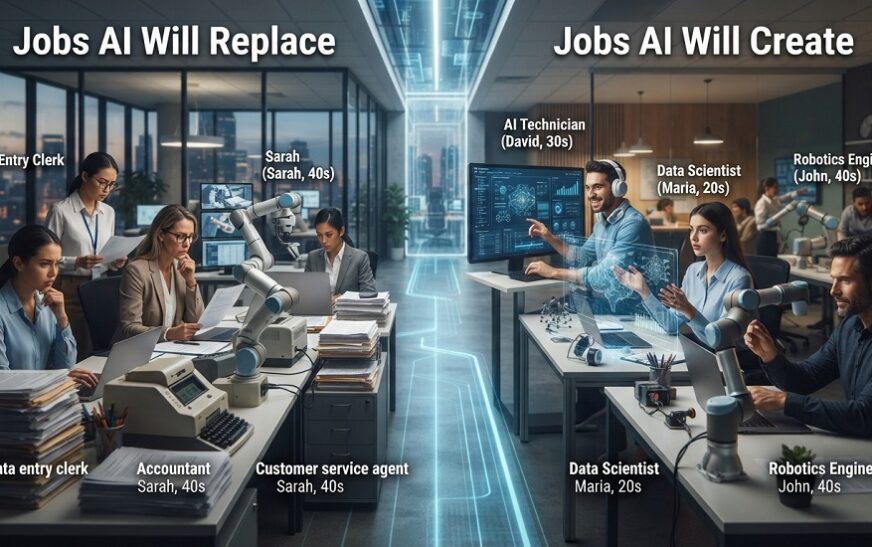
Jobs AI Will Create
AI also creates demand for workers who build, deploy, manage, and govern AI systems.
Potential categories include:
- AI engineering
- Machine learning
- AI product management
- AI implementation
- AI governance
- AI security
- AI training
- AI operations
- Data infrastructure
1. AI Engineers
AI engineers develop and integrate AI systems.
Their work can involve:
- Model integration
- Application development
- Machine learning
- Data pipelines
- AI infrastructure
- System evaluation
Demand can exist across technology, healthcare, finance, manufacturing, and other industries.
2. AI Product Managers
AI product managers combine the following:
- Product strategy
- Customer research
- Technology understanding
- Business objectives
They determine:
- What AI products should do
- Which problems AI can solve
- How users interact with them
- How success should be measured
3. AI Implementation Specialists
Many companies don’t need to build AI models themselves.
They need help implementing existing AI tools.
This creates potential opportunities for professionals who can:
- Map business processes
- Identify automation opportunities
- Configure AI systems
- Train employees
- Measure results
- Manage implementation
This can be particularly attractive to professionals transitioning from consulting, operations, IT, or business roles.
4. AI Trainers
AI trainer jobs can involve helping AI systems improve through:
- Data labeling
- Evaluation
- Feedback
- Quality assessment
- Domain-specific review
The exact nature of these roles varies substantially by company and technology.
Some may be technical, while others rely primarily on subject-matter expertise.
5. Prompt Engineering
The prompt engineer career became highly visible with the growth of generative AI.
Prompt-related skills can be useful for:
- AI application development
- Workflow design
- Content operations
- Research
- Automation
However, workers should avoid treating “prompt engineer” as the only future AI career.
Prompting is increasingly becoming a general AI literacy skill embedded inside broader jobs.
6. LLM Fine-Tuning Careers
Large language models can be adapted for specialized applications.
Potential work includes:
- Fine-tuning
- Model evaluation
- Dataset preparation
- Retrieval systems
- Model optimization
- AI testing
These careers typically require stronger technical skills than basic AI-tool usage.
7. AI Safety and Governance
As organizations deploy increasingly powerful AI systems, they need people who can manage:
- Risk
- Privacy
- Security
- Compliance
- Bias
- Model behavior
- Human oversight
Potential roles include:
- AI governance specialist
- AI risk analyst
- AI safety researcher
- Responsible AI manager
- AI compliance professional
8. AI Security
AI systems introduce new security challenges.
Organizations may need professionals who understand:
- Model security
- Data protection
- Prompt injection
- AI system vulnerabilities
- Access control
- Adversarial attacks
Cybersecurity professionals who develop AI expertise may have an advantage as these systems become more widespread.
9. AI Auditors and Evaluators
Organizations need to determine whether AI systems actually work as expected.
Potential responsibilities include:
- Testing outputs
- Measuring accuracy
- Detecting errors
- Evaluating bias
- Monitoring performance
- Reviewing compliance
This creates a bridge between technical AI systems and organizational accountability.
Autonomous Vehicles and Employment
Autonomous vehicles could significantly affect transportation-related employment.
Potentially affected occupations include:
- Truck drivers
- Taxi drivers
- Delivery drivers
- Some logistics roles
But autonomous transportation can also create demand for the following:
- Fleet operators
- Autonomous vehicle technicians
- Safety specialists
- Remote monitoring professionals
- Transportation-system engineers
- AI infrastructure specialists
The autonomous vehicle impact on jobs therefore includes both displacement and job creation.
AI and the Future of Software Jobs
AI coding tools can automate portions of the following:
- Code generation
- Testing
- Debugging
- Documentation
But software engineering also involves:
- Architecture
- Requirements
- Security
- System integration
- Product decisions
- Reliability
Developers who understand how to direct, evaluate, and integrate AI-generated software may become more productive.
AI and Finance Jobs
AI can automate portions of the following:
- Financial analysis
- Reporting
- Document processing
- Fraud detection
- Customer communication
But financial professionals remain important for the following:
- Risk decisions
- Strategy
- Regulation
- Complex transactions
- Client relationships
The future may favor finance professionals who combine financial expertise with AI and data skills.
AI and Legal Jobs
AI can assist with:
- Legal research
- Contract review
- Document analysis
- Summarization
Lawyers still provide:
- Legal judgment
- Negotiation
- Strategy
- Client advice
- Advocacy
The profession may become more productive rather than disappear.
AI and Marketing Jobs
AI can automate portions of the following:
- Content production
- Ad variations
- Customer segmentation
- Campaign reporting
- Personalization
Marketing professionals can differentiate themselves through:
- Brand strategy
- Customer understanding
- Creative direction
- Positioning
- Market research
AI and Education Jobs
AI can provide:
- Personalized practice
- Automated feedback
- Tutoring
- Lesson assistance
- Administrative support
Teachers can continue focusing on the following:
- Mentoring
- Classroom relationships
- Motivation
- Complex instruction
- Social development
The Most Important Distinction: Tasks vs. Jobs
The biggest mistake in discussions about jobs AI will replace is assuming the following:
One automated task = one eliminated job.
Most occupations contain dozens or hundreds of tasks.
AI may automate some while leaving others untouched.
Consider an accountant.
AI might automate:
- Data entry
- Transaction classification
- Basic reconciliation
But the accountant can still
- Advise management
- Interpret financial information
- Handle complex tax issues
- Manage risk
- Communicate with clients
The occupation changes rather than disappears.
AI Augmentation vs. AI Replacement
Two broad models are emerging.
AI Replacement
Human → AI
A machine performs a task that previously required a person.
AI Augmentation
Human + AI
A worker uses AI to complete tasks faster or better.
For many occupations, the second model may be more common.
The Emerging AI Workforce
The future workforce may increasingly consist of three groups:
AI Builders
People who develop AI systems.
AI Operators
People who use AI within business processes.
AI Managers
People who determine how AI should be governed, evaluated, and deployed.
You don’t necessarily need to become an AI engineer to benefit from the AI economy.
The New Competitive Advantage
As AI becomes more accessible, simply having access to AI tools may no longer provide much differentiation.
The advantage may come from:
Domain expertise + AI skills + judgment
For example:
Healthcare professional + AI literacy
can be more valuable than
AI tool user without healthcare knowledge.
Similarly:
Accountant + AI automation
can be more valuable than generic AI familiarity.
What Workers Should Do Now
Instead of trying to predict exactly which jobs disappear, workers can take practical steps.
Step 1: Identify Your Tasks
Separate your work into:
- Routine
- Analytical
- Creative
- Interpersonal
- Physical
- Strategic
Step 2: Identify AI Exposure
Determine which tasks AI can already perform.
Step 3: Learn AI Tools
Use them for low-risk tasks first.
Step 4: Strengthen Human Skills
Build:
- Communication
- Judgment
- Leadership
- Problem-solving
- Relationship management
Step 5: Build Domain Expertise
Become the person who understands both the industry problem and the technology solution.
How to Assess Whether AI Could Affect Your Job
Rather than labeling entire occupations as “safe” or “at risk,” evaluate the individual tasks within your role.
A useful framework is the following:
Low AI Exposure
Work is predominantly the following:
- Physical
- Relationship-driven
- Highly unpredictable
- Dependent on trust
- Dependent on complex judgment
Moderate AI Exposure
AI can automate some tasks, but human expertise remains important.
High AI Exposure
A large portion of the work involves:
- Digital information
- Repetitive analysis
- Standardized communication
- Structured documentation
- Predictable workflows
High exposure does not automatically mean job elimination.
It means the job may experience significant change.
AI Job Displacement vs. Job Transformation
There are three broad outcomes to consider.
| Outcome | What Happens |
| Displacement | AI performs enough work to reduce the number of workers required |
| Transformation | AI performs some tasks while humans continue performing others |
| Creation | New products, services, and workflows generate new roles |
Most occupations may experience some combination of the three.
White-Collar Work May Face Significant Change
AI’s ability to work with text, data, images, and software means some traditionally office-based activities have relatively high exposure.
Potentially affected areas include:
- Administrative support
- Basic research
- Routine financial analysis
- Customer service
- Content production
- Data processing
- Document review
- Basic software tasks
However, the highest-risk tasks are not necessarily the same as the highest-risk jobs.
Why Some Jobs Will Be Harder to Automate
AI can be powerful at processing information.
But many jobs require interaction with the physical and social world.
For example, a skilled technician may need to do the following:
- Diagnose an unusual physical problem
- Work in an unpredictable environment
- Manipulate equipment
- Communicate with a customer
- Make a safety decision
A model can assist with parts of that process without being able to perform the complete job.
Human Trust Can Become More Valuable
People may be reluctant to delegate certain decisions entirely to an AI system.
Examples include:
- Medical decisions
- Major financial decisions
- Legal strategy
- Hiring decisions
- Childcare
- Mental health
- High-value purchases
In these situations, professionals who can combine AI assistance with human accountability may retain an important role.
AI May Increase Demand for Some Workers
This seems counterintuitive, but automation can sometimes increase demand.
For example:
If AI makes software development cheaper, companies may build more software.
That can increase demand for:
- Developers
- Product managers
- Designers
- Security specialists
- Infrastructure professionals
The same principle can apply across other industries.
Lower production costs can create additional demand for products and services.
The Productivity Effect
Suppose an employee previously spent:
- 5 hours researching
- 3 hours writing
- 2 hours formatting
AI may reduce that workload substantially.
The organization then has several choices:
Option A
Produce the same amount of work with fewer hours.
Option B
Produce more work with the same employee.
Option C
Use the saved time for higher-value activities.
Option D
Reduce headcount.
Which outcome occurs depends on the company’s strategy, demand, economics, and labor market.
AI Can Change the Skill Mix
Imagine a marketing department where AI handles much of the basic content production.
The company may need:
Fewer people focused exclusively on producing routine copy
while increasing demand for the following:
- Brand strategy
- Customer research
- Creative direction
- Analytics
- AI workflow management
This is a skill-mix shift, not necessarily a complete elimination of marketing employment.
Careers AI Creates May Not Look Like “AI Jobs”
A common misconception is that every new AI career will contain “AI” in the title.
AI can create opportunities within traditional industries.
Examples:
Healthcare
AI implementation specialist
Finance
AI risk analyst
Manufacturing
AI-enabled automation technician
Legal
AI-assisted legal operations specialist
Marketing
AI marketing operations manager
Education
AI learning-design specialist
The broader opportunity is often at the intersection of AI + existing domain expertise.
AI Trainer Jobs: What They Actually Involve
AI trainer jobs can include different types of work.
Depending on the organization, workers may:
- Label data
- Evaluate responses
- Rank outputs
- Identify errors
- Provide feedback
- Test model behavior
- Review domain-specific information
Some roles are accessible to people with strong subject knowledge without requiring advanced machine-learning expertise.
Others require technical skills.
Always examine the actual responsibilities rather than assuming the title describes the same work everywhere.
Prompt Engineer Career: Long-Term Outlook
Prompt engineering attracted considerable attention because generative AI systems initially depended heavily on carefully structured instructions.
Prompting remains useful.
But the market is increasingly integrating prompting into broader roles.
Instead of:
“Prompt Engineer”
Many organizations may simply expect the following:
Marketing + AI
Developer + AI
Analyst + AI
Researcher + AI
This suggests that learning prompting is useful, but building an entire career around prompting alone may be less resilient than combining it with substantial domain expertise.
LLM Fine-Tuning Career
Large language models can be adapted for specific applications.
Potential skills include:
- Machine learning
- Python
- Data preparation
- Model evaluation
- Fine-tuning
- Retrieval-augmented generation
- Model optimization
These roles are generally more technical than basic generative-AI usage.
They may be particularly relevant to professionals pursuing engineering or machine-learning careers.
AI Evaluation Jobs
As companies deploy AI, they need to know the following:
Does the system actually work?
Evaluation roles can test:
- Accuracy
- Reliability
- Safety
- Bias
- Consistency
- Hallucinations
- Task performance
This creates a growing need for people who can evaluate AI outputs against meaningful standards.
AI Governance Careers
AI adoption creates organizational questions such as the following:
- Who can use AI?
- What data can be entered?
- How should AI decisions be reviewed?
- How should errors be handled?
- What documentation is required?
- How should regulatory requirements be addressed?
AI governance professionals can help organizations establish these systems.
Potential backgrounds include the following:
- Compliance
- Legal
- Risk
- Cybersecurity
- Policy
- Technology
AI Security Careers
AI systems introduce new attack surfaces.
Organizations may need professionals who understand:
- Model vulnerabilities
- Data security
- Access controls
- Adversarial attacks
- Prompt injection
- AI application security
Cybersecurity professionals who understand AI may therefore have opportunities across multiple industries.
Autonomous Vehicles: Displacement and Creation
Autonomous transportation is a useful case study.
Potentially affected jobs include:
- Long-haul trucking
- Taxi driving
- Delivery driving
- Certain logistics roles
But adoption can create demand for:
- Fleet management
- Vehicle maintenance
- Autonomous-system monitoring
- Safety operations
- Mapping
- Infrastructure
- Robotics engineering
The final employment effect depends heavily on adoption speed, regulation, economics, and consumer acceptance.
AI in Healthcare: Replacement or Augmentation?
Healthcare demonstrates why predictions should be nuanced.
AI may automate:
- Scheduling
- Documentation
- Image analysis
- Administrative processing
- Information retrieval
But healthcare professionals still provide the following:
- Physical care
- Clinical judgment
- Patient communication
- Emotional support
- Accountability
The likely result for many healthcare occupations is augmentation rather than complete replacement.
Customer Service AI Impact
Customer service may become one of the clearest examples of workforce restructuring.
A future support organization could use the following:
AI
For routine questions and first-level troubleshooting.
Human Agents
For difficult or emotionally sensitive cases.
AI Supervisors
For monitoring AI performance and escalating problems.
This can produce fewer traditional support interactions while creating new operational responsibilities.
Jobs AI May Create Through Entirely New Demand
AI can create employment when it enables products that were previously too expensive or impractical.
Consider:
AI makes a service cheaper → more customers use it → demand expands → new supporting jobs appear.
This is one reason forecasting new jobs from AI is difficult.
The largest employment effects may come from industries that don’t yet exist at a significant scale.
AI and Entrepreneurship
AI can also lower the cost of starting a business.
A small team can use AI for:
- Market research
- Coding
- Customer support
- Content
- Design
- Administrative work
This can allow smaller companies to perform tasks previously requiring larger teams.
If entrepreneurship increases, new employment can emerge indirectly through those businesses.
The “AI-Resistant” Career Myth
No occupation should be described as completely AI-proof.
A better concept is
AI-resistant tasks
These tend to involve combinations of:
- Physical dexterity
- Human trust
- Complex judgment
- Leadership
- Emotional intelligence
- Accountability
- Unpredictable environments
Even these jobs can use AI as an assistive tool.
The “AI-Proof” Worker Is More Realistic
Instead of searching for an AI-proof occupation, aim to become an AI-capable professional.
An AI-capable worker can:
- Identify useful AI applications.
- Automate appropriate tasks.
- Verify AI outputs.
- Recognize AI limitations.
- Apply domain expertise.
- Communicate decisions.
- Continue learning.
This approach is more adaptable than betting on one supposedly safe occupation.
A Practical AI Risk Assessment
Score each part of your job from 1 to 5.
| Task | AI Exposure | Human Value |
| Routine data entry | 5 | 1 |
| Basic document drafting | 4 | 2 |
| Complex analysis | 3 | 4 |
| Client relationship | 2 | 5 |
| Strategic decisions | 2 | 5 |
| Physical work | 1 | 5 |
This isn’t a scientific forecast.
It is a career-planning exercise designed to identify where you may need to adapt.
What to Do If Your Job Has High AI Exposure
Don’t immediately abandon your career.
Instead, consider four moves.
Move 1: Become the AI User
Learn how AI can improve your current workflow.
Move 2: Move Up the Value Chain
Transition from executing routine tasks toward the following:
- Strategy
- Decision-making
- Client management
- Quality control
Move 3: Add Domain Expertise
Become highly knowledgeable about an industry or problem.
Move 4: Learn AI Implementation
Help your organization deploy AI rather than simply compete against it.
What to Do If You’re Entering the Workforce
Students and early-career workers should consider combining the following:
One strong domain + AI capability
Examples:
- Finance + AI
- Healthcare + AI
- Marketing + AI
- Engineering + AI
- Law + AI
- Education + AI
- Operations + AI
This creates more career flexibility than learning AI tools without understanding a real-world problem.
What Employers May Look For
Future employers may increasingly value candidates who can demonstrate:
- AI fluency
- Strong judgment
- Problem-solving
- Adaptability
- Domain knowledge
- Communication
- Data literacy
A résumé saying “proficient with AI” is less compelling than evidence such as the following:
Automated a repetitive workflow using AI and reduced processing time by 40%.
Demonstrated results matter.
Build an AI-Ready Portfolio
Workers can demonstrate AI capability through practical projects.
Examples:
Analyst
Build an AI-assisted reporting workflow.
Marketer
Create an AI-supported campaign analysis system.
Developer
Build an AI-powered application.
HR Professional
Create an AI-assisted candidate-screening workflow with appropriate human review.
Operations Professional
Automate a repetitive internal process.
The goal is to show:
Problem → AI solution → Human oversight → Measurable result
Career Strategy: Move Toward Complementarity
A useful rule is:
Move toward work where AI increases your productivity rather than work where AI performs the majority of your value-producing tasks.
For example:
Higher Risk
Creating standardized reports manually.
Lower Risk
Interpreting reports and advising decision-makers.
What the AI Labor Market Could Look Like
A simplified future workforce may contain four categories:
| Category | Example |
| AI Builders | ML engineers, AI engineers |
| AI Integrators | AI implementation specialists |
| AI Users | Professionals using AI in existing jobs |
| AI Governors | Risk, security, compliance, governance |
Most workers won’t need to become AI builders.
But increasingly, many professionals may become AI users or integrators.
Final Career Framework
When evaluating any occupation, ask:
1. What tasks can AI already perform?
2. What tasks are likely to become automated?
3. Which human responsibilities remain?
4. Could AI increase demand for this occupation?
5. What new roles could emerge around the technology?
6. What skills would make me complementary to AI?
These questions are more useful than simply asking whether an occupation is “safe.”
Bottom Line
The labor market impact of AI will likely be uneven.
Some jobs will experience substantial displacement.
Some will be redesigned.
Some will become more productive.
And new careers will emerge around AI development, implementation, evaluation, security, governance, and specialized applications.
The strongest strategy for workers is not to predict exactly which jobs AI will replace.
It is to understand how AI is changing the tasks within their occupation and then deliberately move toward work requiring domain expertise, judgment, relationships, creativity, physical capability, or responsibility.
AI may replace some tasks. Workers who know how to use AI can replace workers who don’t adapt.
Frequently Asked Questions
What jobs will AI replace?
AI is most likely to automate jobs or tasks involving repetitive, predictable, digital, and highly standardized work. Data entry, routine administrative processing, basic customer support, transcription, and some forms of content production may face significant automation.
Will AI replace white-collar jobs?
AI is likely to substantially change many white-collar occupations, particularly those involving routine information processing, writing, analysis, and documentation. However, exposure to AI does not automatically mean an entire occupation will disappear.
What jobs will AI create?
Potential growth areas include AI engineering, AI implementation, AI governance, AI security, AI training, model evaluation, machine learning, AI product management, and specialized roles combining AI with healthcare, finance, marketing, manufacturing, and other industries.
Will AI create more jobs than it destroys?
There is no reliable way to guarantee a single net employment outcome. AI can simultaneously displace tasks, transform occupations, increase productivity, create new products, and generate new roles. The impact will vary by industry, occupation, adoption speed, and economic conditions.
Is prompt engineering a good career?
Prompting is a useful AI skill, but treating “prompt engineer” as a standalone career can be risky. Prompting is increasingly becoming part of broader roles such as software development, marketing, research, operations, and product management. Combining AI skills with strong domain expertise is generally more durable.
What are AI trainer jobs?
AI trainer roles can involve evaluating AI responses, labeling data, ranking outputs, identifying errors, and providing feedback that helps improve AI systems. Requirements vary widely, from subject-matter knowledge to specialized technical expertise.
What is an LLM fine-tuning career?
LLM fine-tuning careers involve adapting large language models for specialized applications. Related skills can include machine learning, Python, data preparation, model evaluation, fine-tuning, and AI application development.
Will AI replace customer service workers?
AI can increasingly handle routine customer-service interactions such as FAQs, order tracking, and basic troubleshooting. Human agents are likely to remain important for complex cases, escalations, negotiation, and sensitive customer interactions.
Will AI replace healthcare workers?
AI may automate or assist with documentation, scheduling, imaging analysis, and other tasks, but many healthcare roles require physical care, clinical judgment, communication, trust, and accountability. For many occupations, AI is more likely to augment workers than completely replace them.
Will autonomous vehicles eliminate driving jobs?
Autonomous vehicles could reduce demand for some driving occupations if adoption becomes widespread. However, the technology can also create jobs in fleet operations, vehicle maintenance, monitoring, safety, mapping, infrastructure, and autonomous-system engineering.
What jobs are safest from AI?
No occupation is completely AI-proof. Jobs involving complex human relationships, physical environments, unpredictable situations, judgment, leadership, and accountability may be more resistant to complete automation, although AI can still change how those workers perform their jobs.
How can I protect my career from AI?
Learn how AI affects your occupation, identify tasks that can be automated, become proficient with relevant AI tools, strengthen domain expertise, and develop skills such as judgment, communication, leadership, and problem-solving.
Should I learn AI if I’m not a technical worker?
Yes. AI literacy can benefit professionals across marketing, finance, healthcare, HR, education, operations, sales, and many other fields. You don’t necessarily need to learn machine learning or programming to become an effective AI-enabled professional.