
A plumbing career combines hands-on construction, mechanical systems, troubleshooting, safety, customer service, and technical problem-solving. Plumbers install, repair, maintain, and inspect systems that move water, wastewater, gas, and other fluids through residential, commercial, industrial, and institutional buildings.
For people researching how to become a plumber, the career can begin with an apprenticeship and progress toward journeyman, master plumber, foreman, contractor, or business-owner roles. The exact licensing structure varies by state and locality, so prospective plumbers need to understand the requirements where they intend to work.
The U.S. Bureau of Labor Statistics reports a $62,970 median annual wage for plumbers, pipefitters, and steamfitters in May 2024 and projects 4% employment growth from 2024 to 2034, with about 44,000 openings per year on average.
This guide covers plumber careers, plumbing apprenticeships, certifications, licenses, journeyman and master plumber paths, salaries, UA union apprenticeships, residential and commercial plumbing, gas fitting, water-treatment work, overtime, and plumbing business ownership. For a broader look at the skilled trade career in the USA across all occupations, explore our comprehensive guide.
What Does a Plumber Do?
Plumbers install and maintain systems that control water, drainage, and related piping.
Typical work includes the following:
- Installing water lines
- Installing drain systems
- Repairing leaks
- Replacing fixtures
- Installing piping
- Maintaining plumbing equipment
- Troubleshooting pressure problems
- Testing systems
- Reading plans
- Maintaining code compliance
Depending on specialization, plumbers may also work with the following:
- Gas systems
- Boilers
- Backflow equipment
- Medical-gas systems
- Industrial piping
- Water-treatment equipment
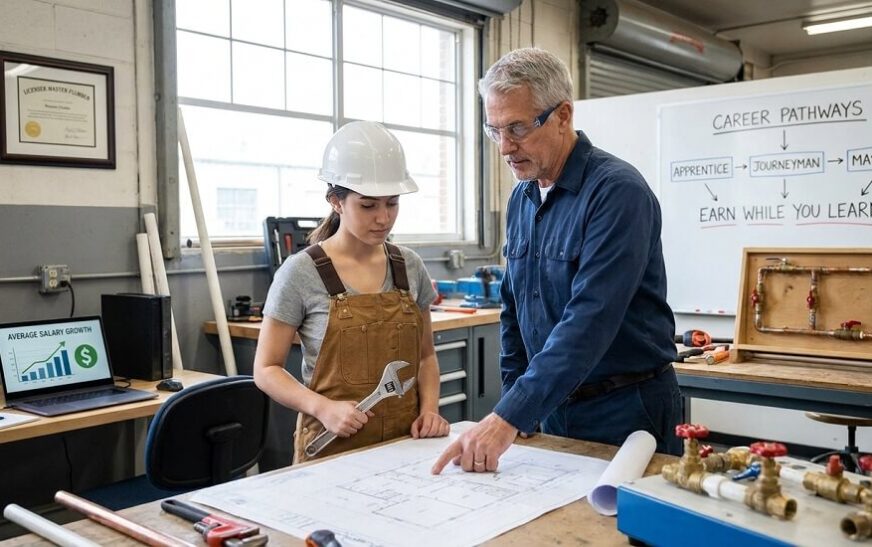
Plumbing Career Path
A common plumbing career path is the following:
Helper or Pre-Apprentice → Apprentice → Journeyman Plumber → Master Plumber → Contractor or Business Owner
The exact titles and legal responsibilities differ by jurisdiction.
Other advancement routes include the following:
Journeyman → Foreman → Superintendent → Project Manager
or:
Journeyman → Estimator → Project Manager → Operations Manager
A plumber can therefore remain highly technical or move toward management and business leadership.
How to Become a Plumber
A typical pathway includes the following:
- Research the licensing requirements in your state or locality.
- Find an apprenticeship or entry-level plumbing employer.
- Complete supervised on-the-job training.
- Complete required classroom or technical instruction.
- Accumulate the required work experience.
- Pass applicable examinations.
- Obtain a journeyman or equivalent license where required.
- Build additional experience for master-level licensing.
- Pursue contractor licensing or business ownership if desired.
BLS notes that most plumbers learn through apprenticeships and that most states require plumbers to be licensed.
Plumbing Apprenticeship
An apprenticeship combines practical work with structured instruction. For a detailed comparison of plumbing apprenticeship and training options versus trade school programs, including costs, timelines, and career outcomes, explore our comprehensive trade school vs apprenticeship guide.
Apprentices learn skills such as the following:
- Pipe installation
- Blueprint reading
- Plumbing codes
- Tool use
- Safety
- System testing
- Troubleshooting
- Mathematics
- Materials
- Installation techniques
The United Association’s Registered Apprenticeship Program combines paid on-the-job training with classroom instruction and describes a typical program as lasting about five years. UA states that its programs include extensive hands-on training and related classroom instruction.
UA Union Plumber Apprenticeship
The United Association (UA) represents workers in plumbing and other piping trades and operates registered apprenticeship programs across the United States and Canada.
UA describes its apprenticeship model as an earn-while-you-learn pathway combining paid work, classroom education, mentoring, progressive wage increases, and benefits.
Typical entry requirements can include the following:
- Being at least 18
- High school diploma or GED
- Aptitude or suitability for the trade
- Interview
- Physical requirements
Exact requirements vary by local training center.
Plumbing Apprenticeship Requirements
Requirements depend on the program and jurisdiction, but candidates may need the following:
- High school diploma or equivalent
- Basic mathematics
- Valid identification
- Physical ability to perform trade work
- Aptitude testing
- Interview
- Drug screening in some programs
Strong applicants can improve their preparation through:
- Algebra
- Mechanical aptitude
- Construction exposure
- Tool familiarity
- Safety awareness
- Reliable attendance
Apprentice Plumber Salary
Apprentices generally earn less than fully qualified plumbers because they are still developing skills under supervision.
BLS specifically notes that apprentices earn less initially but receive higher pay as they learn more.
Apprentice compensation can vary based on:
- Year of apprenticeship
- Union or non-union status
- Employer
- Location
- Overtime
- Construction market
A major financial advantage of apprenticeship is that the worker earns income while gaining experience rather than paying for a full-time traditional college program.
Journeyman Plumber
A journeyman plumber is generally a trained and qualified plumber who has completed the applicable apprenticeship and experience requirements and obtained the required credential or license where applicable.
Journeymen may:
- Install plumbing
- Diagnose problems
- Read plans
- Work independently within legal limits
- Supervise apprentices
- Coordinate jobs
- Perform testing
- Handle service calls
The exact authority of a journeyman differs by state and local licensing system.
Journeyman Plumber Salary
There is no single national wage specifically for licensed journeyman plumbers because BLS groups plumbers, pipefitters, and steamfitters together.
For that broader occupation, the median annual wage was $62,970 in May 2024, while the highest 10% earned more than $105,150.
Actual journeyman pay can vary according to the following:
- Location
- Union status
- Industry
- Experience
- Specialty
- Overtime
- Commercial versus residential work
Master Plumber Career
A master plumber is generally a highly experienced plumber who has met additional experience and examination requirements where the jurisdiction recognizes that classification.
Depending on local law, a master plumber may be permitted to
- Supervise plumbing work
- Oversee journeymen and apprentices
- Qualify a contracting business
- Pull permits
- Design or oversee systems
- Manage larger projects
Not every state uses the same master-plumber classification.
Master Plumber License
There is no universal national master plumber license.
Licensing may be handled by:
- State agencies
- Counties
- Cities
- Local licensing boards
Requirements can include:
- Journeyman experience
- Documented work hours
- Application
- Examination
- Fees
- Insurance
- Continuing education
Because requirements vary, candidates should verify current rules with the licensing authority where they intend to work.
Plumbing License by State
Plumbing licensing can differ significantly across the country.
A jurisdiction may regulate:
- Apprentice registration
- Journeyman licensing
- Master licensing
- Contractor licensing
- Specialty plumbing
- Gas fitting
- Backflow
- Continuing education
Some states have statewide licensing systems, while others delegate substantial responsibility to local governments.
A plumber should never assume that a credential earned in one jurisdiction automatically authorizes work elsewhere.
Plumbing Certification vs. License
Certification and licensing are not necessarily the same.
A certification may demonstrate that someone completed specific training or demonstrated knowledge.
A license is generally a legal authorization to perform regulated work.
Before paying for a certification program, determine whether the credential:
- Is recognized by employers
- Helps satisfy local licensing requirements
- Is required for your target specialty
- Has meaningful industry recognition
Residential Plumber Career
Residential plumbers work primarily in:
- Houses
- Apartments
- Condominiums
- Residential renovations
- New construction
Typical work includes the following:
- Fixtures
- Water lines
- Drain systems
- Water heaters
- Leak repairs
- Sewer lines
Residential plumbing can provide a strong foundation because workers encounter a broad range of common systems and customer-service situations.
Commercial Plumber Career
Commercial plumbers work in the following:
- Office buildings
- Hotels
- Restaurants
- Schools
- Hospitals
- Retail properties
- Warehouses
Commercial projects can involve:
- Larger piping systems
- Complex building plans
- Multiple floors
- Commercial fixtures
- Pumps
- Specialized systems
Commercial plumbing can create pathways toward larger construction projects and supervisory positions.
Residential vs. Commercial Plumber Salary
Pay varies by region, employer, and experience, so there is no universal rule that commercial plumbers always earn more.
Commercial work may offer higher earning potential when it involves:
- Larger projects
- Complex systems
- Specialized skills
- Overtime
- Industrial environments
Residential service work can also be financially attractive, particularly for experienced plumbers who develop strong customer relationships or build their own businesses.
The best comparison is total compensation and career progression rather than job title alone.
Industrial Plumbing and Pipefitting
Industrial environments can involve more complex piping systems.
Professionals may work on:
- Manufacturing plants
- Energy facilities
- Processing equipment
- Boilers
- Pumps
- Industrial piping
This can overlap with pipefitting and steamfitting, which are closely related but distinct specialties.
Industrial work often rewards strong technical troubleshooting and safety skills.
Gas Fitter Career
Gas fitting focuses on systems that transport and use fuel gases.
Work can include:
- Gas piping
- Appliances
- Regulators
- Pressure testing
- Specialized installations
- Safety systems
Gas work is heavily regulated in many jurisdictions.
Requirements may include separate licensing, endorsements, or specialized credentials, so plumbers interested in this path should investigate local rules before performing regulated gas work.
Gas Fitter Skills
Important skills can include:
- Gas-code knowledge
- Pressure testing
- Leak detection
- Appliance connections
- Combustion awareness
- Safety
- Troubleshooting
Because gas-system mistakes can create serious hazards, training and compliance are especially important.
Water Treatment Plumber Career
Water-treatment plumbing can involve systems designed to improve or manage water quality.
Possible areas include:
- Filtration
- Water softening
- Reverse osmosis
- Water-treatment equipment
- Commercial treatment systems
- Industrial water systems
This path can appeal to plumbers who enjoy combining mechanical systems with environmental and water-quality technology.
Water Treatment and Industrial Plumbing
Large facilities may need professionals who understand both piping and treatment systems.
Possible employers include:
- Manufacturing
- Hospitals
- Municipal facilities
- Industrial plants
- Commercial buildings
- Water-treatment businesses
Specialization can help plumbers move into higher-value technical positions.
Plumbing Overtime Income
Overtime can significantly increase a plumber’s annual earnings.
Potential sources include the following:
- Emergency service
- Weekend work
- Construction deadlines
- Industrial shutdowns
- Large commercial projects
- Storm-related repairs
- On-call service
BLS notes that plumbers commonly work full time and may work nights and weekends or be on call for emergencies.
Overtime should be treated as variable income rather than guaranteed base pay.
Plumbing Travel Jobs
Some plumbers travel for:
- Industrial projects
- Power facilities
- Large commercial construction
- Shutdowns
- Specialized installations
- Disaster response
Travel work can provide higher total compensation in some situations but may involve:
- Long periods away from home
- Per diem
- Temporary housing
- Extended shifts
Candidates should compare travel compensation with lifestyle demands.
Plumber Foreman Career
A plumbing foreman coordinates crews and job-site work.
Responsibilities can include:
- Assigning tasks
- Reading plans
- Coordinating materials
- Supervising apprentices
- Monitoring quality
- Coordinating with other trades
- Enforcing safety
- Tracking progress
Foreman work is often the first major step from technical execution into leadership.
Plumbing Superintendent Career
A superintendent generally manages larger projects or several crews.
Responsibilities can include:
- Scheduling
- Crew management
- Material coordination
- Inspections
- Safety
- Quality
- Contractor coordination
- Client communication
This role can lead to:
- Project management
- Construction management
- Operations
- Senior field leadership
Plumbing Estimator Career
Estimators calculate what a plumbing project will cost.
They evaluate:
- Plans
- Labor hours
- Pipe and material quantities
- Fixtures
- Equipment
- Subcontractors
- Scheduling
- Project risk
Experienced plumbers often make effective estimators because they can anticipate real-world installation challenges.
Plumbing Project Manager Career
Project managers oversee the commercial and operational side of plumbing projects.
Responsibilities may include:
- Budget
- Schedule
- Procurement
- Contracts
- Change orders
- Client communication
- Subcontractors
- Project profitability
A plumber who develops financial and communication skills can transition from field work into project management.
Master Plumber to Contractor
A common long-term path is the following:
Apprentice → Journeyman → Master → Contractor → Business Owner
The contractor stage introduces responsibilities outside technical plumbing.
Business owners may manage the following:
- Estimating
- Sales
- Hiring
- Payroll
- Scheduling
- Marketing
- Insurance
- Licensing
- Customer service
- Financial management
The trade becomes a business rather than simply a job.
Plumbing Business Owner Income
A plumbing business owner’s income cannot be represented by one salary figure.
Revenue depends on:
- Number of technicians
- Average job value
- Service mix
- Geographic market
- Pricing
- Commercial contracts
- Customer acquisition
- Utilization
Expenses include:
- Payroll
- Vehicles
- Tools
- Materials
- Insurance
- Licensing
- Office costs
- Advertising
- Taxes
- Warranty work
A company with high revenue can still produce modest owner income if expenses and overhead are high.
How to Start a Plumbing Business
A successful plumbing business typically requires both technical and commercial preparation.
Important steps can include:
- Meet licensing requirements
- Obtain required contractor credentials
- Establish insurance
- Set up accounting
- Develop pricing
- Purchase equipment
- Build a customer-acquisition strategy
- Hire qualified staff
- Establish safety procedures
Local rules differ, so legal and licensing requirements must be verified before opening a business.
Plumbing Business Models
Plumbers can build businesses around the following:
Residential Service
Repairs, replacements, maintenance, and emergency calls.
New Construction
New residential installations.
Commercial Service
Maintenance and repairs for businesses.
Commercial Construction
Large building projects.
Industrial
Specialized systems and facilities.
Specialty Services
Gas fitting, water treatment, backflow, or other specialized work where legally permitted.
Each model has different margins, staffing needs, and customer-acquisition challenges.
Plumbing Career Without College
Plumbing is one of the clearest skilled-trade careers that can be entered without a traditional four-year degree.
Common pathways include:
- Registered apprenticeship
- Union apprenticeship
- Employer-sponsored training
- Technical school
- Community college
- Entry-level plumbing helper positions
“No college” does not mean “no education.”
Plumbers need substantial technical training and, in most states, licensing.
Trade School vs Plumbing Apprenticeship
| Trade School | Apprenticeship |
| Classroom and laboratory instruction | Paid job plus instruction |
| Tuition required | Earn while learning |
| Concentrated technical preparation | Long-term practical development |
| Employer connections vary | Direct workplace experience |
| Can precede apprenticeship | Leads toward qualification |
Some candidates use both pathways.
Plumbing Certifications
Potential credentials can vary according to specialization.
Relevant areas may include:
- Backflow prevention
- Gas fitting
- Water treatment
- Medical gas
- Safety
- Welding
- Specialty systems
The value of a certificate depends on whether employers and licensing authorities recognize it.
Candidates should distinguish between certifications that demonstrate useful expertise and credentials that are legally required.
Plumbing and Safety
Plumbing work can expose workers to the following:
- Confined spaces
- Chemicals
- Hot water
- Pressurized systems
- Construction hazards
- Sewage
- Heights
- Heavy materials
Safety knowledge should cover:
- PPE
- Hazard communication
- Lockout/tagout where applicable
- Confined-space procedures
- Safe lifting
- Fall protection
- Tool safety
Good safety practices are essential to a long career.
Plumbing Tools and Equipment
Common plumbing tools can include:
- Pipe wrenches
- Tubing cutters
- Drain equipment
- Inspection cameras
- Press tools
- Threading tools
- Testing equipment
- Soldering equipment
Specialized commercial and industrial work may require more advanced equipment.
Tool costs should be included when comparing apprenticeship and training options.
Plumbing Technology
Modern plumbing increasingly incorporates technology.
Examples include:
- Video inspection
- Digital leak detection
- Press-connect systems
- Smart water systems
- Building automation
- Remote monitoring
- Water-efficiency technology
Professionals who adopt new systems can improve their productivity and expand specialization.
Smart Plumbing Career
Connected water systems can monitor:
- Flow
- Pressure
- Leaks
- Usage
- Equipment performance
Smart-building technology creates opportunities for plumbers who understand both mechanical systems and digital controls.
Plumbing and Sustainability
Water conservation creates demand for systems designed to reduce the following:
- Water consumption
- Energy use
- Leakage
- Waste
Plumbers may work with the following:
- Low-flow fixtures
- Water recycling
- Efficient hot-water systems
- Smart water monitoring
- Rainwater systems where permitted
Sustainability can therefore become an additional technical specialization.
Plumbing Career Demand
BLS projects plumber, pipefitter, and steamfitter employment to grow 4% from 2024 to 2034, roughly matching the overall projected growth rate.
More importantly, BLS projects approximately 44,000 openings per year over the decade, largely because of replacement needs as workers leave the occupation or retire.
Demand is supported by:
- New construction
- Building maintenance
- Repairs
- Infrastructure
- System replacement
- Aging buildings
Plumbing Job Market 2026
The plumbing job market in 2026 is shaped by both new construction and the enormous installed base of existing buildings.
Maintenance and repair create recurring demand because
- Pipes deteriorate
- Fixtures fail
- Water heaters need replacement
- Drainage systems require maintenance
- Buildings are renovated
- Older systems are upgraded
This replacement and repair component can provide greater stability than markets dependent only on new construction.
Plumbing Career Advancement Strategy
Professionals can increase long-term value by adding skills beyond basic installation.
Technical
- Troubleshooting
- Specialty systems
- Commercial work
- Industrial systems
Leadership
- Crew supervision
- Training
- Scheduling
- Project coordination
Business
- Estimating
- Sales
- Customer relationships
- Financial management
Technology
- Inspection cameras
- Digital diagnostics
- Building systems
- Smart water technology
Master Plumber vs Journeyman Pay
A journeyman typically has more experience and responsibility than an apprentice, while a master plumber generally has additional experience and licensing where that classification exists.
However, salary differences are not automatic.
Pay can be affected by the following:
- Employer
- Region
- Union
- Overtime
- Specialization
- Supervisory role
- Contractor status
A highly experienced journeyman in a strong market can out-earn a master plumber in a lower-paying role.
Business ownership can change the compensation model entirely.
Union vs Non-Union Plumbing
Union Plumbing
Potential advantages include the following:
- Structured apprenticeship
- Wage scales
- Benefits
- Healthcare
- Retirement
- Training
- Collective bargaining
Non-Union Plumbing
Potential advantages may include the following:
- Wider employer selection
- Flexible compensation structures
- Direct company relationships
- Different advancement opportunities
The best option depends on the local market and the specific employer or apprenticeship program.
UA Plumber Career Advancement
The UA states that its career system can progress from apprenticeship to journeyman and beyond, including pathways into the following:
- Foreman
- Estimating
- CAD
- Contracting
- Business ownership
- Instruction
- Union leadership
This illustrates that plumbing apprenticeship can be the beginning of a long technical and management career rather than an endpoint.
Plumbing Career and Work-Life Balance
Plumbing can involve:
- Early mornings
- Emergency calls
- Nights
- Weekends
- Construction schedules
- Physical work
BLS notes that many plumbers work full time, including nights and weekends, and that emergency service may require on-call availability.
Self-employed plumbers may have greater scheduling flexibility but also carry responsibility for customers, staff, and business operations.
How to Choose a Plumbing Specialization
Prefer Homes and Customer Service?
Consider residential service plumbing.
Prefer Large Projects?
Consider commercial plumbing.
Like Industrial Systems?
Explore industrial plumbing and pipefitting.
Want Specialized Licensing?
Consider gas fitting, backflow, or water-treatment specialties where available.
Want Management?
Build toward foreman, superintendent, or project-management roles.
Want Business Ownership?
Develop estimating, sales, customer service, and financial management.
Key Takeaways
- Plumbing careers can progress from apprentice to journeyman, master plumber, foreman, superintendent, project manager, contractor, and business owner.
- BLS reports a $62,970 median annual wage for plumbers, pipefitters, and steamfitters in May 2024, with the highest 10% earning more than $105,150.
- BLS projects 4% employment growth from 2024 to 2034 and about 44,000 openings annually, driven partly by replacement needs and retirements.
- Most plumbers learn through apprenticeships, and most states require plumbers to be licensed.
- UA apprenticeships combine paid work, classroom instruction, mentorship, and progressive wage growth and typically last about five years.
- Plumbing licenses are jurisdiction-specific; there is no single national plumbing license that applies everywhere.
- Residential, commercial, industrial, gas-fitting, and water-treatment work can lead to different technical and earning opportunities.
- Overtime and emergency work can materially increase income, but variable earnings should not be confused with base salary.
- Experienced plumbers can transition into estimating, supervision, project management, contracting, or business ownership.
- A four-year degree is not universally required, but plumbers need substantial technical training and, in most states, licensing.
- Technology such as inspection cameras, digital leak detection, smart water systems, and building automation is expanding the technical side of plumbing.
- The strongest long-term plumbing careers combine technical expertise with safety, customer service, leadership, estimating, and business skills.
Frequently Asked Questions
How do I become a plumber?
A common path is to enter an apprenticeship, complete supervised work and technical instruction, meet applicable experience requirements, and obtain the required license or credential. Requirements vary by jurisdiction.
How much do plumbers make?
BLS reported a $62,970 median annual wage for plumbers, pipefitters, and steamfitters in May 2024. Actual plumber pay depends on location, specialization, experience, union status, overtime, and employer.
Is plumbing a good career?
Plumbing can be a strong career for people who enjoy practical technical work, troubleshooting, construction, and hands-on problem-solving. It can also lead to management and business ownership.
Do plumbers need a license?
Most states require plumbers to be licensed, but the exact requirements and licensing authority vary.
Is a plumbing apprenticeship paid?
Registered apprenticeships are paid employment programs. The UA describes its plumbing apprenticeship pathway as an earn-while-you-learn model with wages and benefits.
How long is a plumbing apprenticeship?
Program length varies, but the UA describes its registered apprenticeship programs as typically lasting about five years. Other programs and jurisdictions can differ.
Is union plumbing better than non-union plumbing?
Neither is universally better. Compare wages, benefits, pension or retirement, healthcare, training, job opportunities, location, and career advancement.
What is the difference between a journeyman and master plumber?
A journeyman generally has completed the required training and qualification for that level, while a master plumber typically has additional experience and examination requirements where the jurisdiction recognizes a master classification.
Can plumbers own businesses?
Yes. Experienced plumbers can pursue contractor licensing where required and establish residential, commercial, industrial, or specialty plumbing businesses.
How much can a plumbing business owner make?
There is no standardized owner salary. Income depends on revenue, margins, staffing, pricing, service mix, overhead, and the number of crews or technicians.
Is commercial plumbing better than residential plumbing?
Neither is automatically better. Commercial work can offer larger projects and complex systems, while residential service can provide recurring customers, emergency work, and business-ownership opportunities.
Can plumbers become gas fitters?
In jurisdictions that regulate gas fitting separately, plumbers may need additional training, licensing, or endorsements to perform regulated gas work.
Can plumbers work in water treatment?
Yes. Plumbing professionals can specialize in filtration, water-softening, reverse osmosis, commercial treatment, and industrial water systems where applicable.
Can plumbers make six figures?
Some experienced plumbers can reach six-figure compensation through specialization, overtime, management, travel work, contracting, strong local markets, or business ownership. It is not guaranteed by the trade alone.
Conclusion
Plumbing provides a practical skilled-trade pathway from apprenticeship to professional qualification, leadership, contracting, and business ownership.
For someone entering the field, an apprenticeship can provide an attractive combination of wages, hands-on experience, technical instruction, and structured progression. The United Association, for example, operates registered apprenticeship programs that combine paid field training with classroom education and support advancement toward journeyman and later leadership roles.
The career can then branch into residential service, commercial construction, industrial plumbing, gas fitting, water treatment, project management, estimating, or entrepreneurship.
Licensing is one of the most important considerations because plumbing regulation is highly local. Before enrolling in a program or accepting work, candidates should confirm what their target state or municipality requires for apprentice, journeyman, master, and contractor-level work.
Long-term earning potential is also broader than the starting hourly rate. A plumber can increase value through specialization, overtime, supervision, estimating, project management, and ultimately ownership of a contracting business.
For people who enjoy practical problem-solving and want a career that combines technical skill with clear advancement opportunities, plumbing can offer a strong alternative to a traditional four-year education path.
The most durable plumbing careers are built through apprenticeship + licensing + technical specialization + leadership + business skills.