
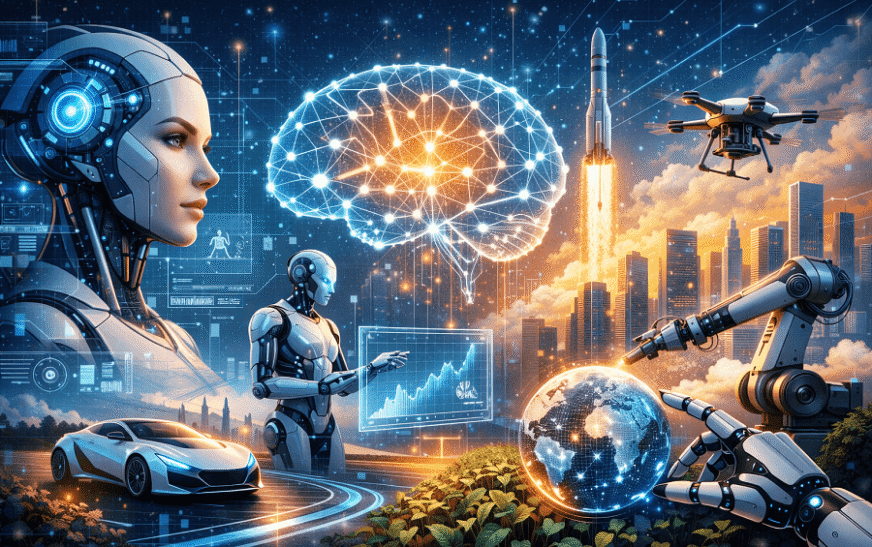
Artificial intelligence is no longer an emerging technology confined to research labs or science fiction. It has become one of the most transformative forces shaping modern society, influencing how people work, learn, communicate, create, and make decisions.
From intelligent virtual assistants and generative AI tools to autonomous vehicles, healthcare diagnostics, financial services, and advanced robotics, AI is rapidly becoming integrated into nearly every industry, and for a closer look at how AI is already influencing daily life through the latest developments, explore our guide on this topic. Organizations of all sizes are investing in artificial intelligence to improve productivity, automate repetitive tasks, enhance customer experiences, and unlock new business opportunities.
As AI capabilities continue advancing, experts expect the technology to evolve far beyond today’s applications. More intelligent AI systems, autonomous agents, multimodal models, personalized digital assistants, and collaborative human-AI workflows are expected to redefine industries over the coming decade.
Understanding where artificial intelligence is heading is increasingly important for businesses, professionals, students, policymakers, and everyday consumers. Those who prepare for these changes will be better positioned to benefit from the opportunities while adapting to the challenges AI will introduce.
This guide explores the future of artificial intelligence, the technologies driving its evolution, major industry applications, career opportunities, ethical considerations, and predictions for the years ahead.
Understanding Artificial Intelligence Today
Artificial intelligence refers to computer systems designed to perform tasks that normally require human intelligence.
These tasks include:
- Learning from data
- Understanding language
- Recognizing images
- Making predictions
- Solving problems
- Generating content
- Planning workflows
- Supporting decision-making
Recent advances in machine learning, large language models, cloud computing, and high-performance hardware have significantly accelerated AI development.
Why Artificial Intelligence Is Advancing Rapidly
Several technological and economic factors are driving AI innovation.
Increased Computing Power
Modern processors, cloud infrastructure, and specialized AI chips allow complex models to train faster while processing enormous amounts of information.
Greater computing power enables larger and more capable AI systems.
Massive Data Availability
Artificial intelligence improves by learning from large datasets.
Today’s digital world continuously generates information from the following:
- Websites
- Mobile devices
- Social media
- Scientific research
- Financial markets
- Business operations
- Healthcare systems
This abundance of data helps AI models become increasingly accurate.
Breakthroughs in Machine Learning
Machine learning algorithms continue becoming more efficient and capable.
These improvements enable AI systems to:
- Recognize patterns
- Make predictions
- Learn from feedback
- Improve over time
- Handle increasingly complex tasks
Machine learning remains the foundation of modern AI development.
Cloud Computing
Cloud platforms provide organizations with scalable infrastructure for developing and deploying AI solutions.
Cloud computing reduces barriers to AI adoption while supporting innovation across businesses of all sizes, a trend that has accelerated the broader shift from AI experimentation to measurable ROI, as organizations now expect tangible business outcomes from their AI investments.
Core Technologies Shaping the Future of AI
Artificial intelligence depends on multiple interconnected technologies.
Large Language Models
Large Language Models (LLMs) power many modern conversational AI systems.
They help AI:
- Understand context
- Generate natural language
- Answer questions
- Summarize information
- Translate languages
- Assist with research
LLMs continue improving in accuracy, reasoning, and multilingual capabilities.
Machine Learning
Machine learning enables AI systems to identify patterns within data without requiring explicit programming for every scenario.
Applications include:
- Fraud detection
- Recommendation systems
- Medical diagnosis
- Predictive analytics
- Customer behavior analysis
Machine learning will remain central to future AI innovation.
Natural Language Processing
Natural Language Processing (NLP) allows AI to understand and generate human language.
Future improvements are expected to enable:
- Better multilingual communication
- More natural conversations
- Improved contextual understanding
- Stronger reasoning capabilities
NLP is making human-computer interaction increasingly intuitive.
Computer Vision
Computer vision enables AI to analyze and interpret visual information.
Applications include:
- Medical imaging
- Manufacturing quality control
- Autonomous vehicles
- Security systems
- Retail analytics
- Agricultural monitoring
Advancements in computer vision continue expanding AI’s real-world applications.
Robotics
Artificial intelligence increasingly powers robots capable of performing physical tasks.
AI-driven robotics is transforming industries such as:
- Manufacturing
- Warehousing
- Healthcare
- Agriculture
- Logistics
- Space exploration
Future robots are expected to become more adaptive and collaborative.
Why AI Matters Across Every Industry
Artificial intelligence is no longer limited to technology companies.
Organizations across nearly every sector now use AI to improve efficiency, reduce costs, and enhance decision-making.
AI Helps Organizations
- Automate repetitive work
- Improve productivity
- Analyze large datasets
- Reduce operational costs
- Personalize customer experiences
- Support innovation
- Enhance forecasting
- Strengthen cybersecurity
These benefits continue driving rapid global AI adoption.
1. Healthcare Will Become More Intelligent
Healthcare represents one of the most promising applications of artificial intelligence.
Future AI systems may assist healthcare professionals by improving diagnosis, treatment planning, and patient monitoring.
AI Applications
Artificial intelligence may support:
- Medical imaging analysis
- Drug discovery
- Disease prediction
- Personalized medicine
- Remote patient monitoring
- Clinical decision support
Rather than replacing healthcare professionals, AI is expected to enhance clinical expertise.
Opportunities
Potential benefits include the following:
- Earlier disease detection
- Improved treatment accuracy
- Faster research
- Better patient outcomes
- Reduced administrative workloads
2. Education Will Become More Personalized
Artificial intelligence is transforming education by adapting learning experiences to individual students.
Future AI-powered education platforms may provide the following:
- Personalized lesson plans
- Intelligent tutoring
- Automated feedback
- Learning analytics
- Skill recommendations
- Adaptive assessments
These capabilities help improve learning outcomes while supporting teachers.
3. Business Automation Will Accelerate
Businesses increasingly rely on AI to automate repetitive processes while improving operational efficiency.
AI supports functions including:
- Customer service
- Marketing
- Finance
- Human resources
- Supply chain management
- Sales forecasting
Automation allows employees to focus on more strategic responsibilities.
4. Finance Will Become More Intelligent
The financial sector has been one of the earliest adopters of artificial intelligence, and its role will continue expanding over the coming years.
Future AI systems will help financial institutions make faster decisions, improve security, personalize services, and automate complex operations.
Future AI Applications in Finance
Artificial intelligence is expected to support:
- Fraud detection
- Credit risk assessment
- Investment analysis
- Personalized financial planning
- Automated compliance monitoring
- Digital banking
- Insurance claims processing
- Cash-flow forecasting
Banks and fintech companies will increasingly rely on AI to improve both operational efficiency and customer experiences.
Opportunities
AI can help financial institutions:
- Reduce fraud losses
- Improve lending decisions
- Enhance customer support
- Increase operational efficiency
- Deliver personalized financial products
5. Manufacturing Will Become Smarter
Manufacturing is entering a new era powered by artificial intelligence, robotics, and industrial automation.
AI enables factories to become more efficient while improving product quality and reducing downtime.
AI Applications
Manufacturers increasingly use AI for:
- Predictive maintenance
- Quality inspection
- Production optimization
- Inventory management
- Supply chain forecasting
- Energy efficiency
- Industrial robotics
These capabilities support faster production with fewer operational disruptions.
Benefits
AI-driven manufacturing helps organizations:
- Reduce waste
- Improve productivity
- Lower maintenance costs
- Increase product quality
- Improve workplace safety
6. Transportation Will Become More Autonomous
Artificial intelligence is reshaping transportation by improving safety, efficiency, and logistics.
Although fully autonomous transportation continues developing, AI already plays a significant role in modern mobility.
Future Applications
AI may increasingly support:
- Autonomous vehicles
- Intelligent traffic management
- Route optimization
- Fleet management
- Predictive maintenance
- Smart logistics
- Delivery automation
These innovations can reduce congestion while improving transportation efficiency.
Opportunities
Potential benefits include the following:
- Safer roads
- Reduced fuel consumption
- Faster deliveries
- Lower transportation costs
- Improved urban mobility
7. Cybersecurity Will Become More Proactive
As cyber threats become increasingly sophisticated, AI will play an even greater role in protecting digital systems.
Instead of reacting after an attack occurs, future AI systems will continuously monitor networks and identify threats before they cause significant damage.
AI Security Applications
Artificial intelligence supports:
- Threat detection
- Fraud prevention
- Malware analysis
- Identity verification
- Behavioral analytics
- Security monitoring
- Incident response
AI enables security teams to respond more quickly to evolving cyber risks.
Benefits
Organizations gain:
- Faster threat detection
- Improved security monitoring
- Reduced response times
- Better protection of sensitive information
8. Scientific Research Will Accelerate
Artificial intelligence is becoming a valuable research partner across scientific disciplines.
Researchers use AI to analyze enormous datasets that would otherwise require years of manual investigation.
Research Applications
AI contributes to:
- Drug discovery
- Climate modeling
- Genomics
- Astronomy
- Materials science
- Environmental monitoring
- Engineering research
By identifying patterns and generating insights, AI helps accelerate scientific discovery.
Opportunities
AI can:
- Shorten research timelines
- Improve analytical accuracy
- Support innovation
- Reduce research costs
- Enable more complex scientific investigations
9. Creative Industries Will Continue Evolving
Artificial intelligence is transforming creative work by assisting professionals rather than replacing creativity itself.
Designers, writers, filmmakers, musicians, marketers, and artists increasingly use AI to improve productivity and generate ideas.
Creative Applications
AI can assist with:
- Writing
- Graphic design
- Video production
- Music composition
- Animation
- Advertising
- Content planning
Human creativity remains essential for storytelling, strategy, originality, and emotional connection.
Benefits
Creative professionals benefit from:
- Faster workflows
- Idea generation
- Content optimization
- Improved productivity
- More time for strategic and creative thinking
10. The Future of AI Jobs
Artificial intelligence will transform employment rather than simply eliminate jobs.
Some repetitive tasks will become automated, while many entirely new careers are expected to emerge.
Emerging AI Careers
Growing demand is expected for professionals such as:
- AI Engineers
- Machine Learning Engineers
- Data Scientists
- AI Product Managers
- Prompt Engineers
- AI Ethics Specialists
- AI Security Analysts
- Robotics Engineers
- AI Researchers
- AI Governance Consultants
Professionals who combine technical expertise with business knowledge will be particularly valuable.
Skills for the AI Economy
Individuals preparing for the future should focus on developing:
- Critical thinking
- Problem-solving
- Data literacy
- AI fundamentals
- Communication
- Creativity
- Digital collaboration
- Continuous learning
These skills complement AI rather than compete with it.
11. Generative AI and Agentic AI Will Expand
The next generation of AI will move beyond content generation toward greater autonomy and collaboration.
Generative AI
Generative AI focuses on creating:
- Text
- Images
- Audio
- Video
- Code
- Presentations
These systems improve productivity by helping users generate high-quality content more efficiently.
Agentic AI
Agentic AI represents a significant evolution, and for a deeper understanding of how AI agents are replacing traditional chatbots across customer-facing roles, explore our comprehensive guide on the subject.
Instead of simply responding to prompts, Agentic AI can:
- Plan tasks
- Make decisions
- Coordinate workflows
- Collaborate with other AI systems
- Adapt to changing conditions
- Pursue defined objectives
This capability will transform business operations across many industries.
12. Human-AI Collaboration Will Define the Future
The future of artificial intelligence is unlikely to involve humans competing with AI.
Instead, the most successful organizations will combine:
- Human creativity
- Strategic thinking
- Emotional intelligence
- Ethical judgment
with AI’s strengths in:
- Data analysis
- Automation
- Pattern recognition
- Speed
- Scalability
This collaborative model is expected to deliver the greatest long-term value.
Challenges That Must Be Addressed
Despite its enormous potential, AI also introduces important challenges.
Ethical Concerns
Organizations must ensure AI systems are:
- Fair
- Transparent
- Accountable
- Explainable
- Responsible
Ethical AI governance will become increasingly important.
Privacy
AI depends on large amounts of data.
Protecting personal information while maintaining innovation remains a critical priority.
Workforce Transition
Automation may change many job roles.
Governments, businesses, and educational institutions will need to invest in:
- Reskilling
- Upskilling
- Workforce development
- Lifelong learning
Helping workers adapt will maximize the benefits of AI adoption.
Misinformation
Generative AI can create realistic content quickly.
Organizations must develop safeguards to reduce misinformation, deepfakes, and other forms of AI misuse.
Major Predictions for the Future of Artificial Intelligence
Artificial intelligence is advancing at an unprecedented pace, making long-term predictions difficult. However, several trends are already emerging that are likely to define the next decade of AI development.
Rather than focusing on a single breakthrough, the future will be shaped by the integration of AI into nearly every aspect of daily life, business operations, scientific research, and global infrastructure.
AI Will Become an Everyday Assistant
Artificial intelligence will increasingly function as a personal digital assistant capable of managing multiple tasks across work and personal life.
Future AI assistants may help users:
- Plan schedules
- Organize emails
- Conduct research
- Manage finances
- Book travel
- Summarize meetings
- Monitor health goals
- Coordinate smart home devices
These assistants will become more proactive by anticipating user needs rather than waiting for instructions.
AI Agents Will Work Together
One of the most significant developments will be the rise of collaborative AI agents, and for real-world examples of how businesses are using Agentic AI to boost productivity across organizations, explore our in-depth guide on the topic.
Instead of relying on a single AI model, organizations may deploy specialized AI agents responsible for different functions, such as:
- Customer support
- Sales assistance
- Financial analysis
- Cybersecurity monitoring
- Software development
- Research
- Workflow automation
These agents will collaborate to complete complex business processes more efficiently.
Multimodal AI Will Become Standard
Future AI systems will seamlessly understand and generate multiple forms of information at the same time.
This includes:
- Text
- Images
- Audio
- Video
- Code
- Documents
- Voice conversations
Users will increasingly interact with AI through natural conversations rather than switching between multiple specialized tools.
Robotics Will Become More Intelligent
Advances in robotics combined with artificial intelligence will expand automation beyond software.
Future intelligent robots may assist with:
- Healthcare
- Manufacturing
- Agriculture
- Warehousing
- Construction
- Disaster response
- Home assistance
Rather than replacing people entirely, many robots will work alongside human teams to improve productivity and safety.
Scientific Discovery Will Accelerate
Artificial intelligence is expected to play an increasingly important role in solving complex scientific challenges.
Researchers may use AI to accelerate progress in:
- Drug development
- Climate science
- Renewable energy
- Materials engineering
- Space exploration
- Disease prevention
By processing enormous datasets and identifying hidden patterns, AI can help scientists reach discoveries more efficiently.
Responsible AI Will Shape Long-Term Success
As AI becomes more powerful, responsible development will become just as important as technical innovation.
Governments, businesses, researchers, and technology companies are increasingly working toward frameworks that encourage innovation while reducing potential risks.
Transparency
AI systems should clearly explain the following:
- How decisions are made
- What information is analyzed
- When AI is being used
- What limitations exist
Transparency builds trust between users and AI-powered systems.
Human Oversight
Even highly advanced AI systems should continue operating under appropriate human supervision, particularly in high-impact areas such as the following:
- Healthcare
- Banking
- Legal services
- National security
- Critical infrastructure
Human judgment remains essential for ethical and complex decision-making.
Security
As AI capabilities expand, protecting AI systems from misuse becomes increasingly important.
Organizations should invest in:
- Secure infrastructure
- Data protection
- Access controls
- Continuous monitoring
- AI governance policies
Strong security helps ensure AI remains reliable and trustworthy.
Will Artificial Intelligence Replace Humans?
One of the most frequently discussed questions about AI concerns its impact on human employment and decision-making.
The most likely outcome is not widespread human replacement but greater collaboration between people and intelligent systems.
Tasks AI Will Continue Automating
Artificial intelligence performs particularly well at:
- Repetitive administrative work
- Data processing
- Pattern recognition
- Forecasting
- Report generation
- Routine customer interactions
Automating these tasks allows people to focus on higher-value work.
Human Strengths That Remain Essential
People continue providing qualities that AI cannot fully replicate, including:
- Creativity
- Empathy
- Leadership
- Ethical judgment
- Strategic thinking
- Relationship building
- Innovation
- Cultural understanding
The future workforce will increasingly combine these human strengths with AI-powered tools.
Preparing for an AI-Driven Future
Individuals and organizations can prepare for the future of AI by embracing continuous learning and responsible adoption.
Practical steps include:
- Building AI literacy
- Learning digital skills
- Staying informed about emerging technologies
- Experimenting with AI productivity tools
- Developing critical thinking
- Strengthening communication skills
- Understanding ethical AI principles
Adaptability will become one of the most valuable professional skills in the coming years.
Frequently Asked Questions
What is the future of artificial intelligence?
The future of artificial intelligence is expected to include more autonomous AI systems, personalized digital assistants, intelligent robotics, multimodal AI, scientific breakthroughs, and deeper integration across industries such as healthcare, finance, education, manufacturing, and transportation.
Which industries will benefit most from AI?
Almost every industry is expected to benefit, including healthcare, finance, education, manufacturing, retail, logistics, agriculture, cybersecurity, entertainment, and scientific research.
Will AI create new jobs?
Yes. While AI will automate certain repetitive tasks, it is also expected to create new careers in areas such as machine learning, AI engineering, robotics, cybersecurity, AI governance, data science, prompt engineering, and AI product management.
What are the biggest challenges facing AI?
Major challenges include ethical governance, privacy, cybersecurity, misinformation, workforce transition, algorithmic bias, transparency, and responsible regulation.
What is Agentic AI?
Agentic AI refers to artificial intelligence systems capable of planning, making decisions, adapting to changing situations, and completing multi-step tasks with limited human intervention.
How can individuals prepare for the future of AI?
People can prepare by improving digital literacy, understanding AI fundamentals, learning complementary technical skills, embracing lifelong learning, and developing uniquely human capabilities such as creativity, leadership, and critical thinking.
Key Takeaways
- Artificial intelligence is becoming one of the most influential technologies of the 21st century, transforming industries, economies, and everyday life.
- Advances in machine learning, large language models, robotics, computer vision, cloud computing, and agentic AI will continue driving innovation.
- AI will increasingly support healthcare, education, finance, manufacturing, cybersecurity, transportation, scientific research, and creative industries.
- Responsible AI development requires transparency, security, ethical governance, privacy protection, and meaningful human oversight.
- The future will likely be defined by collaboration between humans and AI, enabling greater productivity, innovation, and better decision-making rather than replacing human expertise.
Final Thoughts
Artificial intelligence is moving beyond automation to become a core driver of innovation across nearly every industry. As technologies such as generative AI, Agentic AI, robotics, and multimodal systems continue to mature, they will create new opportunities for businesses, professionals, and society while reshaping how people work and solve problems.
Preparing for this future requires more than adopting new technology. Organizations and individuals who prioritize continuous learning, responsible AI use, and human-AI collaboration will be best positioned to benefit from the next generation of intelligent systems.