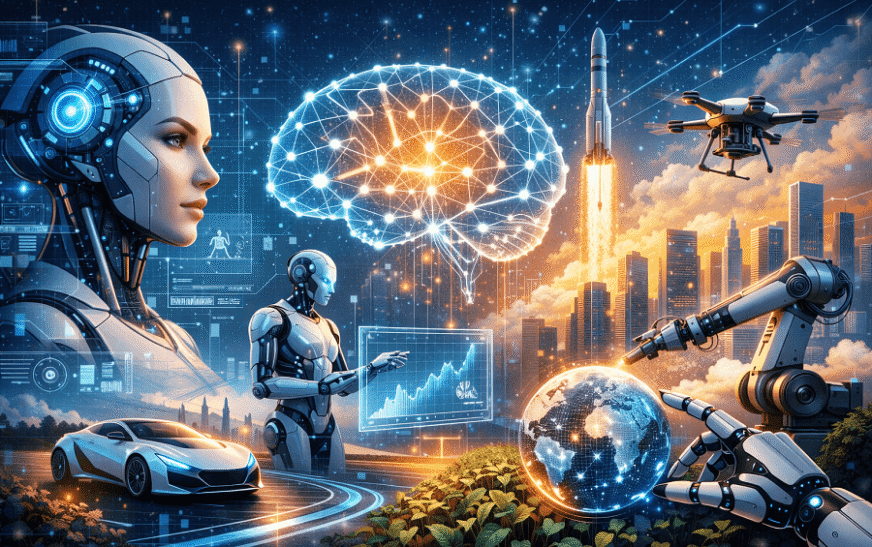


Artificial intelligence has moved beyond being an emerging technology to become one of the primary drivers of innovation across the global technology sector. Businesses, governments, startups, and research organizations are investing heavily in AI to improve productivity, automate workflows, enhance customer experiences, and accelerate scientific discovery.
The pace of AI development has accelerated significantly in recent years. Advances in large language models, machine learning, robotics, computer vision, cloud computing, and autonomous systems are transforming how software is built, how businesses operate, and how people interact with technology.
Over the next five years, AI is expected to influence nearly every aspect of the digital economy. Organizations that understand these emerging trends will be better prepared to adapt, compete, and innovate in an increasingly AI-driven world, a transition that reflects the broader shift from AI experimentation to measurable ROI, as companies now demand tangible business outcomes from their AI investments.
This guide explores the most important AI trends likely to shape the technology industry, explains why they matter, and highlights the opportunities and challenges they present for businesses, professionals, and consumers.
Why AI Is Entering a New Era
Artificial intelligence has evolved rapidly due to breakthroughs in computing power, data availability, cloud infrastructure, and advanced machine learning techniques.
Unlike earlier AI systems that focused on narrow tasks, modern AI models can understand language, generate content, analyze images, write code, support decision-making, and automate increasingly complex workflows.
The next phase of AI development will focus on systems that are
- More autonomous
- More collaborative
- More personalized
- More secure
- More efficient
- Better integrated into everyday life
These advancements will reshape industries far beyond traditional technology companies.
Technologies Powering Future AI
Several foundational technologies are driving the next generation of artificial intelligence.
Large Language Models
Large Language Models (LLMs) enable AI to understand context, generate human-like language, summarize information, answer questions, and assist with research.
Future LLMs are expected to become:
- More accurate
- Faster
- More energy efficient
- Better at reasoning
- More multilingual
- Better at understanding long conversations
Machine Learning
Machine learning continues to power prediction, automation, and intelligent decision-making.
Organizations use machine learning for:
- Fraud detection
- Forecasting
- Recommendation systems
- Healthcare diagnostics
- Customer analytics
- Risk assessment
Machine learning will remain one of the most important foundations of future AI innovation.
Cloud Computing
Cloud infrastructure makes AI accessible to organizations of every size.
Cloud platforms provide the following:
- Scalable computing
- AI development tools
- Data storage
- Model deployment
- Security infrastructure
- Collaborative development environments
Cloud computing will continue enabling widespread AI adoption.
High-Performance AI Hardware
Powerful AI requires specialized hardware.
Growing investment in GPUs, AI accelerators, and custom processors will enable larger, faster, and more efficient AI systems over the coming years.
Trend 1: Agentic AI Will Become Mainstream
One of the biggest developments expected over the next five years is the rise of Agentic AI, and for a deeper understanding of how AI agents are replacing traditional chatbots in customer-facing roles today, explore our comprehensive guide on the subject.
Unlike traditional AI systems that respond to prompts, Agentic AI can plan, make decisions, coordinate multiple tasks, and pursue defined objectives with limited human supervision.
Potential Applications
Agentic AI may support:
- Customer service
- Business operations
- Financial management
- Healthcare workflows
- Supply chain coordination
- Software development
- Enterprise automation
Organizations are expected to increasingly deploy AI agents capable of collaborating across departments and systems.
Why It Matters
Agentic AI moves beyond simple automation toward intelligent workflow management, enabling businesses to improve productivity while reducing repetitive work, and for real-world examples of how businesses are using Agentic AI to boost productivity across organizations, explore our in-depth guide on the topic.
Trend 2: Multimodal AI Will Become Standard
Future AI systems will no longer rely solely on text.
Instead, they will understand and generate multiple forms of information simultaneously.
Multimodal AI Can Process
- Text
- Images
- Audio
- Video
- Documents
- Voice commands
- Code
This capability enables richer interactions and more natural user experiences.
Business Benefits
Multimodal AI supports:
- Smarter customer service
- Improved healthcare diagnostics
- Enhanced education
- Better accessibility
- Faster content creation
- More intuitive digital assistants
Trend 3: AI Search Will Continue Transforming Information Discovery
Search engines are rapidly evolving from keyword-based retrieval systems into conversational knowledge assistants. For a comprehensive look at how AI search engines are transforming information discovery and reshaping SEO, explore our detailed guide on how AI is changing Google Search.
Future AI search experiences are expected to provide:
- Direct answers
- Personalized recommendations
- Conversational follow-up
- Multi-source summaries
- Context-aware responses
Businesses will increasingly optimize content for AI-powered search rather than traditional keyword rankings alone.
Trend 4: Hyper-Personalized AI Experiences
Artificial intelligence is making digital experiences more relevant by understanding user preferences, behaviors, and goals.
Future personalization may include:
- Personalized education
- Individual healthcare recommendations
- Customized financial planning
- Adaptive shopping experiences
- Intelligent travel planning
- Tailored entertainment recommendations
Organizations that use personalization responsibly can improve customer satisfaction and engagement.
Trend 5: AI-Powered Robotics Will Expand Across Industries
Artificial intelligence is making robots more intelligent, adaptable, and capable of working alongside people. Instead of performing only repetitive programmed tasks, future AI-powered robots will learn from their environments, recognize objects, and make decisions based on real-time data.
Over the next five years, robotics will become increasingly common across both industrial and service sectors.
Industries Driving AI Robotics
AI-powered robots are expected to play a larger role in:
- Manufacturing
- Healthcare
- Warehousing
- Agriculture
- Construction
- Logistics
- Hospitality
- Retail
Rather than replacing every human role, robots will automate physically demanding, repetitive, or hazardous tasks while supporting human workers.
Business Benefits
Organizations adopting AI robotics can benefit from:
- Higher productivity
- Improved workplace safety
- Better operational efficiency
- Reduced production errors
- Faster order fulfillment
- Lower long-term operational costs
Trend 6: AI Will Transform Cybersecurity
As cyber threats become more advanced, traditional security systems are no longer sufficient on their own.
Artificial intelligence is helping organizations detect, analyze, and respond to attacks faster than manual methods.
Future cybersecurity strategies will increasingly rely on AI for continuous monitoring and predictive threat analysis.
AI Cybersecurity Applications
AI can strengthen security through:
- Threat detection
- Malware analysis
- Fraud prevention
- Identity verification
- Network monitoring
- Behavioral analytics
- Automated incident response
AI enables security teams to identify unusual activity before significant damage occurs.
Why This Matters
As businesses generate more digital data, proactive cybersecurity becomes essential.
AI helps reduce response times while improving the overall resilience of digital infrastructure.
Trend 7: AI-Assisted Software Development
Artificial intelligence is changing how software is designed, written, tested, and maintained.
Developers increasingly use AI-powered coding assistants to improve productivity and reduce repetitive work.
Rather than replacing software engineers, AI acts as a collaborative development tool.
AI Can Assist With
- Code generation
- Bug detection
- Documentation
- Code optimization
- Software testing
- Security analysis
- Refactoring
- API development
These capabilities help development teams deliver software more efficiently.
Benefits
AI-assisted development offers:
- Faster coding
- Higher software quality
- Reduced development time
- Improved collaboration
- Better code consistency
Human developers remain responsible for architecture, business logic, and strategic decision-making.
Trend 8: Digital Twins Will Become More Common
Digital twins are virtual representations of physical systems that use real-time data to simulate performance and predict outcomes.
Artificial intelligence enhances digital twins by continuously analyzing operational data and recommending improvements.
Digital Twin Applications
Organizations use digital twins in:
- Manufacturing
- Smart cities
- Energy systems
- Transportation
- Healthcare
- Infrastructure management
These simulations help improve planning, maintenance, and operational efficiency.
Opportunities
Digital twins enable organizations to:
- Predict equipment failures
- Optimize operations
- Reduce downtime
- Improve product design
- Test scenarios safely
Trend 9: Edge AI Will Accelerate Real-Time Decision-Making
Traditional AI often relies on cloud computing to process information.
Edge AI moves intelligence closer to where data is generated, allowing devices to make decisions locally with minimal delay.
Edge AI Applications
Examples include:
- Smart cameras
- Autonomous vehicles
- Industrial sensors
- Medical devices
- Drones
- Wearable technology
- Smart factories
Processing data locally reduces latency while improving privacy and reliability.
Benefits
Edge AI provides:
- Faster responses
- Reduced bandwidth usage
- Better data privacy
- Increased reliability
- Improved offline performance
As connected devices continue growing, Edge AI will become increasingly important.
Trend 10: Responsible AI Will Become a Competitive Advantage
As AI becomes more powerful, businesses must ensure these technologies are developed and deployed responsibly.
Responsible AI focuses on fairness, transparency, accountability, privacy, and security.
Organizations that build trustworthy AI systems are more likely to earn customer confidence and meet evolving regulatory requirements.
Responsible AI Includes
- Ethical development
- Bias reduction
- Transparent decision-making
- Human oversight
- Privacy protection
- Regulatory compliance
- Secure AI deployment
Trust will become a major differentiator for AI-powered businesses.
Trend 11: AI Will Accelerate Scientific Research
Artificial intelligence is helping researchers analyze complex datasets, identify patterns, and generate new discoveries across multiple scientific disciplines.
Over the next five years, AI is expected to accelerate innovation in areas that traditionally required years of research.
AI Research Applications
Artificial intelligence supports:
- Drug discovery
- Climate modeling
- Genomics
- Materials science
- Astronomy
- Renewable energy research
- Environmental analysis
AI enables scientists to process vast amounts of information more efficiently, helping bring new innovations to market faster.
Benefits
Research organizations may experience:
- Faster experimentation
- Lower research costs
- Better predictive modeling
- Improved collaboration
- Accelerated scientific breakthroughs
Trend 12: Autonomous Business Operations
Businesses are increasingly moving beyond isolated AI tools toward intelligent systems capable of coordinating complete operational workflows.
The emergence of autonomous business operations will become one of the defining AI trends of the next five years.
AI May Coordinate
- Customer service
- Inventory management
- Supply chains
- Marketing campaigns
- Financial reporting
- HR processes
- Sales operations
- Procurement
Rather than automating one task, AI will increasingly orchestrate entire business processes.
Business Benefits
Organizations can achieve the following:
- Lower operating costs
- Faster decision-making
- Higher productivity
- Improved customer experiences
- Better resource allocation
- Greater operational scalability
Trend 13: The Demand for AI Skills Will Continue Growing
The rapid adoption of artificial intelligence is creating demand for professionals who understand both technology and business.
AI literacy is becoming valuable across industries—not just within software development.
High-Demand AI Careers
Growing opportunities include:
- AI Engineers
- Machine Learning Engineers
- Data Scientists
- AI Product Managers
- Robotics Engineers
- AI Researchers
- Cybersecurity Specialists
- AI Ethics Consultants
- Automation Architects
- Cloud AI Specialists
Professionals who combine technical expertise with communication, problem-solving, and business strategy will be particularly well positioned.
Skills Worth Developing
To prepare for the next five years, professionals should focus on:
- AI fundamentals
- Data analysis
- Machine learning concepts
- Prompt engineering
- Cloud computing
- Cybersecurity awareness
- Critical thinking
- Adaptability
- Continuous learning
These skills will remain valuable as AI continues transforming the technology landscape.
Challenges Accompanying AI Growth
While AI offers tremendous opportunities, organizations must also address several important challenges.
Data Privacy
AI systems rely on large volumes of information, making responsible data collection, storage, and protection essential.
Organizations must balance innovation with strong privacy practices.
Algorithmic Bias
Poor-quality or unrepresentative training data can lead to biased AI outcomes.
Continuous testing and monitoring help reduce this risk.
Security Risks
AI systems themselves may become targets for cyberattacks.
Protecting AI infrastructure and models will become an increasingly important aspect of enterprise security strategies.
Workforce Adaptation
As AI automates certain tasks, organizations should invest in reskilling and upskilling employees to prepare them for evolving roles.
Supporting workforce development helps maximize the long-term benefits of AI adoption.
What the AI-Powered Tech Industry Could Look Like by 2031
Over the next five years, artificial intelligence is expected to become a core part of nearly every digital product, business process, and technology platform. Rather than existing as a standalone tool, AI will be embedded into the software and services people use every day.
Organizations that embrace AI responsibly are likely to gain advantages in productivity, innovation, customer experience, and operational efficiency.
AI Will Be Built Into Everyday Technology
Artificial intelligence is expected to become a standard feature across consumer and business technologies.
Future AI-powered products may include:
- Smartphones with advanced AI assistants
- Productivity software with built-in automation
- Intelligent search engines
- Smart home ecosystems
- Autonomous business platforms
- AI-powered healthcare systems
- Personalized education platforms
- Connected transportation networks
AI will increasingly work behind the scenes, helping users complete tasks more efficiently.
Businesses Will Shift Toward AI-First Strategies
Many organizations are already moving from experimenting with AI to integrating it into long-term business strategies.
Future AI-first businesses are likely to focus on:
- Intelligent automation
- Data-driven decision-making
- Personalized customer experiences
- Continuous workflow optimization
- AI-assisted product development
- Predictive business analytics
Rather than replacing human expertise, AI will support faster and more informed decision-making.
Human-AI Collaboration Will Become the Standard
The future of work is expected to emphasize collaboration between humans and intelligent systems.
Artificial intelligence excels at:
- Processing large datasets
- Identifying patterns
- Automating repetitive tasks
- Generating insights
- Monitoring systems continuously
People continue contributing strengths such as the following:
- Creativity
- Strategic thinking
- Leadership
- Ethical judgment
- Emotional intelligence
- Relationship building
Organizations that combine these complementary strengths are likely to achieve the best outcomes.
How Businesses Can Prepare for Future AI Trends
Preparing for an AI-driven future requires more than adopting the latest technology. Successful organizations build a long-term strategy that aligns AI with business goals while maintaining security, transparency, and customer trust.
Invest in AI Literacy
Leaders and employees should understand the fundamentals of artificial intelligence, including:
- Machine learning
- Generative AI
- Agentic AI
- Data analytics
- AI ethics
- Automation
A workforce with strong AI literacy is better equipped to identify opportunities and use AI effectively.
Strengthen Data Quality
High-quality data is the foundation of effective AI systems.
Businesses should prioritize the following:
- Accurate data collection
- Consistent data management
- Secure storage
- Regular updates
- Strong governance
Reliable data leads to better AI performance and more trustworthy outcomes.
Focus on Responsible AI
Organizations should develop clear policies covering:
- Privacy protection
- Ethical AI use
- Human oversight
- Transparency
- Security
- Regulatory compliance
Responsible AI practices help build customer confidence and reduce operational risks.
Encourage Continuous Learning
Because AI technology evolves rapidly, businesses should promote ongoing learning through:
- Employee training
- Professional certifications
- Industry events
- Internal knowledge sharing
- Experimentation with new AI tools
Continuous learning supports long-term innovation.
Frequently Asked Questions
What are the biggest AI trends over the next five years?
Major AI trends include Agentic AI, multimodal AI, AI-powered robotics, Edge AI, AI-assisted software development, intelligent cybersecurity, autonomous business operations, responsible AI, and personalized digital experiences.
Why is Agentic AI considered important?
Agentic AI can plan, make decisions, coordinate multiple tasks, and adapt to changing situations with minimal human supervision. This makes it useful for automating complex workflows across industries.
How will AI affect technology companies?
AI is expected to improve software development, cybersecurity, customer support, product innovation, business analytics, and operational efficiency while enabling entirely new products and services.
Which industries will benefit most from future AI trends?
Healthcare, finance, education, manufacturing, transportation, retail, logistics, scientific research, agriculture, and cybersecurity are expected to experience significant transformation through AI.
Will AI replace software developers?
Artificial intelligence will increasingly assist developers by generating code, identifying bugs, automating testing, and improving productivity. However, human developers remain essential for architecture, complex problem-solving, security, and innovation.
How should businesses prepare for AI?
Organizations should build AI literacy, improve data quality, strengthen cybersecurity, invest in responsible AI governance, and identify opportunities where AI can enhance productivity and customer experiences.
Key Takeaways
- Artificial intelligence is entering a new phase defined by greater autonomy, collaboration, and integration across industries.
- Trends such as Agentic AI, multimodal AI, Edge AI, intelligent robotics, AI-assisted software development, and autonomous business operations will reshape the technology sector over the next five years.
- Businesses that invest in responsible AI, high-quality data, cybersecurity, and workforce development will be better positioned to succeed.
- Human expertise remains essential for creativity, leadership, ethics, and strategic decision-making, making human-AI collaboration the most likely model for future innovation.
- Continuous learning and adaptability will be critical for professionals and organizations navigating the rapidly evolving AI landscape.
Final Thoughts
Artificial intelligence is no longer a technology to watch from the sidelines—it is becoming the foundation of the next generation of digital innovation. Over the next five years, advances in Agentic AI, robotics, multimodal systems, Edge AI, and intelligent automation will reshape how businesses operate and how people interact with technology.
Organizations and professionals who embrace AI responsibly, invest in new skills, and focus on long-term innovation will be well positioned to thrive in an increasingly AI-powered world.