

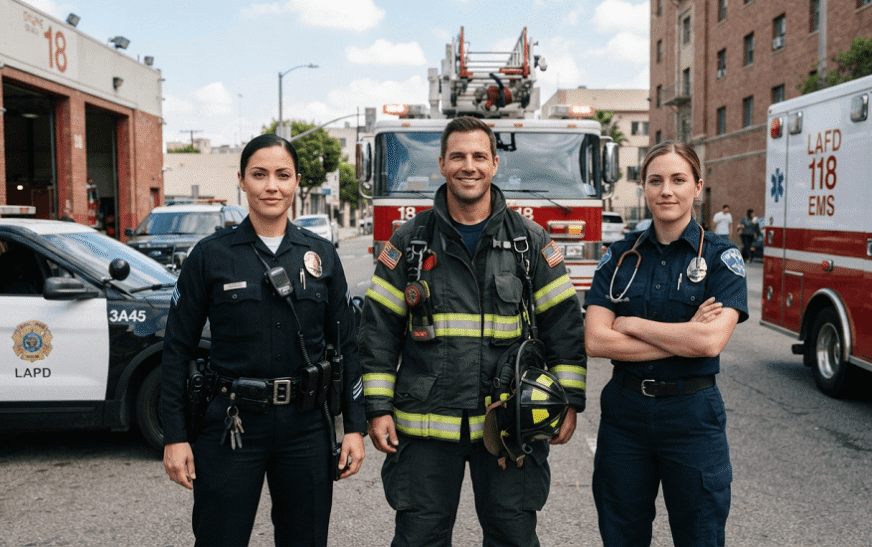
Public safety professionals are among the most essential members of every community. Whether responding to emergencies, protecting neighborhoods, fighting fires, providing emergency medical care, or supporting disaster response, these professionals play a critical role in protecting lives and property across the United States.
Public safety careers offer more than competitive salaries—they provide purpose, job stability, strong retirement benefits, and opportunities to make a lasting impact on society. From local police departments and municipal fire services to emergency medical services (EMS), sheriff’s offices, state law enforcement agencies, and federal public safety organizations, there are thousands of career opportunities available for individuals who thrive under pressure and are committed to serving others.
As communities continue investing in emergency preparedness, public health, homeland security, disaster response, and community policing, demand remains strong for qualified public safety professionals.
This guide explores the major public safety career paths, hiring requirements, salaries, advancement opportunities, training, certifications, and long-term career prospects across law enforcement, fire services, and emergency medical services, and for a complete overview of the broader government employment landscape across federal, state, and local levels, explore our comprehensive guide.
What Are Public Safety Careers?
Public safety careers focus on protecting people, property, and communities through emergency response, law enforcement, fire prevention, medical care, disaster management, and public education.
Professionals work in organizations such as the following:
- Municipal Police Departments
- Sheriff’s Offices
- State Police Agencies
- Highway Patrol
- Fire Departments
- Emergency Medical Services (EMS)
- Emergency Management Agencies
- Airport Police
- Transit Police
- Park Rangers
- University Police
- Federal Law Enforcement Agencies
These careers combine technical expertise, physical readiness, teamwork, leadership, and public service.
Why Choose a Public Safety Career?
Public safety careers appeal to professionals who want meaningful work while enjoying long-term career stability and structured advancement.
Major advantages include the following:
- Strong job security
- Competitive salaries
- Comprehensive healthcare
- Paid training
- Tuition assistance
- Leadership opportunities
- Specialized career tracks
- Community impact
- Opportunities for overtime and specialty pay
- Pension and retirement benefits: For a deeper look at pension and retirement benefits available to public servants, explore our comprehensive benefits guide.
Many agencies also provide continuous professional development, allowing employees to build specialized expertise throughout their careers.
Police Officer Career
Police officers protect communities by enforcing laws, preventing crime, responding to emergencies, conducting investigations, and building relationships with the public.
Typical responsibilities include:
- Patrol neighborhoods
- Respond to emergency calls
- Conduct criminal investigations
- Prepare reports
- Make arrests
- Collect evidence
- Assist victims
- Testify in court
- Direct traffic
- Support community policing initiatives
Police officers may later specialize in areas such as the following:
- Criminal Investigations
- K-9 Units
- SWAT
- Cybercrime
- Narcotics
- Traffic Enforcement
- Intelligence
- School Resource Officers
- Community Relations
- Aviation Units
Law enforcement offers diverse career opportunities beyond traditional patrol duties, and understanding the government hiring process is essential for navigating the structured application systems used by police departments, fire services, and EMS agencies.
Firefighter Jobs
Firefighters protect lives and property by responding to fires, hazardous materials incidents, vehicle accidents, medical emergencies, rescues, and natural disasters.
Daily responsibilities include:
- Fire suppression
- Emergency rescue
- Hazardous materials response
- Equipment inspections
- Fire prevention education
- Search and rescue
- Building inspections
- Emergency medical response
- Training exercises
- Disaster response
Many firefighters are also certified emergency medical technicians (EMTs) or paramedics.
EMS Career
Emergency Medical Services (EMS) professionals provide lifesaving medical care before patients reach hospitals.
EMS careers include:
- Emergency Medical Technician (EMT)
- Advanced EMT
- Paramedic
- Flight Paramedic
- Critical Care Paramedic
- EMS Supervisor
- EMS Educator
- EMS Operations Manager
EMS professionals assess patients, administer emergency treatment, stabilize injuries, and transport patients safely to healthcare facilities.
Public Safety Jobs Beyond First Responders
The public safety sector extends beyond police officers, firefighters, and paramedics.
Additional career opportunities include:
- Emergency Management Specialist
- Crime Analyst
- Public Safety Communications Manager
- Fire Prevention Officer
- Safety Coordinator
- Emergency Preparedness Planner
- Homeland Security Specialist
- Public Safety Technology Specialist
- Emergency Operations Coordinator
- Public Information Officer
These positions support emergency response systems while contributing to community resilience and disaster preparedness.
Law Enforcement Career Guide
Law enforcement careers exist at multiple levels of government.
Professionals may work for:
- Municipal Police Departments
- Sheriff’s Offices
- State Police
- Highway Patrol
- Campus Police
- Transit Police
- Park Police
- Airport Police
- Federal Agencies
- Tribal Law Enforcement
Each agency offers different responsibilities, career paths, and advancement opportunities while sharing the common mission of protecting public safety.
Fire Department Hiring Process
Although hiring procedures vary, most fire departments follow a structured recruitment process.
Typical steps include the following:
- Submit an application.
- Pass a written examination.
- Complete the Candidate Physical Ability Test (CPAT) or equivalent physical assessment.
- Attend interviews.
- Pass medical evaluations.
- Complete psychological assessments.
- Undergo background investigations.
- Graduate from the fire academy.
- Complete probationary training.
Departments seek candidates with physical fitness, teamwork, communication skills, and sound decision-making abilities.
Paramedic Career Path
Many EMS professionals begin their careers as emergency medical technicians before advancing to higher levels of certification.
A common progression includes:
- Emergency Medical Technician (EMT)
- Advanced EMT
- Paramedic
- Critical Care Paramedic
- EMS Supervisor
- EMS Manager
- Director of EMS Operations
Continuing education and specialized certifications can accelerate advancement throughout an EMS career.
Skills Every Public Safety Professional Needs
Successful public safety professionals combine technical expertise with strong interpersonal abilities.
Highly valued skills include:
- Communication
- Critical Thinking
- Leadership
- Physical Fitness
- Emergency Decision-Making
- Teamwork
- Problem-Solving
- Conflict Resolution
- Situational Awareness
- Stress Management
- First Aid
- Incident Command
- Report Writing
- Public Relations
- Community Engagement
These competencies help professionals perform effectively in high-pressure environments while serving the public with integrity.
Police Officer Salary in the USA
Police officer salaries vary based on location, agency, education, years of service, overtime opportunities, and specialized assignments. Large metropolitan departments and state law enforcement agencies generally offer higher compensation than smaller municipal departments.
Factors that influence earnings include:
- State and local government pay scales
- Rank and years of service
- Overtime availability
- Shift differentials
- Hazard pay
- Specialized unit assignments
- Educational incentives
- Certification bonuses
As officers advance into detective, sergeant, lieutenant, captain, or command positions, total compensation typically increases significantly through both salary growth and enhanced benefits.
Firefighter Physical Test (CPAT)
Most fire departments require candidates to pass the Candidate Physical Ability Test (CPAT) or an equivalent physical assessment before entering the fire academy.
The CPAT evaluates a candidate’s ability to perform physically demanding tasks similar to those encountered during emergency response.
Typical components include the following:
- Stair climb with weighted vest
- Hose drag
- Equipment carry
- Ladder raise and extension
- Forcible entry simulation
- Search exercise
- Rescue drag
- Ceiling breach and pull
Preparing through cardiovascular conditioning, strength training, and functional fitness greatly improves the likelihood of passing these assessments.
EMT to Paramedic Career
Many professionals begin their emergency medical careers as emergency medical technicians (EMTs) before advancing to the paramedic level.
The progression generally follows these steps:
- Complete EMT education.
- Obtain state licensure or certification.
- Gain field experience.
- Enroll in an accredited paramedic program.
- Complete clinical and field internships.
- Pass the National Registry or state certification examination.
- Begin practicing as a licensed paramedic.
Paramedics perform more advanced medical procedures than EMTs, including medication administration, cardiac monitoring, advanced airway management, and intravenous therapy.
Police Academy Requirements
Every state establishes minimum standards for police officer training, though specific requirements vary by jurisdiction.
Common admission requirements include:
- Minimum age requirement
- High school diploma or equivalent
- Valid driver’s license
- Background investigation
- Medical examination
- Psychological evaluation
- Drug screening
- Physical fitness assessment
- Written examination
- Oral interview
Police academy training typically covers:
- Criminal law
- Constitutional law
- Defensive tactics
- Firearms training
- Emergency vehicle operations
- Report writing
- Community policing
- Ethics
- Crisis intervention
- De-escalation techniques
Graduates generally complete a field training program before serving independently.
Fire Inspector Career
Fire inspectors help prevent emergencies by ensuring buildings comply with fire codes and safety regulations.
Typical responsibilities include:
- Conducting building inspections
- Investigating fire hazards
- Reviewing construction plans
- Enforcing fire codes
- Educating businesses and residents
- Preparing inspection reports
- Supporting fire investigations
- Recommending corrective actions
Many fire inspectors begin their careers as firefighters before moving into prevention, code enforcement, or fire investigation roles.
911 Dispatcher Jobs
Emergency communications specialists, commonly known as 911 dispatchers, serve as the first point of contact during emergencies.
Daily responsibilities include:
- Answering emergency calls
- Prioritizing incidents
- Dispatching police, fire, and EMS units
- Monitoring radio communications
- Coordinating emergency responses
- Providing pre-arrival instructions
- Maintaining detailed incident records
- Supporting multi-agency operations
These professionals require excellent communication skills, emotional resilience, and the ability to make rapid decisions under pressure.
Border Patrol Agent Career
Border Patrol agents protect national borders by preventing illegal crossings, combating smuggling, and supporting national security operations.
Primary responsibilities include:
- Border surveillance
- Immigration enforcement
- Criminal investigations
- Search and rescue operations
- Intelligence gathering
- Vehicle inspections
- Technology-assisted monitoring
- Emergency response
Compensation generally includes base salary, locality adjustments, overtime opportunities, premium pay, retirement benefits, and comprehensive federal employee benefits.
Sheriff Deputy Career
Deputy sheriffs serve county governments and perform many responsibilities similar to municipal police officers while often covering larger geographic areas.
Typical duties include the following:
- Patrol unincorporated communities
- Respond to emergency calls
- Execute court orders
- Serve civil process
- Transport inmates
- Conduct investigations
- Provide courthouse security
- Support search and rescue operations
- Assist disaster response efforts
Many sheriff’s offices also operate specialized divisions such as marine patrol, aviation, K-9 units, narcotics, tactical response teams, and criminal investigations.
Comparing Public Safety Career Paths
| Career | Primary Responsibility | Typical Work Environment |
| Police Officer | Law enforcement and crime prevention | Municipal or state law enforcement agencies |
| Firefighter | Fire suppression and rescue operations | Municipal fire departments |
| EMT | Emergency medical care | Ambulance services and EMS agencies |
| Paramedic | Advanced emergency medical treatment | EMS, hospitals, air medical services |
| Fire Inspector | Fire prevention and code enforcement | Government fire departments |
| 911 Dispatcher | Emergency communications | Public Safety Answering Points (PSAPs) |
| Deputy Sheriff | County law enforcement | Sheriff’s Offices |
| Border Patrol Agent | Border security and immigration enforcement | Federal law enforcement agencies |
Career Progression in Public Safety
Public safety careers provide structured advancement through experience, training, certifications, and leadership development.
A typical progression may look like:
- Entry-Level Recruit
- Certified Officer / Firefighter / EMT
- Senior Officer / Firefighter / Paramedic
- Field Training Officer / Crew Leader
- Sergeant / Lieutenant / Captain
- Division Commander / Battalion Chief
- Assistant Chief / Deputy Chief
- Chief of Police / Fire Chief / EMS Director
Many professionals also transition into specialized assignments, training academies, investigations, emergency management, homeland security, or executive leadership.
Future Outlook for Public Safety Careers
Public safety agencies continue investing in workforce expansion, technology modernization, and community-focused services. Population growth, disaster preparedness, cybersecurity threats, and evolving emergency response needs are increasing demand for qualified professionals.
Key growth areas include the following:
- Community policing initiatives
- Emergency preparedness
- Disaster response
- Cybercrime investigations
- Digital forensics
- Emergency communications
- Wildland firefighting
- Hazardous materials response
- Public health emergency planning
- Drone and unmanned aerial systems
- Data-driven policing
- Emergency management technology
Professionals who combine traditional public safety training with expertise in technology, leadership, and crisis management will be well positioned for long-term career growth.
How to Build a Successful Career in Public Safety
A career in public safety is built on continuous learning, discipline, teamwork, and a commitment to serving the community. While each profession—law enforcement, fire service, and emergency medical services—has its own training requirements, successful professionals share many of the same qualities and career development strategies.
1. Choose the Right Career Path
Public safety includes many specialized professions, each with unique responsibilities and advancement opportunities.
Consider your interests before applying:
- Police Officer
- Deputy Sheriff
- State Trooper
- Firefighter
- Fire Inspector
- Emergency Medical Technician (EMT)
- Paramedic
- 911 Dispatcher
- Emergency Management Specialist
- Border Patrol Agent
Research daily responsibilities, physical requirements, work schedules, and long-term career progression to find the best fit.
2. Meet Training and Certification Requirements
Every public safety profession requires formal training and certification.
Examples include:
- Police Academy
- Fire Academy
- EMT Certification
- Paramedic Licensure
- CPR Certification
- Advanced Cardiac Life Support (ACLS)
- Incident Command System (ICS) Training
- Hazardous Materials (HAZMAT) Certification
Many agencies also provide paid continuing education throughout your career.
3. Maintain Physical and Mental Readiness
Public safety professionals often work in physically demanding and high-stress environments.
To remain prepared:
- Exercise regularly
- Maintain cardiovascular fitness
- Develop strength and endurance
- Practice stress management
- Prioritize sleep and recovery
- Stay current with medical evaluations
- Build resilience through ongoing training
Physical readiness is just as important as technical knowledge for long-term success.
4. Develop Leadership Skills
As your career progresses, leadership becomes increasingly important.
Focus on strengthening:
- Communication
- Decision-making
- Conflict resolution
- Team coordination
- Crisis management
- Ethical leadership
- Community engagement
- Mentoring and coaching
Leadership skills can open opportunities for supervisory, command, and executive positions.
5. Pursue Specialized Assignments
Many agencies offer specialized career tracks that allow professionals to build expertise while increasing promotion potential.
Examples include:
- Criminal Investigations
- SWAT
- K-9 Units
- Cybercrime
- Fire Investigation
- Fire Prevention
- Aviation Units
- Marine Patrol
- Search and Rescue
- Tactical EMS
- Emergency Management
- Homeland Security
Specialized assignments often come with advanced training and additional responsibilities.
6. Commit to Lifelong Learning
Technology, emergency response practices, and public safety policies continue to evolve.
Stay competitive by learning about:
- Digital evidence
- Artificial Intelligence
- Drone operations
- Incident management systems
- Community policing strategies
- Disaster response planning
- Emergency communications technology
- Data analytics for public safety
Continuous learning improves both career prospects and operational effectiveness.
Key Takeaways
- Public safety careers include law enforcement, fire service, emergency medical services, emergency communications, and emergency management.
- Police officers, firefighters, EMTs, paramedics, deputy sheriffs, and 911 dispatchers all play essential roles in protecting communities.
- These careers offer competitive salaries, strong retirement benefits, structured promotion pathways, and extensive professional training.
- Success requires physical fitness, technical knowledge, sound decision-making, teamwork, and a commitment to public service.
- Specialized assignments in investigations, tactical operations, fire prevention, cybercrime, aviation, and emergency management provide additional career growth opportunities.
- Ongoing education, certifications, and leadership development are essential for long-term advancement.
Frequently Asked Questions
What are public safety careers?
Public safety careers involve protecting people and communities through law enforcement, firefighting, emergency medical services, emergency communications, disaster response, and public safety administration.
How do I become a police officer?
Most agencies require applicants to meet age and education requirements, pass written and physical examinations, complete a background investigation, graduate from a police academy, and successfully finish field training.
Do firefighters need medical training?
Many fire departments require firefighters to hold EMT certification, and some departments prefer or require paramedic credentials due to the increasing number of medical emergency calls.
What’s the difference between an EMT and a paramedic?
EMTs provide basic emergency medical care and patient transport, while paramedics receive advanced medical training that allows them to administer medications, interpret cardiac rhythms, establish intravenous access, and perform advanced airway procedures.
Are public safety careers physically demanding?
Yes. Many law enforcement, fire service, and EMS positions require physical fitness, endurance, and the ability to work under stressful and unpredictable conditions.
What skills are most important for public safety professionals?
Communication, leadership, teamwork, problem-solving, situational awareness, critical thinking, emotional resilience, and sound decision-making are among the most valuable skills.
Can I move into leadership roles?
Yes. Most agencies provide structured promotion pathways into supervisory, management, and executive positions, supported by experience, leadership training, and continued education.
Are public safety jobs expected to grow?
Demand is expected to remain steady as communities continue investing in emergency preparedness, disaster response, public health, cybersecurity, and modern emergency communication systems.
Conclusion
Public safety careers offer a unique opportunity to serve your community while building a stable, rewarding profession. Whether you’re interested in law enforcement, firefighting, emergency medical services, or emergency communications, these careers combine purpose with long-term job security, competitive benefits, and opportunities for advancement. By completing the required training, maintaining physical and professional readiness, and continuously developing your skills, you can build a meaningful career dedicated to protecting lives and strengthening the communities you serve.