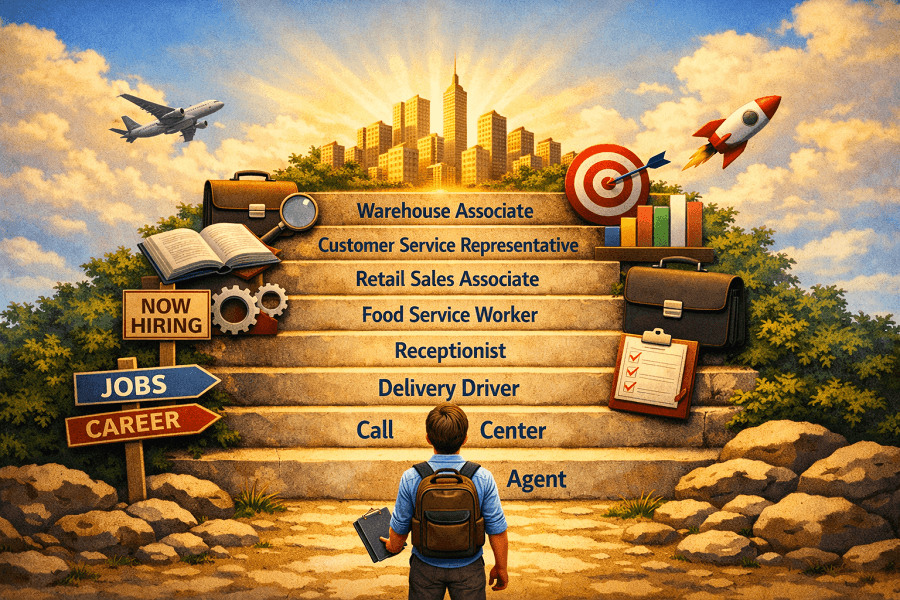


Sales is one of the few career fields where professionals can enter without years of specialized education and still build toward substantial earning potential. Entry-level sales roles can provide a direct pathway into account executive positions, enterprise sales, technical sales, business development, and sales management.
The most accessible starting points include Sales Development Representative (SDR), Business Development Representative (BDR), junior sales representative, inside sales representative, and industry-specific trainee positions. Some employers prioritize communication ability, customer experience, resilience, and coachability over a specific degree.
Pay varies significantly by industry and compensation structure. For example, Indeed reported an average U.S. base salary of about $69,855 for entry-level sales representatives in July 2026, based on job-posting data. Salary.com reported an average of $58,658 for entry-level SDRs in July 2026, illustrating how much compensation estimates can differ by title and methodology.
This guide explains the best entry-level sales jobs, how to find sales jobs with no experience, what starting salaries look like, how commission works, and how to turn your first sales job into a long-term career, and for a broader look at the broader sales career landscape across all industries and experience levels, explore our comprehensive sales careers guide and career path.
What Are Entry-Level Sales Jobs?
Entry-level sales jobs are positions designed for professionals who have limited or no previous experience in professional selling.
Common titles include:
- Sales Development Representative
- Business Development Representative
- Junior Sales Representative
- Inside Sales Representative
- Sales Associate
- Sales Trainee
- Account Development Representative
- Lead Generation Representative
- Territory Sales Assistant
Some positions are primarily focused on prospecting, while others involve direct selling and closing.
The best first role depends on your existing skills and whether your goal is to become an account executive, pursue field sales, specialize in an industry, or eventually move into sales management.
Sales Jobs With No Experience
You do not necessarily need previous sales experience to enter the profession.
Employers often look for transferable skills such as the following:
- Communication
- Customer service
- Persuasion
- Organization
- Resilience
- Time management
- Problem-solving
- Competitive drive
- Coachability
People entering sales can come from backgrounds including the following:
- Retail
- Hospitality
- Recruiting
- Customer service
- Real estate
- Insurance
- Banking
- Call centers
- Fundraising
- Entrepreneurship
The key is showing how your previous experience connects to sales outcomes.
For example, a retail employee can demonstrate experience exceeding sales targets, increasing average transaction value, handling objections, and building customer relationships.
First Sales Job With High Pay
The phrase “high-paying entry-level sales job” needs context because compensation can contain both fixed and variable earnings.
A job advertising $70,000 OTE does not necessarily guarantee $70,000 in annual income.
Sales compensation may include the following:
Base Salary + Commission + Bonus = Total Earnings
For a deeper understanding of commission-based compensation models across different industries, explore our comprehensive guide.
When comparing first sales jobs, examine the following:
- Base salary
- Target commission
- OTE
- Quota
- Ramp period
- Commission caps
- Accelerators
- Actual team quota attainment
The best first job is often the one with a realistic path to advancement rather than the one with the highest advertised OTE.
SDR Jobs for Beginners
Sales development representatives are among the most common entry points into B2B and SaaS sales, and for a deeper look at SaaS sales career paths, including compensation, OTE, and progression from SDR to enterprise AE, explore our comprehensive guide.
An SDR typically focuses on creating qualified opportunities for account executives.
Responsibilities may include:
- Cold calling
- Email prospecting
- Social selling
- Account research
- Lead qualification
- Appointment setting
- CRM updates
- Pipeline development
An SDR generally does not own the entire sales cycle. The role is designed to develop prospecting, discovery, communication, and qualification skills.
SDR Entry-Level Salary in 2026
SDR compensation varies substantially by company, geography, industry, and whether the title refers specifically to a junior SDR role.
Salary.com reported an average entry-level sales development representative salary of $58,658 in the U.S. as of July 1, 2026, with a reported majority range of approximately $48,656–$66,678.
Other salary databases produce materially different estimates depending on how they define SDR positions. That makes it important to compare an actual job’s base, variable compensation, quota, and benefits rather than relying on a single national average.
Junior Sales Representative
Junior Sales Representatives can have more direct selling responsibilities than SDRs.
Depending on the employer, they may
- Handle inbound leads
- Conduct sales calls
- Present products
- Prepare quotes
- Follow up with prospects
- Process orders
- Manage smaller accounts
- Support senior sales representatives
These positions can be especially useful for people who want to develop closing skills early.
Starting Salary for Sales Jobs in the USA
Starting salaries vary substantially across sales occupations.
For context, BLS reported 2024 median annual wages of $74,100 for wholesale and manufacturing sales representatives overall and $66,780 for nontechnical wholesale and manufacturing sales representatives. Technical and scientific sales representatives had a much higher 2024 median of $100,070.
These are occupation-wide figures, not entry-level salaries. They illustrate why industry specialization can make a major difference in long-term sales earning potential.
A new salesperson should therefore distinguish between the following:
Entry-level compensation
and
Career-level compensation
Your first sales job is often valuable because it gives you the experience needed to move into better-paying roles.
Entry-Level Sales Commission
Commission is one of the biggest differences between sales and many other career paths.
A sales representative may receive:
- Base salary
- Commission per sale
- Monthly or quarterly bonuses
- Accelerators
- New-customer bonuses
- Performance incentives
For example:
| Compensation Component | Example |
| Base salary | $50,000 |
| Target commission | $20,000 |
| OTE | $70,000 |
| Above-quota accelerator | Additional upside |
Not every company uses this structure.
Before accepting an offer, ask how commission is calculated and what percentage of the sales team actually reaches target.
How to Evaluate Your First Sales Compensation Plan
A strong compensation package is more than a large OTE.
Ask the employer:
What percentage of the team hit quota?
This helps determine whether the advertised variable pay is realistic.
How long is the ramp period?
New salespeople need time to learn the product, market, CRM, and sales process.
What happens during a ramp?
Some companies provide guaranteed variable compensation or reduced targets during the initial period.
Is commission capped?
An uncapped commission plan can provide additional upside for high performers.
Are accelerators available?
Accelerators can increase commission rates after reaching certain performance thresholds.
What is the average deal size?
Knowing average deal value helps you understand how much selling activity may be required to reach a target.
Cold Calling Training Programs
Cold calling remains a valuable skill for beginners because it teaches communication, resilience, objection handling, and prospecting discipline.
Useful training should cover:
- Call preparation
- Opening statements
- Discovery questions
- Objection handling
- Voicemail strategy
- Follow-up
- Call recording and review
- CRM documentation
Do not focus exclusively on scripts. Strong salespeople learn how to adapt conversations based on the prospect’s situation.
HubSpot Sales Certification
HubSpot Academy offers sales education that can be useful for beginners building foundational knowledge.
Its published learning materials include an inbound sales certification covering prospect identification, connecting with prospects, exploring needs, and advising customers. HubSpot also offers sales software certification covering its CRM and sales processes.
These resources can help a beginner demonstrate initiative before applying for sales positions.
Salesforce Trailhead for SDRs
Salesforce Trailhead provides free, modular learning content covering Salesforce and sales concepts.
The platform includes badges, guided trails, hands-on exercises, and learning paths that allow beginners to build familiarity with Salesforce workflows. Salesforce also offers a Sales Cloud fundamentals trail covering accounts, contacts, leads, opportunities, sales practices, customer service, and sales management.
For an aspiring SDR, the most useful fundamentals include:
- Leads
- Contacts
- Accounts
- Opportunities
- Pipeline stages
- Activities
- Reports
- Forecasting
Learning CRM terminology before an interview can help demonstrate job readiness.
Sales Training Bootcamp
Sales bootcamps can provide concentrated training for people transitioning into sales.
Programs may cover:
- Prospecting
- Cold calling
- Email outreach
- Discovery
- Objection handling
- CRM usage
- Sales methodology
- Interview preparation
However, a bootcamp is not automatically necessary.
Free learning resources, practical role-play, volunteer sales experience, customer-service work, and hands-on CRM training can also demonstrate relevant skills.
A paid program should be judged by its practical value, instructor quality, employer connections, and measurable outcomes rather than marketing claims.
Tech Sales Entry-Level Careers
Technology sales is one of the most popular routes for people looking for an entry-level sales career.
Common roles include:
- SDR
- BDR
- Junior Account Executive
- Inside Sales Representative
- Sales Development Associate
- Customer Expansion Representative
Technology companies may sell:
- SaaS
- Cybersecurity
- Cloud infrastructure
- AI software
- Data platforms
- CRM systems
- Marketing technology
- Financial technology
A technology sales career can eventually lead into enterprise software sales, solutions consulting, sales engineering, or sales management.
Pharma Sales Entry-Level With No Experience
Pharmaceutical sales can be more specialized than general entry-level sales.
Employers may prefer candidates with:
- Life sciences education
- Healthcare knowledge
- Strong communication
- Territory-management experience
- Customer-facing experience
- Commercial skills
Some entry paths are available to candidates without direct pharmaceutical sales experience, but hiring requirements vary substantially by company and product category.
Candidates can improve their competitiveness by understanding basic healthcare terminology, ethical sales practices, product education, and relationship management.
Real Estate Sales Entry-Level
Real estate offers another potential entry point into sales, although the career model differs from salaried sales development roles.
Real estate professionals may earn primarily through commissions rather than a traditional salary.
Entry requirements depend on state licensing rules and may include the following:
- Pre-licensing education
- Licensing examination
- Background requirements
- Association or brokerage onboarding
Real estate can provide substantial earning potential, but income may be less predictable, particularly during the early stages of a career.
Sales Career Entry Point
A strong first sales job should teach skills that remain valuable as you advance.
Look for opportunities to develop:
- Prospecting
- Discovery
- CRM management
- Objection handling
- Presentation
- Negotiation
- Pipeline management
- Forecasting
- Account research
- Business communication
A role that gives you measurable achievements and strong sales fundamentals can be more valuable than a slightly higher starting salary.
Best Entry-Level Sales Careers by Career Goal
| Career Goal | Strong Starting Point |
| SaaS / Tech Sales | SDR or BDR |
| Enterprise Sales | SDR → AE |
| Field Sales | Junior Territory Rep |
| Healthcare Sales | Medical/Pharma Sales Trainee |
| Real Estate | Licensed Sales Agent |
| Financial Services | Sales/Client Service Associate |
| Fastest Closing Experience | Junior Inside Sales |
| Sales Management | SDR → AE → Sales Manager |
| High Commission Potential | Performance-based B2B Sales |
Entry-Level Sales Career Progression
A common B2B pathway looks like:
- SDR / BDR
- Account Executive
- Senior Account Executive
- Enterprise / Strategic AE
- Sales Manager or Senior Individual Contributor
- Sales Director
- VP of Sales
- Chief Revenue Officer
Other routes are available.
For example:
- SDR
- Sales Operations
- Revenue Operations
- Revenue Operations Manager
Or:
- Sales Representative
- Sales Engineer
- Senior Sales Engineer
- Sales Engineering Manager
Your first sales role creates options by giving you measurable commercial experience.
Skills Employers Want in Entry-Level Sales Candidates
Employers hiring beginners often look for evidence of:
Communication
Can you explain ideas clearly and listen actively?
Resilience
Can you handle rejection without losing consistency?
Coachability
Can you accept feedback and change your approach?
Organization
Can you manage follow-ups, activities, and CRM records?
Curiosity
Can you ask good questions and understand a customer’s needs?
Commercial Awareness
Do you understand why customers buy products and how businesses evaluate value?
Competitive Drive
Can you work toward measurable goals without sacrificing professionalism?
These traits can often compensate for limited direct sales experience.
How to Get Your First Sales Job
Start by translating your existing experience into sales language.
A retail employee might highlight the following:
“Exceeded monthly sales target by 18% while increasing average transaction value.”
A hospitality worker might highlight:
“Managed high-volume customer interactions while maintaining service standards during peak periods.”
A recruiter might highlight the following:
“Built candidate pipeline through outbound prospecting and consistently exceeded interview-placement targets.”
The goal is to demonstrate that you already possess behaviors that successful salespeople need.
Entry-Level Sales Interview Questions
Prepare for questions such as:
Why do you want to work in sales?
Explain why the combination of communication, measurable performance, competition, customer interaction, and career progression appeals to you.
How do you handle rejection?
Give a real example demonstrating resilience and learning.
Sell me this product.
Start with questions rather than immediately pitching.
Why should we hire you without sales experience?
Connect your transferable skills to the sales process.
How would you respond if a prospect said no?
Show that you would seek to understand the reason, respond appropriately, document the interaction, and maintain professional follow-up.
How to Choose a Good First Sales Job
Evaluate the employer as carefully as the employer evaluates you.
Look for:
- Structured onboarding
- Experienced sales leadership
- Clear promotion criteria
- Realistic quotas
- Strong product-market fit
- Quality CRM and sales tools
- Coaching
- Transparent compensation
- Low unexplained turnover
- Evidence of internal promotion
For an SDR role, one of the best interview questions is:
“How many current account executives started as SDRs here?”
A strong answer gives you insight into whether the advertised career path is actually achievable.
Key Takeaways
- Entry-level sales jobs can provide an accessible route into high-earning careers without requiring extensive prior sales experience.
- SDR and BDR positions are among the most common starting points for technology and B2B sales careers.
- Compensation varies widely; current 2026 salary data shows meaningful differences depending on the exact sales title and methodology used to calculate pay.
- Sales commission can substantially increase earnings, but candidates should evaluate quota, attainment, ramp time, accelerators, and commission rules rather than focusing only on OTE.
- Free resources from HubSpot Academy and Salesforce Trailhead can help beginners develop foundational sales and CRM knowledge.
- People without traditional sales backgrounds can enter through retail, hospitality, recruiting, customer service, real estate, banking, or other customer-facing careers.
- Tech sales, pharmaceutical sales, real estate, financial services, inside sales, and junior representative roles provide different starting points depending on career goals.
- The best first sales job is usually the one that provides strong training, measurable achievements, realistic earning potential, and a credible path toward higher-value roles.
Frequently Asked Questions
What is the best entry-level sales job?
For people targeting B2B technology, SaaS, or enterprise sales, an SDR or BDR position is often a strong starting point because it teaches prospecting and qualification while providing a potential path to Account Executive roles.
Can I get a sales job with no experience?
Yes. Many entry-level sales employers prioritize communication, resilience, coachability, and customer-facing experience rather than requiring previous professional sales experience.
How much does an entry-level sales representative make?
Indeed’s July 2026 data puts the average U.S. base salary for an entry-level sales representative at about $69,855, while specific SDR salary estimates can differ considerably depending on the data source and title definition.
Do sales jobs pay commission?
Many do, although compensation structures vary. Some positions combine salary and commission, while others use bonuses or more heavily variable compensation.
Can I get into tech sales without a college degree?
Yes. Some SDR and BDR employers do not require a bachelor’s degree. Strong communication, customer-service experience, sales training, CRM familiarity, and evidence of achievement can strengthen an application.
Is HubSpot sales certification free?
HubSpot Academy offers sales education and certification resources, including inbound sales and sales software training. Verify the current course and certification terms directly with HubSpot because offerings can change.
Is Salesforce Trailhead useful for beginners?
Yes. Trailhead provides guided learning paths, badges, and hands-on exercises, including foundational Sales Cloud material covering leads, accounts, contacts, opportunities, and sales practices.
Can an SDR become an account executive?
Yes. Many organizations use SDR roles as a development path toward closing positions, although promotion timing varies significantly by company and individual performance.
Conclusion
Entry-level sales careers can provide one of the most accessible routes into professional selling and long-term revenue careers. SDRs, BDRs, junior sales representatives, inside sales representatives, pharmaceutical sales trainees, and other beginner roles can help professionals build prospecting, communication, negotiation, CRM, and customer-management skills.
The smartest way to choose your first sales job is to look beyond the starting salary. Evaluate training, manager quality, quota realism, commission structure, product-market fit, promotion history, and the skills you will gain. With the right first role, a beginner can progress from an entry-level position into account executive, enterprise sales, business development, sales engineering, or sales leadership.